RBI Suspends G-Sec and Forex Settlements for Public Holiday
Source:The Hindu ↗
Why It Matters
This article highlights the operational mechanisms of Indian financial markets, specifically how public holidays declared under the Negotiable Instruments Act affect the settlement of trades in critical segments like Government Securities (G-Secs), foreign exchange, and money markets. It also underscores the role of the RBI's Liquidity Adjustment Facility (LAF) in daily banking operations, which is directly relevant to the UPSC syllabus on the Indian Economy (GS Paper 3) and Prelims Economics.
Summary
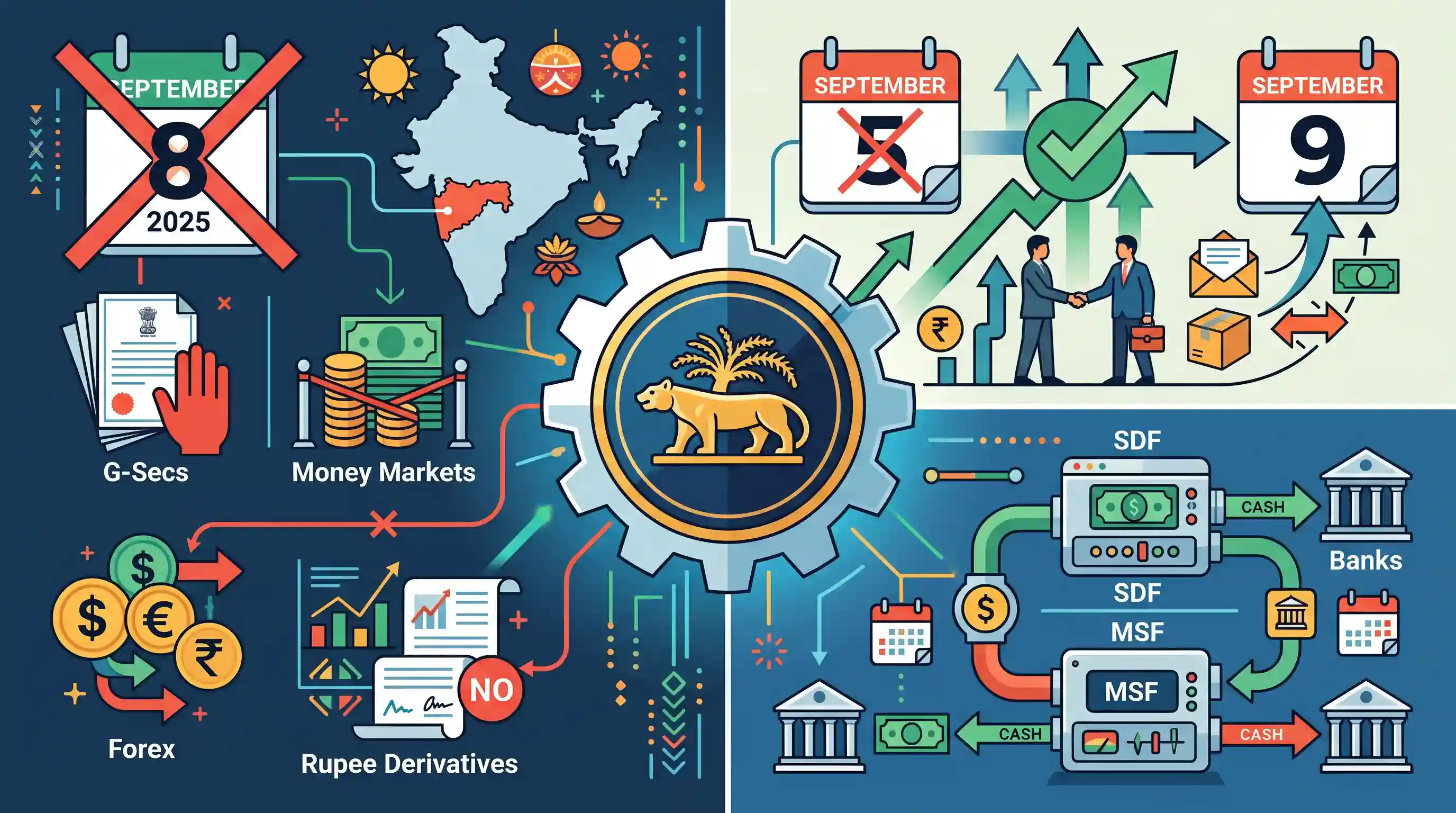
The Reserve Bank of India (RBI) announced that no transactions and settlements will occur in Government Securities (G-Secs), foreign exchange, money markets, and rupee interest rate derivatives on September 8, 2025. This is due to a public holiday declared by the Maharashtra Government under Section 25 of the Negotiable Instruments Act, 1881. The previously declared holiday for September 5 was cancelled, so markets will operate normally on that day, and settlements originally scheduled for September 8 will be deferred to September 9. RBI's Standing Deposit Facility (SDF) and Marginal Standing Facility (MSF) under the Liquidity Adjustment Facility (LAF) will function according to the revised holiday schedule.
Key Points
- The RBI suspended trading and settlements in G-Secs, forex, money markets, and rupee interest rate derivatives for September 8, 2025.
- The suspension is due to the Maharashtra Government declaring September 8 a public holiday under Section 25 of the Negotiable Instruments Act, 1881.
- A previously announced market holiday on September 5, 2025, has been cancelled, allowing normal market operations on that day.
- All outstanding settlements scheduled for September 8 will be deferred to the next working day, September 9.
- The Liquidity Adjustment Facility (LAF) windows, including the Standing Deposit Facility (SDF) and Marginal Standing Facility (MSF), will operate according to the revised holiday schedule.
Important Terms
Negotiable Instruments Act, 1881

A law governing promissory notes, bills of exchange, and cheques. Section 25 allows the government to declare public holidays, which determines the maturity and settlement dates of financial instruments.
UPSC context
GS Paper 3 (Economy); tests legal framework of financial markets and bank holiday declarations.
Liquidity Adjustment Facility (LAF)
The primary framework used by the RBI to manage daily liquidity. It allows banks to borrow money (Repo) or park funds (SDF/Reverse Repo) to adjust short-term cash mismatches.
UPSC context
GS Paper 3 (Monetary Policy); critical tool for managing inflation and money supply.
Standing Deposit Facility (SDF)
A collateral-free liquidity absorption tool introduced in 2022. It allows banks to park excess money with the RBI, acting as the lower floor of the interest rate corridor.
UPSC context
GS Paper 3 (Banking); modern tool for absorbing surplus liquidity without requiring government securities.
Marginal Standing Facility (MSF)
An emergency window allowing banks to borrow overnight funds from the RBI by pledging government securities, even from their SLR quota, at a rate higher than Repo.
UPSC context
GS Paper 3 (Economy); tests emergency borrowing mechanisms and the interest rate corridor.
Government Securities (G-Sec)
Debt instruments issued by the government to borrow money from the public. They include short-term Treasury bills and long-term Dated Securities, carrying sovereign guarantee with zero default risk.
UPSC context
GS Paper 3 (Fiscal/Monetary Policy); essential for understanding sovereign debt and open market operations.
Reserve Bank of India (RBI)
India's central bank and regulatory body for the banking system. It formulates monetary policy, manages foreign exchange, and oversees the payment and settlement systems in the country.
UPSC context
GS Paper 3 (Economic Development); core institution for banking, inflation, and financial stability.
Prelims Trap
The RBI solely declares public holidays for banks and financial markets across India under the Reserve Bank of India Act.
Bank holidays are declared under Section 25 of the Negotiable Instruments Act, 1881, not the RBI Act. Furthermore, State Governments have delegated power to notify them.
Static Concepts Connected
How does the Standing Deposit Facility (SDF) differ from other LAF windows?
- Collateral-free: Unlike the Reverse Repo rate, SDF allows the RBI to absorb surplus liquidity from commercial banks without having to provide government securities as collateral.
- LAF Corridor Floor: Introduced in 2022, SDF acts as the lower bound (floor) of the LAF corridor, effectively replacing the fixed reverse repo rate.
What defines a 'negotiable instrument' and bank holidays under the NI Act?
- Strict Definition: Section 13 limits negotiable instruments strictly to a promissory note, bill of exchange, or cheque payable either to order or to bearer.
- Holiday Declaration: Under Section 25, the Central Government (and States via delegated authority) declare public holidays, legally mandating the closure of banks and financial markets on those dates.
Cross-Topic Patterns
State holidays vs National financial markets
A single state's holiday (Maharashtra) under the NI Act halting nationwide RBI market operations demonstrates the outsized role of India's financial capital in federal economic administration.
Liquidity adjustment and SLR quotas
When interbank money markets close, banks must rely entirely on automated RBI windows like MSF, dipping into their Statutory Liquidity Ratio (SLR) quota to manage sudden overnight mismatches.

Expect a Prelims 2026 question comparing SDF (collateral-free liquidity absorption) against MSF (penal borrowing using SLR quota).
Linked PYQs · 4
Linked PYQs · 4
- 2024PrelimsGS1
With reference to the Indian economy, "Collateral Borrowing and Lending Obligations" are the instruments of:
- 2024PrelimsGS1
Consider the following statements : 1. In India, Non-Banking Financial Companies can access the Liquidity Adjustment Facility window of the Reserve Bank of India. 2. In India, Foreign Institutional Investors can hold the Government Securities (G-Secs). 3. In India, Stock Exchanges can offer separate trading platforms for debts. Which of the statements given above is/are correct?
- 2023PrelimsGS1
Consider the following markets: 1. Government Bond Market 2. Call Money Market 3. Treasury Bill Market 4. Stock Market How many of the above are included in capital markets?
- 2020PrelimsGS1
If the RBI decides to adopt an expansionist monetary policy, which of the following would it not do ? 1. Cut and optimize the Statutory Liquidity Ratio 2. Increase the Marginal Standing Facility Rate 3. Cut the Bank Rate and Repo Rate Select the correct answer using the code given below:
