India enters top 100 in Sustainable Development Report
Source:The Hindu ↗
Why It Matters
The SDSN's Sustainable Development Report provides a vital, independent assessment of India's progress on the UN SDGs. The contrast between India's successes in digital infrastructure/financial inclusion and its enduring struggles with malnutrition, poverty, and institutional governance offers excellent fodder for Mains answers across GS-2 (Social Justice & Governance) and GS-3 (Economy & Infrastructure).
Summary
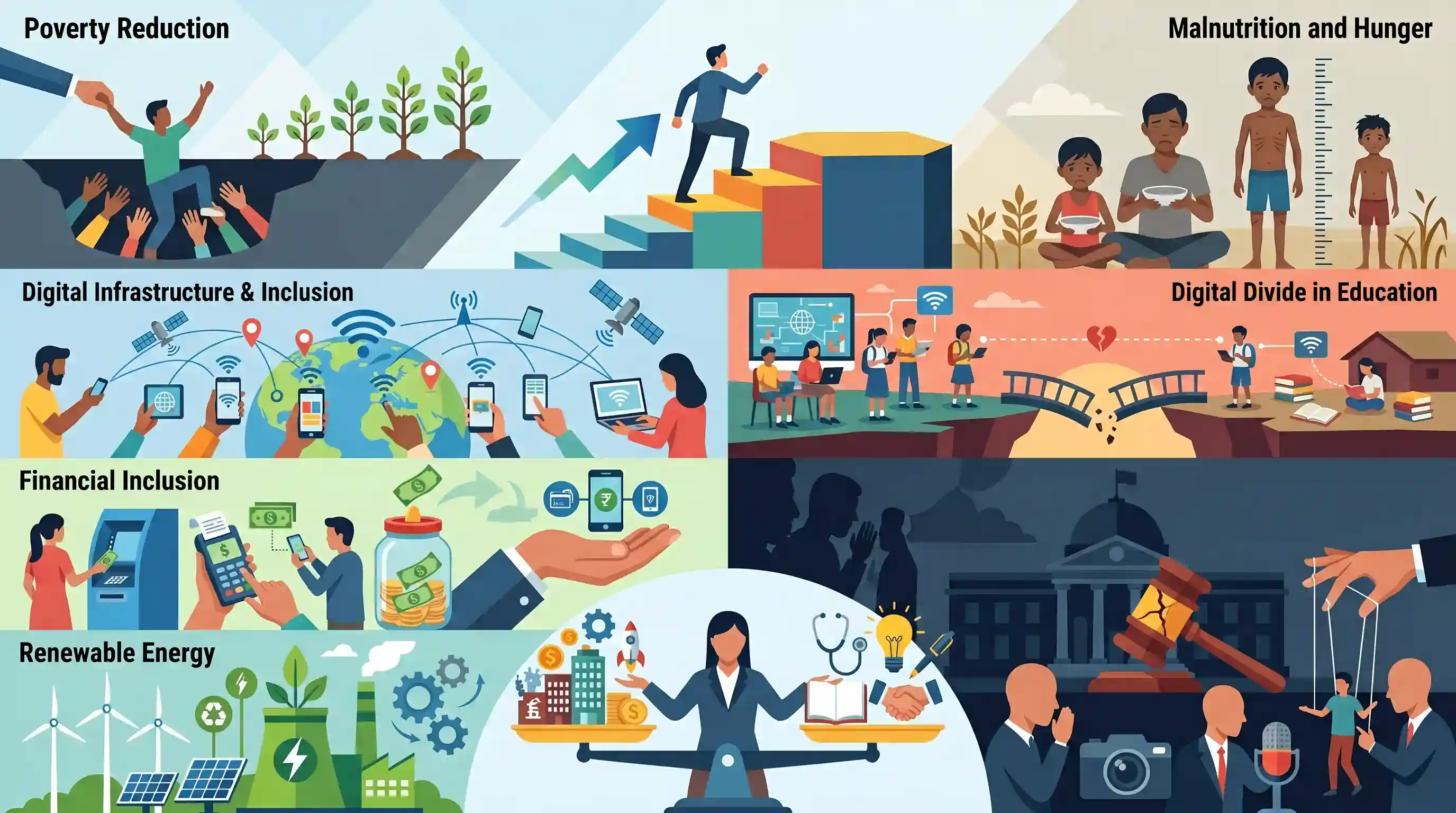
India has broken into the top 100 of the Sustainable Development Report published by the Sustainable Development Solutions Network (SDSN) for the first time, securing the 99th rank. While the report acknowledges India's progress in poverty reduction, digital infrastructure, financial inclusion, and renewable energy, it also underscores persistent challenges. Chief among these are alarming levels of malnutrition and hunger (stunting and wasting), a glaring digital divide that impacts education, and lagging indicators in governance, press freedom, and institutional independence (SDG 16). The findings highlight the need for India to balance its infrastructural and economic strides with robust social welfare and democratic reforms.
Key Points
- India ranked 99th out of 167 nations in the Sustainable Development Report by the SDSN, entering the top 100 for the first time since the data series began in 2016.
- The report highlights notable progress in eradicating extreme poverty (SDG 1), though the lack of domestic consumption expenditure data since 2018 makes this hard to verify locally.
- Achieving 'Zero Hunger' (SDG 2) remains a severe challenge, with NFHS-5 data showing high rates of stunting (35.5%) and wasting (19.3%), alongside a doubling of obesity rates between 2006 and 2021.
- India has shown strong performance in infrastructure (SDG 9) and affordable energy (SDG 7), driven by near-universal household electrification, renewable energy capacity expansion, and digital financial inclusion via UPI.
- The report points out significant deficits in 'Peace, Justice and Strong Institutions' (SDG 16), highlighting the need to bolster the rule of law, press freedom, and institutional independence.
- The COVID-19 pandemic exposed a stark rural-urban digital divide, which continues to impact equitable access to education and essential services.
Important Terms
Sustainable Development Goals (SDGs)

A collection of 17 global goals and 169 targets adopted by the UN in 2015 to address social, economic, and environmental challenges by 2030.
UPSC context
GS Papers II & III; foundational framework for social justice, environmental policy, and inclusive growth.
Sustainable Development Solutions Network (SDSN)
A UN-launched initiative that mobilizes global scientific and technological expertise to promote practical problem-solving for sustainable development and implement the SDGs.
UPSC context
GS Paper II; key international body producing the Sustainable Development Report and Global SDG Index.
SDG 16 (Peace, Justice, and Strong Institutions)
A specific Sustainable Development Goal aimed at promoting peaceful societies, ensuring access to justice, and building effective, accountable, and transparent institutions.
UPSC context
GS Paper II (Governance); directly tests indicators like press freedom, institutional independence, and rule of law.
Stunting and Wasting
Stunting refers to low height-for-age (chronic undernutrition), while wasting refers to low weight-for-height (acute undernutrition), both serving as critical indicators of child malnutrition.
UPSC context
GS Paper II (Health & Hunger); vital for analyzing the efficacy of schemes like Mission Poshan 2.0.
Unified Payments Interface (UPI)
A real-time payment system developed by the NPCI that enables instant mobile-based inter-bank fund transfers using a Virtual Payment Address (VPA).
UPSC context
GS Paper III (Economy/DPI); represents India's progress in financial inclusion and digital infrastructure.
National Family Health Survey (NFHS)
A comprehensive multi-round survey providing high-quality data on health, nutrition, and family welfare indicators across all Indian states and Union Territories.
UPSC context
GS Paper II; the gold-standard data source for monitoring social sector development and health policy impacts.
Prelims Trap
"The Sustainable Development Report is published annually by the UNDP."
Aspirants often confuse the SDSN (Sustainable Development Solutions Network), which publishes this report, with the UNDP, which publishes the Human Development Report.
Static Concepts Connected
How are the primary indicators of child malnutrition defined?
- Stunting: Low height for age, indicating chronic undernutrition and prolonged deprivation.
- Wasting: Low weight for height, indicating acute undernutrition, often resulting from recent and severe food shortage or illness.
- Underweight: Low weight for age, serving as a composite indicator of both stunting and wasting.
What are the core components of SDG 16?
- Peace & Justice: Reducing all forms of violence and ensuring equal access to justice for all.
- Strong Institutions: Developing effective, accountable, and transparent institutions at all levels, while reducing corruption and bribery.
- Inclusive Societies: Ensuring responsive, inclusive, participatory, and representative decision-making, along with protecting fundamental freedoms.
Cross-Topic Patterns
The Poverty vs Malnutrition Paradox
India's multidimensional poverty (MPI) is dropping, but structural malnutrition metrics (stunting/wasting) remain stubbornly high, highlighting the gap between asset creation and actual nutritional security.
DPI growth vs the Digital Divide
While UPI and digital finance drive SDG 9 (Infrastructure), the rural-urban digital divide hinders SDG 4 (Education), demonstrating how tech-led governance can unintentionally deepen social inequality without universal basic access.

A 2026 Prelims question will likely contrast India's DPI-led SDG 9 progress with stagnant SDG 2 (nutrition) metrics using NFHS-5 data.
Linked PYQs · 4
Linked PYQs · 4
- 2024MainsGS2
Poverty and malnutrition create a vicious cycle, adversely affecting human capital formation. What steps can be taken to break the cycle ?
- 2019MainsGS2
There is a growing divergence in the relationship between poverty and hunger in India. The shrinking of social expenditure by the government is forcing the poor to spend more on non-food essential items squeezing their food-budget. - Elucidate.
- 2022MainsGS3
Is inclusive growth possible under market economy ? State the significance of financial inclusion in achieving economic growth in India.
- 2015MainsGS2
For achieving the desired objectives, it is necessary to ensure that the regulatory institutions remain independent and autonomous. Discuss in the light of the experiences in recent past.
