Ladakh Regional Autonomy and Autonomous Council Proposal
Source:The Hindu ↗
ఇది ఎందుకు ముఖ్యం
It highlights the evolving model of asymmetrical federalism, regional autonomy, and local governance frameworks in sensitive border Union Territories like Ladakh, directly intersecting with questions of constitutional schedules and devolution of power.
సారాంశం
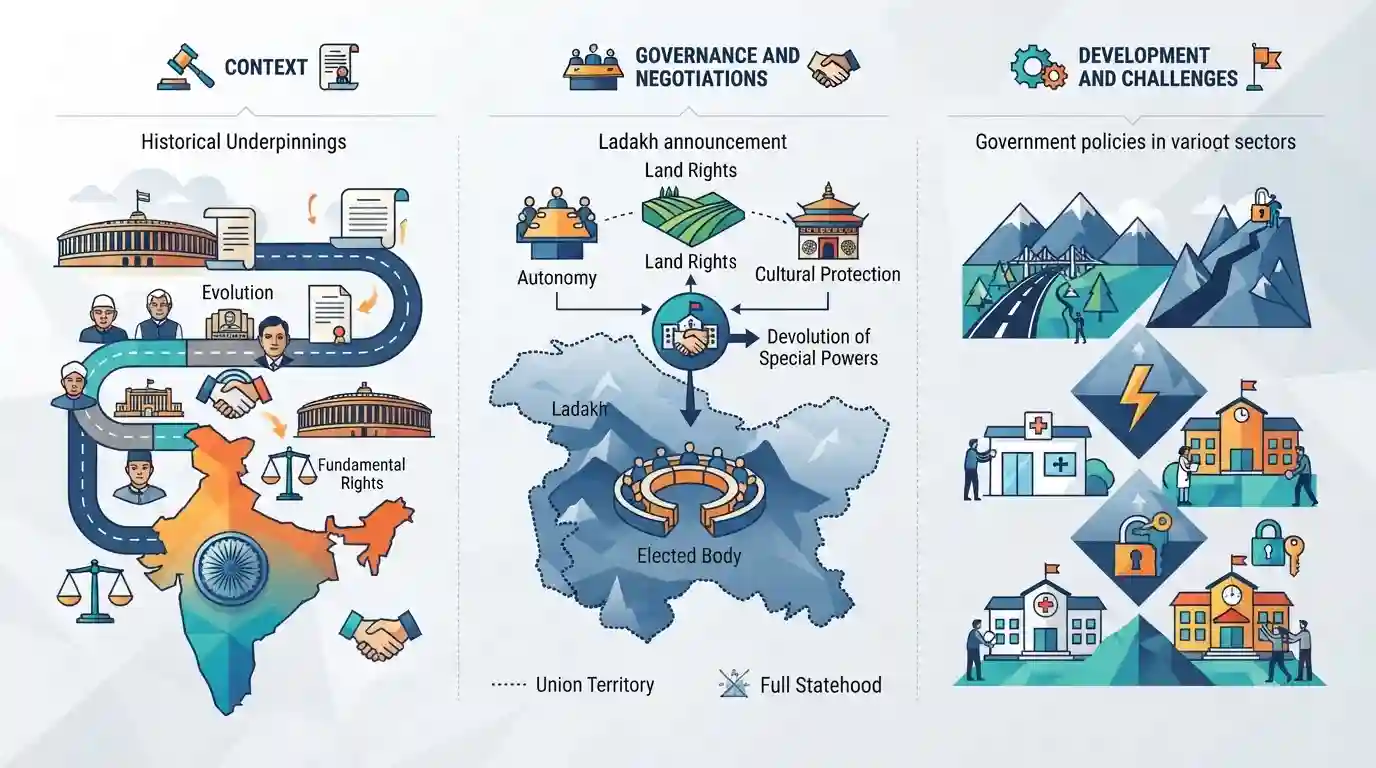
The Chief Secretary of Ladakh announced that the Union Territory will not receive full statehood, but the Centre is working on a unique elected body with special powers to meet regional governance and developmental needs. This decision addresses ongoing negotiations with local leadership over autonomy, land rights, and cultural protection in the sensitive border region.
ముఖ్య అంశాలు
- The Union Territory of Ladakh will not be granted full statehood; instead, the government proposes to establish a unique elected body to address local political and developmental aspirations.
- This comes in the wake of prolonged agitations by civil society groups in Ladakh, such as the Leh Apex Body (LAB) and Kargil Democratic Alliance (KDA), demanding statehood and Sixth Schedule protections.
- The proposed framework aims to provide enhanced legislative, financial, and administrative powers to local representatives without conferring state status.
- Strategic, security, and geographical sensitivities of the border region remain central considerations for the Central Government's governance model.
ముఖ్యమైన పదాలు
Sixth Schedule

A constitutional provision under Articles 244(2) and 275(1) providing for Autonomous District Councils with legislative, judicial, and executive powers to protect tribal populations in Assam, Meghalaya, Tripura, and Mizoram.
UPSC context
UPSC GS Paper II (Indian Constitution - Features and Federalism); tests understanding of asymmetrical federalism and constitutional safeguards for tribal areas.
Autonomous Hill Development Council Act
Statutory bodies created to provide decentralized governance and developmental planning at the district level in regions like Ladakh, operating with limited executive and financial powers compared to Sixth Schedule councils.
UPSC context
UPSC GS Paper II (Devolution of Powers and Finances up to Local Levels); tests knowledge of local self-government structures in hill and border regions.
Ministry of Home Affairs
The nodal ministry of the Union government responsible for internal security, domestic policy, centre-state relations, and the administration of Union Territories including Ladakh.
UPSC context
UPSC GS Paper II (Structure, Organization and Functioning of the Executive); tests role of central ministries in border area governance and autonomy negotiations.
ప్రిలిమ్స్ ఉచ్చు
Ladakh has been granted inclusion under the Sixth Schedule of the Indian Constitution to safeguard its land and culture.
Aspirants often confuse the Ladakh Autonomous Hill Development Council (LAHDC) framework with Sixth Schedule status. LAHDC is created via a Parliamentary Act, whereas the Sixth Schedule is a constitutional provision applicable only to specific Northeast states.
అనుసంధానమైన స్థిర భావనలు
What are the constitutional provisions for the administration of Scheduled Areas and Tribal Areas in India?
- Fifth Schedule: Article 244(1) provides for the administration of Scheduled Areas in states other than Assam, Meghalaya, Tripura, and Mizoram through Tribes Advisory Councils.
- Sixth Schedule: Article 244(2) contains provisions for Tribal Areas in Assam, Meghalaya, Tripura, and Mizoram, establishing Autonomous District Councils (ADCs) with legislative and judicial powers.
- Parliamentary Power: Parliament can amend the schedules by simple majority; inclusion depends on criteria like tribal population preponderance, economic backwardness, and distinctive culture.
అంతర-అంశ నమూనాలు
Strategic Border Governance & Asymmetrical Federalism
The Ladakh border dispute mirrors the security imperatives and special constitutional safeguards seen in Northeast states under Article 371, testing the limits of asymmetrical federalism.
Civic Agitation & Decentralized Governance Models
Civil society groups like LAB and KDA leverage democratic pressure for decentralization, connecting grassroots local body reforms directly to the 73rd/74th Constitutional Amendments.

Ladakh's governance deadlock, Sixth Schedule criteria, and UT administrative powers are prime candidates for a multi-statement prelims Q.
అనుసంధాన PYQలు · 1
అనుసంధాన PYQలు · 1
- 2019PrelimsGS1
Under which Schedule of the Constitution of India can the transfer of tribal land to private parties for mining be declared null and void?
