Impact of US Visa Fee Hike on Indian IT Services Sector
Source:The Hindu ↗
Why It Matters
The article provides a real-world case study of how Indian IT and engineering services firms are navigating protectionist policies (like H-1B visa fee hikes and tariffs) in their primary markets. It highlights the strategic shift from an offshore-dependent workforce to localized hiring to mitigate geopolitical and trade risks, which is highly relevant for understanding the evolving challenges in India's software and services export sector.
Summary
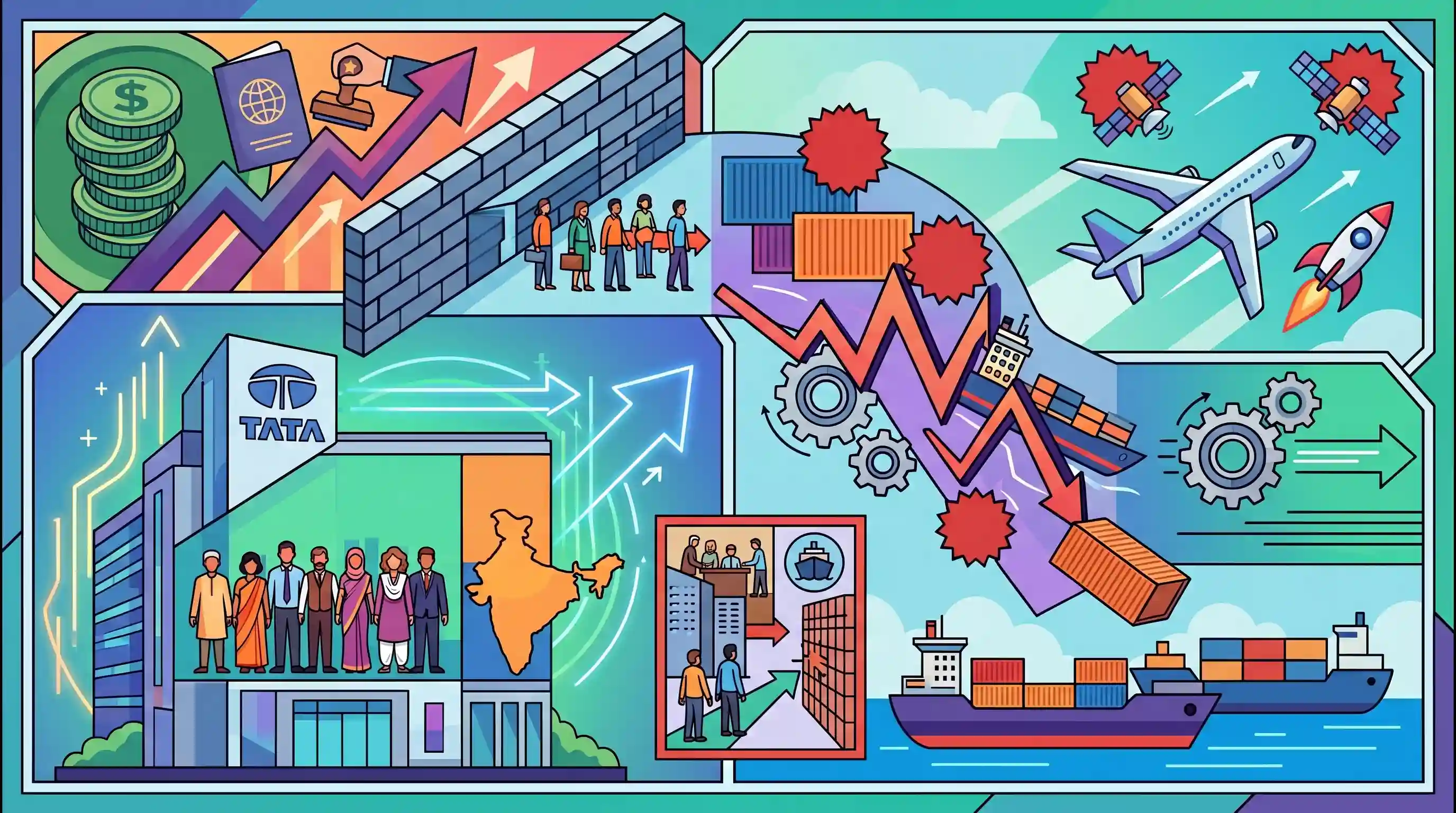
Tata Technologies CEO Warren Harris stated that the recent hike in the US H-1B visa fee to $100,000 by the Trump administration will not have a short-term impact on the firm due to its localized workforce model. Unlike traditional 'India-out' IT competitors, Tata Technologies hires approximately 70% local nationals in its operational geographies, shielding it from immediate visa-related disruptions, though future resourcing plans will be adjusted. Additionally, while recent US tariffs prompted clients to re-evaluate their global supply chains and product plans, this strategic reset has largely concluded, with specific sectors like aerospace remaining immune to the slowdown.
Key Points
- The US administration increased the H-1B visa fee to $100,000, illustrating growing protectionist sentiment affecting international professional migration.
- Tata Technologies remains largely unaffected in the short term due to its localized staffing architecture, employing roughly 70% local nationals rather than following a traditional 'India-out' model.
- Traditional Indian IT firms heavily dependent on deploying Indian workers abroad face greater exposure to these visa regulations.
- US tariffs have compelled global clients to reassess their product viability and supply chains, demonstrating the broader macroeconomic impact of trade protectionism.
Important Terms
H-1B Visa

A non-immigrant visa allowing US employers to temporarily employ foreign workers in specialty occupations requiring theoretical or technical expertise, predominantly in STEM and IT fields.
UPSC context
GS Paper 2 & 3; tests understanding of India-US relations, service exports, and the impact of developed-nation policies on India.
Protectionism
Economic policy of shielding domestic industries from foreign competition through restrictive trade barriers such as high tariffs, quotas, or punitive visa fee regulations.
UPSC context
GS Paper 2 (International Relations) and GS Paper 3 (Effects of liberalization); relevant to global trade dynamics and strategic autonomy.
Localization Strategy
A corporate strategy of hiring local nationals in foreign markets rather than deploying expatriates, aimed at mitigating regulatory hurdles and reducing dependency on work visas.
UPSC context
GS Paper 3 (Industrial Policy/Employment); tests knowledge of how Indian firms adapt to global regulatory shifts and protectionism.
Tariffs
Duties or taxes imposed by a government on imported goods or services, often used to increase domestic production or as a geopolitical leverage in trade wars.
UPSC context
GS Paper 3 (Economy); critical for understanding trade balance, global supply chain disruptions, and bilateral economic groupings.
Global Supply Chain
A globally integrated network of organizations and resources involved in the production and distribution of a product or service across international borders.
UPSC context
GS Paper 3 (Infrastructure and Industry); focuses on resilience, de-risking, and the 'China Plus One' strategy in manufacturing and IT.
Prelims Trap
The US H-1B visa falls under the permanent immigration framework mandated by the WTO GATS.
The H-1B is a temporary (non-immigrant) visa, not a permanent one. Additionally, WTO GATS explicitly excludes permanent migration and citizenship from its framework.
Static Concepts Connected
How does WTO GATS classify the international trade in services?
- Mode 1: Cross-border supply, where services flow from one country to another without physical movement (e.g., offshore software development).
- Mode 3: Commercial presence, involving a foreign company establishing local subsidiaries, branches, or joint ventures in another country.
- Mode 4: Presence of natural persons, covering individuals temporarily traveling abroad to provide services (e.g., Indian IT workers on H-1B visas).
What are Global Capability Centres (GCCs)?
- Core definition: Offshore facilities established by multinational corporations to handle specialized in-house IT, R&D, and engineering services globally.
- Captive vs Outsourced: Unlike traditional third-party IT outsourcing firms, GCCs are captive units that internalize high-value operations and intellectual property creation.
- Employment engine: GCCs drive high-skill STEM job creation in India, helping offset opportunities lost due to increasingly restrictive overseas migration and visa policies.
Cross-Topic Patterns
Service protectionism vs. GATS Mode 4
Visa fee hikes act as non-tariff barriers in services trade, undermining the spirit of WTO GATS Mode 4 commitments regarding the temporary movement of natural persons.
Protectionism reversing Brain Drain
Stringent overseas visa norms are inadvertently curbing brain drain and fueling the expansion of Global Capability Centres (GCCs), shifting India's IT focus from offshoring to captive innovation.

Expect a GS3 Mains question linking Western service protectionism (H-1B hikes) to the rapid rise of Global Capability Centres in India.
Linked PYQs · 3
Linked PYQs · 3
- 2012MainsGS2
Discuss the likely negative impact of the protectionist measures proposed by the US on India's software industry.
- 2025MainsGS3
What are the challenges before the Indian economy when the world is moving away from free trade and multilateralism to protectionism and bilateralism? How can these challenges be met?
- 2018MainsGS3
How would the recent phenomena of protectionism and currency manipulations in world trade affect macroeconomic stability of India?
