US H 1B Visa Fee Hike Impact on Indian IT Sector
Source:The Hindu ↗
Why It Matters
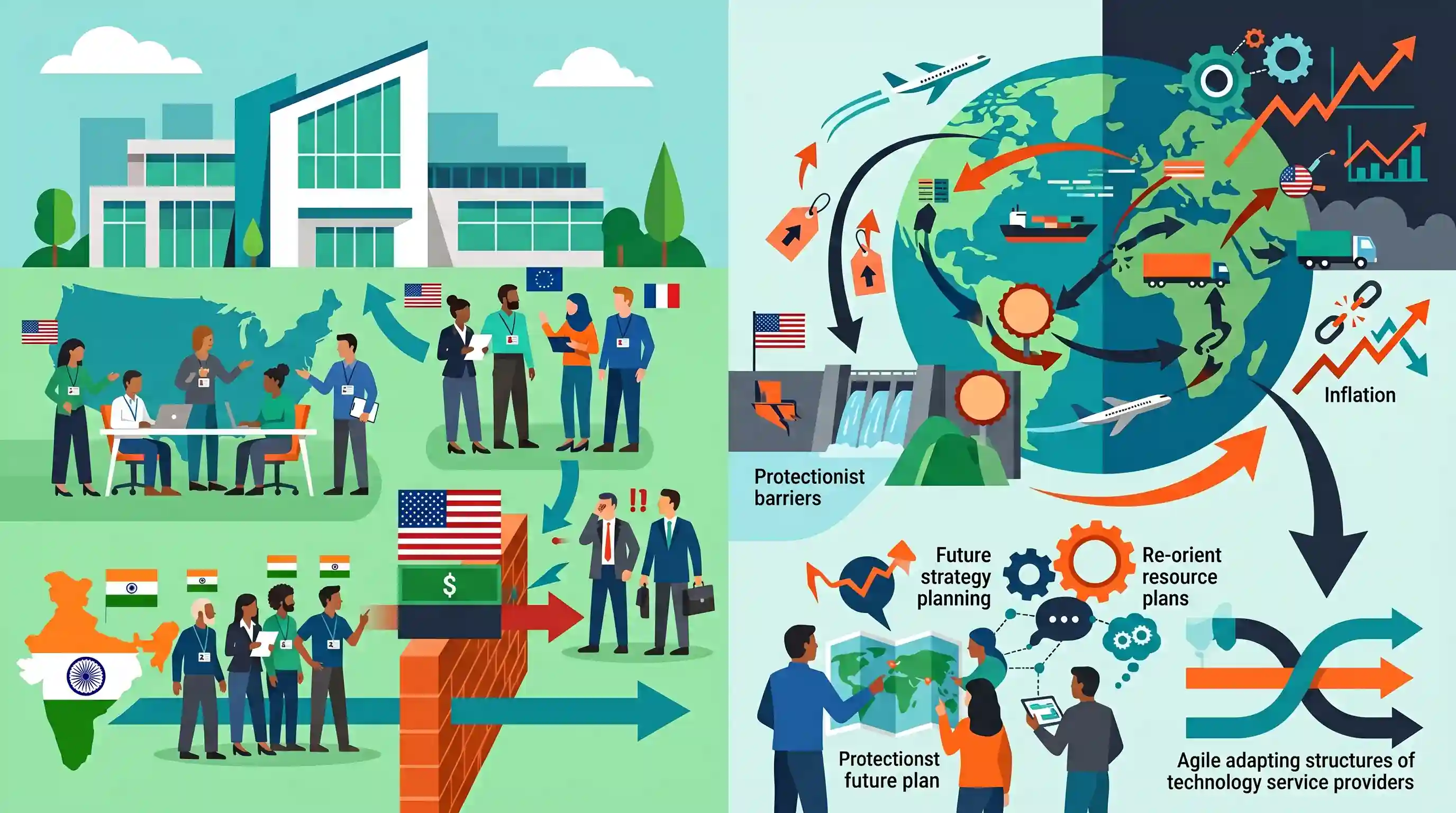
Demonstrates how Indian IT and engineering firms are adapting to stringent US immigration policies and rising protectionism by localizing their global workforces to mitigate trade uncertainties.
Summary
Tata Technologies Ltd. CEO Warren Harris asserts that the recent U.S. hike in H-1B visa fees to $100,000 will not immediately disrupt the company's operations, thanks to its localized workforce strategy. Unlike competitors heavily reliant on an 'India-out' offshore model, Tata Tech employs around 70% local nationals in its operating regions. However, Harris acknowledges that the stringent immigration policy will force a reevaluation of future global resourcing plans across the IT sector. Additionally, potential protectionist tariffs proposed by the U.S. administration could trigger macro-economic ripple effects, including inflation and disrupted global supply chains, requiring agile adaptations by technology service providers.
Key Points
- The Trump administration significantly hiked the H-1B visa fee to $100,000, aiming to prioritize domestic American workers over foreign hires.
- Tata Technologies remains insulated in the short term because its workforce model emphasizes localization, with roughly 70% of its employees in a given country being nationals of that country.
- The fee hike is expected to severely impact traditional 'India-out' offshore models, forcing Indian IT firms to rethink their global staffing architectures and resourcing plans.
- Broader protectionist policies and potential US trade tariffs may create macro-economic challenges, potentially driving up inflation and affecting client spending in global supply chains.
Important Terms
H-1B Visa Program

A non-immigrant U.S. visa allowing companies to temporarily employ foreign workers in specialty occupations requiring technical expertise; recent policy shifts include substantial fee hikes to incentivize domestic hiring.
UPSC context
GS Paper II (International Relations) — effect of foreign policies on Indian diaspora and GS Paper III (IT Sector).
Protectionism
Economic policies, such as tariffs or restrictive visa regulations, designed to shield domestic industries from foreign competition and reduce trade deficits.
UPSC context
GS Paper III (Economy) — issues relating to liberalization, globalization, and their impact on Indian industry.
Localization Strategy
A business strategy where a company hires local nationals in foreign markets instead of sending expatriates, used to mitigate immigration risks and enhance regional client relationships.
UPSC context
GS Paper III (Economy) — growth of the services sector and global workforce management.
Offshore Delivery Model (India-out)
The traditional IT service model where work is performed in India for global clients; currently under pressure from rising visa costs and protectionist trade barriers.
UPSC context
GS Paper III (Indian Economy) — external sector challenges and exports of services.
Global Supply Chain
The interconnected network of organizations and resources involved in producing and delivering goods/services globally; vulnerable to disruptions from trade wars and protectionist policies.
UPSC context
GS Paper III (Infrastructure and Supply Chain Management) — resilience and diversification.
Reciprocal Tariffs
Taxes imposed on imported goods as a direct response to similar tariffs levied by the exporting country, often leading to increased costs and inflation.
UPSC context
GS Paper III (International Trade) — impact of trade wars on the domestic economy and inflation.
Prelims Trap
H-1B visa restrictions violate WTO GATS Mode 1 or are entirely exempt from WTO trade rules.
H-1B and skilled worker mobility fall under GATS Mode 4 (presence of natural persons), not Mode 1 (cross-border supply). It is a trade issue, not just immigration.
Static Concepts Connected
What are the four modes of service supply under WTO's GATS?
- Mode 1 (Cross-border): Service crosses the border without people moving (e.g., software downloads, remote BPO services).
- Mode 2 (Consumption abroad): Consumer travels to the supplying country (e.g., medical tourism, foreign higher education).
- Mode 3 (Commercial presence): A company sets up subsidiaries, joint ventures, or branches in another country.
- Mode 4 (Natural persons): Temporary movement of individuals to supply services in a foreign country (e.g., H-1B IT professionals).
How do immigration policies act as Non-Tariff Barriers (NTBs)?
- Cost Escalation: Exorbitant visa fees ($100,000) act like tariffs, artificially inflating the cost of imported service labor to protect domestic workers.
- Quantitative Restrictions: Arbitrary caps, quotas, and lottery systems for work visas restrict foreign service providers' market access despite WTO commitments.
- Compliance Burden: Stringent localization regulations force IT companies to abandon cost-effective 'offshore' models, functioning as disguised trade protectionism.
Cross-Topic Patterns
Protectionism & Cost-Push Inflation
Restrictive visa regimes force expensive local hiring in host nations. This raises tech-service costs, feeding into macro cost-push inflation within the US and tech supply chains.
MMPAs vs. Western Protectionism
India’s pursuit of Migration and Mobility Partnership Agreements (MMPAs) with EU/UK directly contrasts with rising US protectionism restricting Mode 4 service trade mobility.

Expect a Mains question analyzing how Western non-tariff barriers (like visa hikes & CBAM) threaten India's service-led export strategy.
Linked PYQs · 2
Linked PYQs · 2
- 2025MainsGS3
What are the challenges before the Indian economy when the world is moving away from free trade and multilateralism to protectionism and bilateralism? How can these challenges be met?
- 2020MainsGS2
Indian diaspora has a decisive role to play in the politics and economy of America and European Countries'. Comment with examples.
