Centre-State Tax Devolution and Divisible Pool Mechanics
Source:The Hindu ↗
Why It Matters
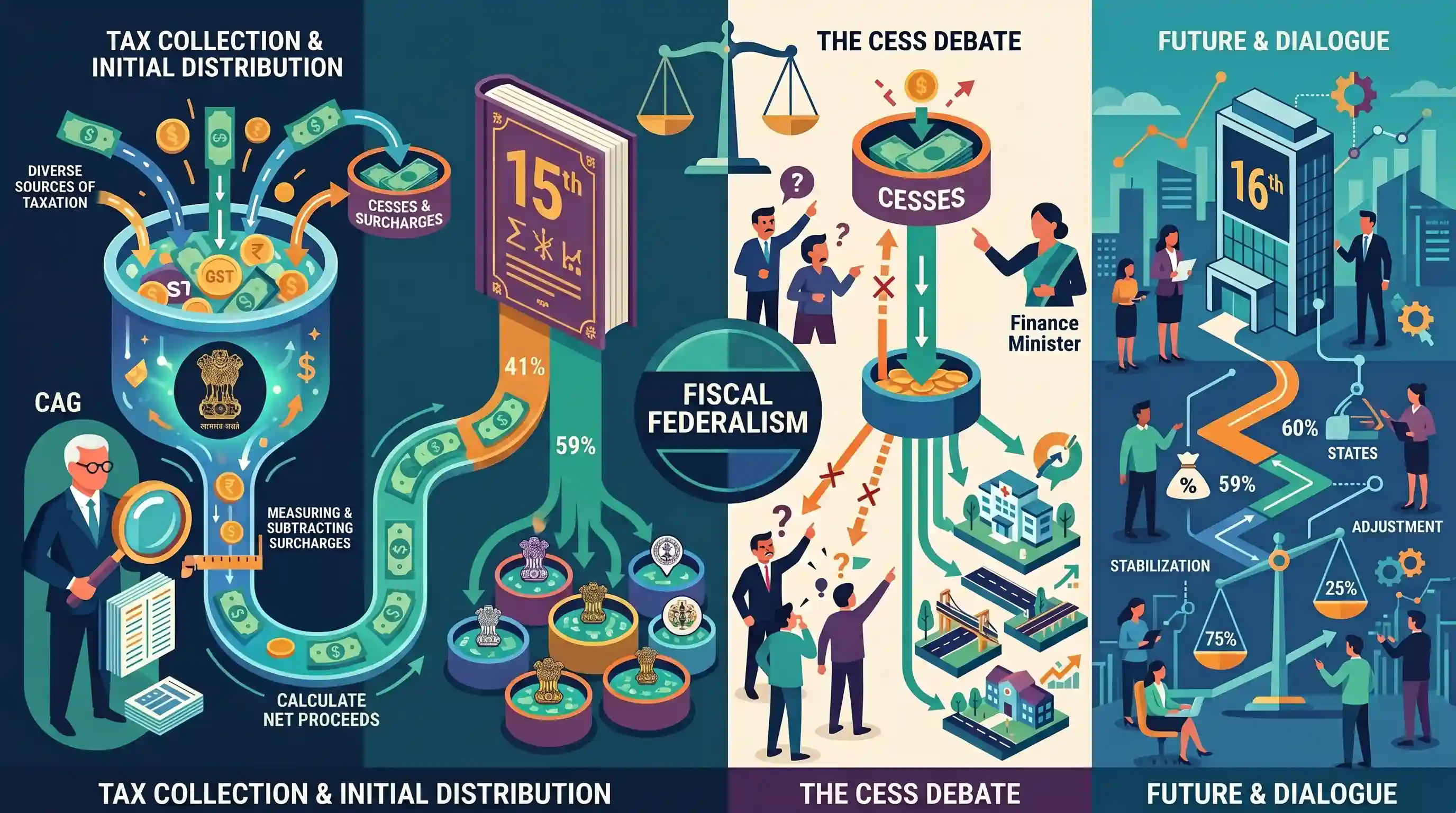
The distribution of tax revenues between the Centre and States is a core aspect of Indian fiscal federalism. The debate over cesses and surcharges shrinking the divisible pool is a recurring theme in Centre-State relations and has been a central issue for successive Finance Commissions. Understanding the constitutional provisions for tax sharing (Articles 270, 271, 279, 280) and the role of the CAG is critical for GS-2 (Polity) and GS-3 (Economy) preparation.
Summary
Union Finance Minister Nirmala Sitharaman has refuted Opposition allegations that the Centre is denying states their rightful share of taxes. Reaffirming adherence to the 15th Finance Commission's mandate, she clarified that states receive 41% of the 'divisible pool' of taxes, not the gross tax revenue. She emphasized that the Comptroller and Auditor General (CAG) independently determines the net proceeds by subtracting constitutionally permitted cesses and surcharges. While the Opposition criticized the Centre's reliance on cesses (which are not shared with states), the FM argued these funds are ring-fenced for specific development areas—like health and infrastructure—that ultimately benefit the states. The article highlights ongoing debates around fiscal federalism and the determination of state revenues ahead of the 16th Finance Commission's recommendations.
Key Points
- Finance Minister Nirmala Sitharaman stated that the Centre has fully complied with the 15th Finance Commission's recommendation to devolve 41% of the divisible tax pool to states.
- The divisible pool (net proceeds) is determined by subtracting cesses and surcharges from gross tax receipts, a calculation audited and certified by the Comptroller and Auditor General (CAG).
- The Opposition accused the Centre of reducing the states' share by increasingly relying on cesses and surcharges, which are not shared with states.
- The FM defended cesses and surcharges, noting they are constitutionally permitted and are used for specific sectors like health, education, and infrastructure that benefit states.
- The upcoming Union Budget 2026 will largely depend on the recommendations of the newly formed 16th Finance Commission.
Important Terms
15th Finance Commission

A constitutional body (Article 280) chaired by N.K. Singh that recommended a 41% vertical devolution of the divisible tax pool to states for the 2021–2026 period.
UPSC context
GS Paper 2/3: Significant for questions on vertical/horizontal devolution and performance-based incentives for states.
16th Finance Commission
Constituted under Arvind Panagariya, this commission will recommend tax-sharing formulas and fiscal roadmaps for the five-year period commencing April 1, 2026.
UPSC context
GS Paper 3: Crucial for upcoming exams regarding future fiscal consolidation and disaster management financing.
Divisible Pool of Taxes
The portion of gross tax revenue shared between the Union and States, excluding cost of collection, cesses, and surcharges, as per Article 270.
UPSC context
GS Paper 3: Tests understanding of 'net proceeds' versus 'gross revenue' in Centre-State financial relations.
Cess and Surcharge
Additional taxes levied by the Centre for specific purposes (Cess) or on high income (Surcharge) that are not shared with state governments.
UPSC context
GS Paper 3: Often tested in the context of shrinking state revenues and fiscal federalism challenges.
Fiscal Federalism
The division of financial powers and responsibilities between the Centre, States, and Local bodies, aiming for regional equity and national economic stability.
UPSC context
GS Paper 2: A core theme in Indian Polity concerning the federal structure and financial autonomy.
Comptroller and Auditor General (CAG)
A constitutional authority (Article 148) that audits government accounts and certifies the 'net proceeds' of taxes, a certificate that is final for tax devolution.
UPSC context
GS Paper 2: Key for topics on accountability, transparency, and the 'Guardian of the Public Purse'.
Prelims Trap
"States are entitled to 41% of the gross tax revenue collected by the Union government."
The 41% share recommended by the Finance Commission applies only to the 'divisible pool' (net proceeds), which strictly excludes cesses, surcharges, and tax collection costs.
Static Concepts Connected
How is the 'Divisible Pool' of taxes constitutionally determined?
- Article 270: Defines taxes levied and collected by the Union that must be distributed between the Centre and the States.
- Article 271: Empowers Parliament to levy surcharges, explicitly excluding them and specific-purpose cesses from the divisible pool.
- Article 279 (CAG Role): Mandates the CAG to calculate and certify the 'net proceeds' of taxes. The CAG's certification is final and binding.
What is the constitutional and functional difference between a Cess and a Surcharge?
- End-use restriction: A cess is collected for a specific, earmarked purpose (e.g., Health Cess) and must be spent only on that sector.
- General purpose: A surcharge goes into the Consolidated Fund of India and can be used for any general government purpose.
- Devolution exclusion: Neither a cess nor a surcharge is shared with the states; both are retained entirely by the Union government.
Cross-Topic Patterns
16th FC & demographic weightage
Tension over cesses connects to broader fiscal federalism debates, especially Southern states' fears of losing devolution share due to 2011 census population weightages used by the Finance Commission.
Post-GST Compensation fiscal strain
With the end of guaranteed GST compensation, states rely more heavily on the divisible pool, amplifying friction over the Centre's expanding use of unshared cesses and surcharges.

Expect a multi-statement Prelims question testing the constitutional articles (270, 271, 279) governing cesses, surcharges, and the CAG.
Linked PYQs · 5
Linked PYQs · 5
- 2015PrelimsGS1
With reference to the Fourteenth Finance Commission, which of the following statements is/are correct? 1. It has increased the share of States in the central divisible pool from 32 percent to 42 percent. 2. It has made recommendations concerning sector-specific grants. Select the correct answer using the code given below.
- 2023PrelimsGS1
Consider the following: 1. Demographic performance 2. Forest and ecology 3. Governance reforms 4. Stable government 5. Tax and fiscal efforts For the horizontal tax devolution, the Fifteenth Finance Commission used how many of the above as criteria other than population area and income distance?
- 2025PrelimsGS1
Which of the following statements with regard to recommendations of the 15th Finance Commission of India are correct? I. It has recommended grants of ₹ 4,800 crores from the year 2022-23 to the year 2025-26 for incentivizing States to enhance educational outcomes. II. 45% of the net proceeds of Union taxes are to be shared with States. III. ₹ 45,000 crores are to be kept as performance-based incentive for all States for carrying out agricultural reforms. IV. It reintroduced tax effort criteria to reward fiscal performance. Select the correct answer using the code given below.
- 2025MainsGS2
Examine the evolving pattern of Centre-State financial relations in the context of planned development in India. How far have the recent reforms impacted the fiscal federalism in India?
- 2018MainsGS2
How is the Finance Commission of India constituted? What do you know about the terms of reference of the recently constituted Finance Commission? Discuss.
