Supreme Court declines stay on data protection law RTI amendments
Source:Indian Express ↗
Why It Matters
The clash between the DPDP Act and the RTI Act brings to the forefront a critical constitutional dilemma: balancing the Right to Privacy against the Right to Information. This intersection is highly relevant for GS-2 (Governance, Accountability, and Fundamental Rights) as it tests the boundaries of state transparency, citizen oversight, and data protection in India's evolving digital landscape.
Summary
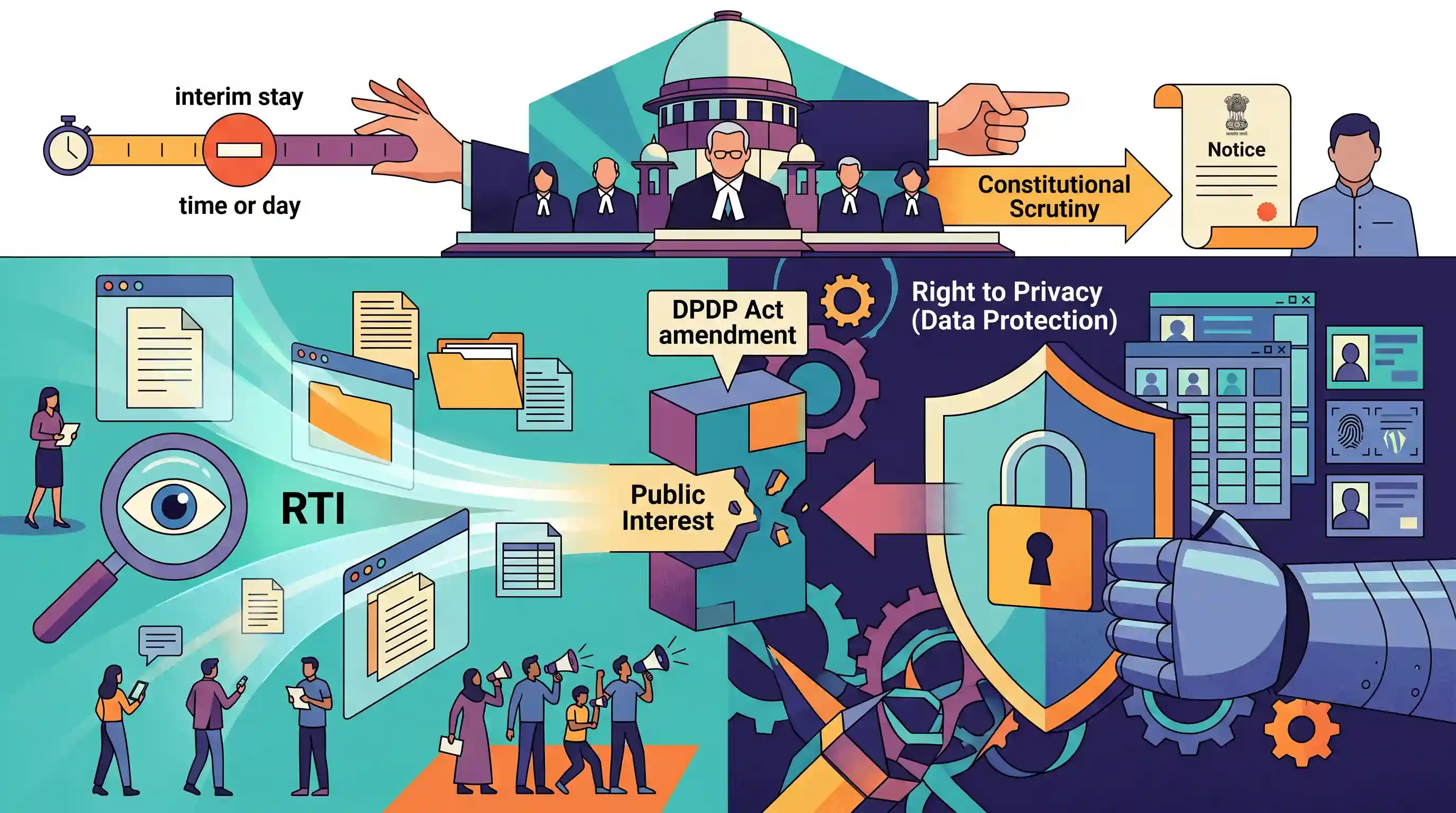
The Supreme Court has refused an interim stay on the amendments made to the Right to Information (RTI) Act by the Digital Personal Data Protection (DPDP) Act, 2023. Petitioners, including the National Campaign for People’s Right to Information (NCPRI) and the Reporters' Collective, challenged Section 44(3) of the DPDP Act which amends Section 8(1)(j) of the RTI Act. They argue the amendment imposes a blanket ban on the disclosure of personal information by removing the clause that previously permitted such disclosure if it served an overriding public interest. A bench headed by Chief Justice of India Surya Kant noted that balancing the competing fundamental rights of privacy and information is a complex issue but maintained the principle that legislation passed by Parliament should not be stayed via interim orders unless absolutely necessary. The Court has issued a notice to the Centre and referred the matter to a larger bench for deeper constitutional scrutiny.
Key Points
- The Supreme Court of India declined to issue an interim stay on amendments made to the RTI Act via the Digital Personal Data Protection (DPDP) Act, 2023.
- Section 44(3) of the DPDP Act alters Section 8(1)(j) of the RTI Act, effectively instituting a blanket ban on the disclosure of personal information by removing the previous 'larger public interest' override.
- Transparency advocates argue this amendment decisively undermines accountability by destroying the settled balance between two competing fundamental rights: the Right to Information and the Right to Privacy.
- A three-judge bench led by CJI Surya Kant issued notice to the Centre, observing that while the issue touches upon complex and competing fundamental rights, acts of Parliament cannot be disrupted by interim stays without compelling reasons.
Important Terms
Digital Personal Data Protection (DPDP) Act, 2023

A 2023 law regulating digital personal data processing, it mandates individual consent for data usage while providing the government broad powers to exempt agencies for national security.
UPSC context
GS II/III; central to debates on the Fundamental Right to Privacy (Art 21) versus state surveillance and transparency.
Right to Information (RTI) Act, 2005
Legislation that grants citizens the legal right to access records held by public authorities, aiming to ensure transparency and accountability in government functioning.
UPSC context
GS II (Governance); a critical tool for citizen-led accountability and derived from the freedom of speech (Art 19(1)(a)).
Section 8(1)(j) of the RTI Act
A specific RTI provision that exempts personal information from disclosure unless the Information Officer is satisfied that a larger public interest justifies such disclosure.
UPSC context
GS II (Governance); the focal point of the legal battle between privacy protection and the "right to know."
Public Interest Override
A legal provision allowing the disclosure of otherwise exempt information if the benefit to the general public outweighs the harm to private interest.
UPSC context
GS II (Transparency); its removal via the DPDP Act is the primary grievance of transparency activists.
Proportionality Test
A four-part judicial standard (from the Puttaswamy case) requiring state restrictions on fundamental rights to have a legitimate aim, necessity, and the least-intrusive means.
UPSC context
GS II (Judiciary/Fundamental Rights); used to test the constitutional validity of laws that infringe on privacy or information.
National Campaign for People’s Right to Information (NCPRI)
A civil society coalition formed in 1996 that was instrumental in drafting and advocating for the original RTI Act in India.
UPSC context
GS II (Civil Society/NGOs); represents the organized effort of citizens to maintain transparency frameworks.
Data Fiduciary
An entity (person, company, or state) that determines the purpose and means of processing personal data, carrying significant legal obligations under the DPDP Act.
UPSC context
GS III (Cyber Security/Economy); crucial for understanding corporate and state accountability in the digital data ecosystem.
Prelims Trap
Personal data can still be disclosed under RTI if larger public interest justifies it.
This was true originally. However, the DPDP Act 2023 amended Section 8(1)(j) to remove the 'public interest' override, establishing a blanket ban on personal info disclosure.
Static Concepts Connected
What are the key exemptions under Section 8 of the RTI Act?
- National Security: Information that prejudicially affects the sovereignty, integrity, security, or economic interests of the State.
- Contempt of Court: Information whose publication is expressly forbidden by any court of law or tribunal.
- Fiduciary & Commercial: Information related to trade secrets, intellectual property, or held in a fiduciary capacity.
- Section 8(1)(j): Personal information is now comprehensively exempted due to the DPDP Act 2023 amendment removing the public interest override.
What is the Doctrine of Presumption of Constitutionality?
- Core Principle: Courts operate on the default assumption that laws enacted by Parliament or State Legislatures are valid and constitutional.
- Burden of Proof: The onus lies entirely on the petitioner to demonstrate that the statute violates fundamental rights or constitutional provisions.
- No Interim Stays: Courts generally refuse to issue interim stays on legislation unless the law is blatantly unconstitutional on its face.
Cross-Topic Patterns
RTI vs Privacy: Article 19 vs Article 21
The DPDP-RTI conflict reflects the classic constitutional friction between transparency (Right to Information, implicitly under Art 19(1)(a)) and the Right to Privacy (Puttaswamy case, Art 21).
Information Asymmetry in Governance
Severe penalties on Public Information Officers under DPDP rules may lead to 'safe' blanket denials, diluting citizen-led accountability and shifting power back toward an opaque bureaucracy.

Expect a GS-2 Mains question on balancing Art 19 (RTI) vs Art 21 (Privacy), or Prelims multi-statements on Section 8(1)(j) exemptions.
Linked PYQs · 5
Linked PYQs · 5
- 2020MainsGS2
Recent amendments to the Right to Information Act will have profound impact on the autonomy and independence of the Information Commission". Discuss.
- 2017MainsGS2
Examine the scope of Fundamental Rights in the light of the latest judgement of the Supreme Court on Right to Privacy.
- 2024MainsGS2
Right to privacy is intrinsic to life and personal liberty and is inherently protected under Article 21 of the constitution. Explain. In this reference discuss the law relating to D.N.A. testing of child in the womb to establish its paternity.
- 2024PrelimsGS1
Under which of the following Articles of the Constitution of India, has the Supreme Court of India placed the Right to Privacy ?
- 2021PrelimsGS1
'Right to Privacy' is protected under which Article of the Constitution of India?
