Bihar Prohibition Law Will Not Be Reviewed Says JD U
Source:The Hindu ↗
Why It Matters
Evaluates the socio-economic trade-offs of state-level prohibition policies. This is a flagship policy of the Bihar government, making it highly relevant for BPSC Prelims, specifically testing candidates on its constitutional backing (DPSP Article 47), governance challenges (bootlegging, state exchequer losses), and social impacts.
Summary
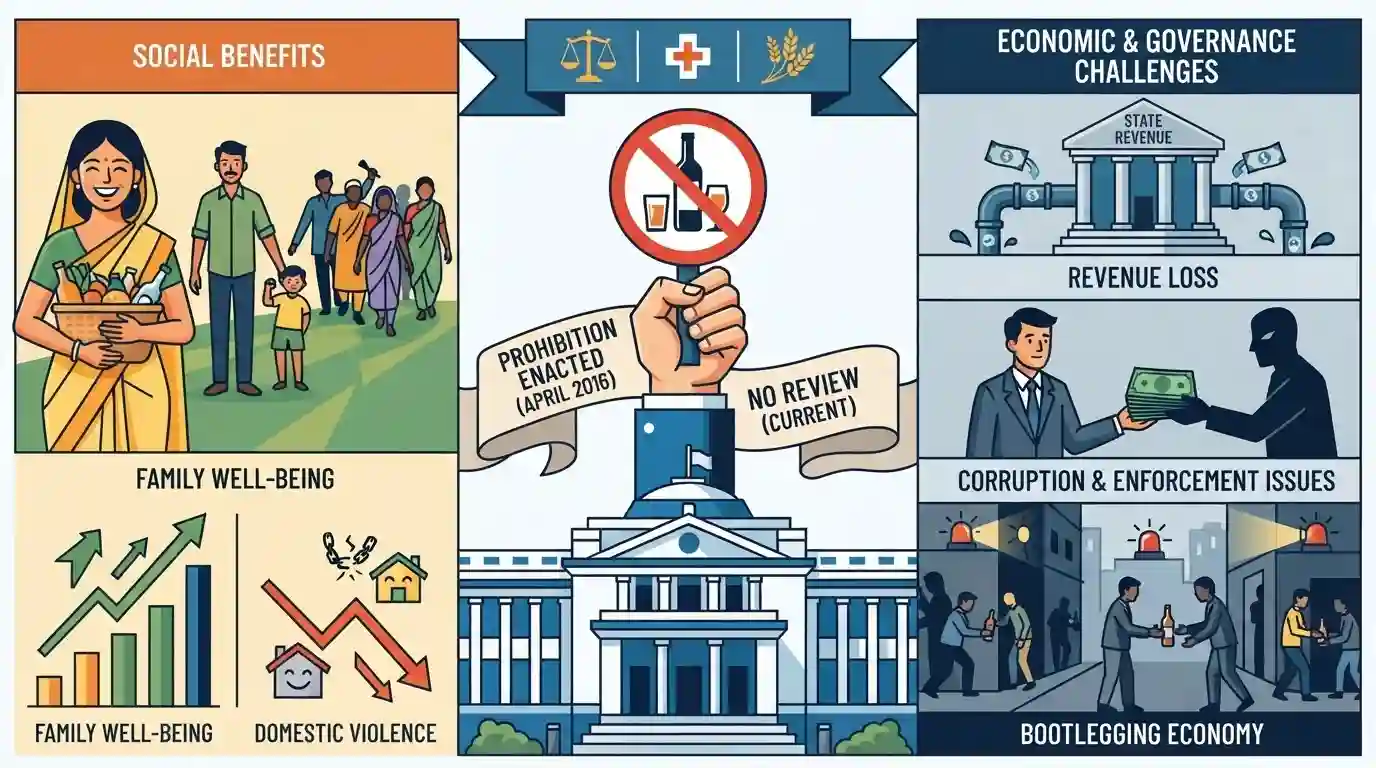
The ruling JD(U) has categorically dismissed any possibility of reviewing Bihar's liquor prohibition law, which was enacted in April 2016. Despite a recent study by the National Council of Applied Economic Research (NCAER) highlighting massive revenue losses, corruption, and the emergence of a parallel bootlegging economy, the state government maintains that the ban has yielded substantial social benefits, particularly for women and marginalized communities. Suggestions from allies to implement a 'Gujarat model' with permit-based access were also firmly rejected, reaffirming the state's zero-tolerance policy towards alcohol consumption.
Key Points
- The Bihar government, led by JD(U), firmly rejected any plans to review or lift the liquor prohibition law implemented in April 2016.
- Despite significant revenue losses and the rise of a bootlegging economy noted in an NCAER report, the government cited positive social outcomes like reduced domestic violence and improved living standards for the marginalized.
- Suggestions to adopt a 'Gujarat model' of prohibition, allowing controlled access via permits, were dismissed by JD(U) leaders.
- The policy aligns with Article 47 of the Constitution (DPSP), which directs the State to endeavor to bring about prohibition of intoxicating drinks.
Important Terms
Article 47 (Directive Principles of State Policy)

A constitutional provision under Part IV directing the State to improve public health and the standard of living. It specifically encourages the prohibition of intoxicating drinks and health-injurious drugs, except for medicinal purposes.
UPSC context
GS Paper 2 (Polity). Tests the constitutional mandate and Directive Principles underpinning state-level liquor prohibition policies.
Bihar Prohibition and Excise Act, 2016
A state legislation enforcing the complete prohibition of manufacturing, distributing, selling, and consuming liquor in Bihar. It aims to reduce domestic violence and improve social welfare, despite causing severe state revenue losses.
UPSC context
GS Paper 2 & 3. Tests governance, social justice, and the socio-economic trade-offs between public health benefits and massive fiscal revenue losses.
National Council of Applied Economic Research (NCAER)
Established in 1956, NCAER is India's oldest and largest independent, non-profit economic policy research institute. It specializes in empirical research, data collection, and household surveys to inform public policy choices and governance.
UPSC context
GS Paper 3 (Indian Economy). Relevant for policy evaluation and citing independent economic data on the socio-economic impacts of government policies.
Prelims Trap
The exclusive power of states over 'intoxicating liquors' under Entry 8 of the State List excluded industrial alcohol until a constitutional amendment in 2024.
No constitutional amendment occurred; the change was a 2024 Supreme Court 9-judge bench judicial interpretation overruling the 1989 Synthetics & Chemicals precedent.
Static Concepts Connected
What is the constitutional framework governing alcohol regulation in India?
- Seventh Schedule distribution: Entry 8 of the State List gives state legislatures exclusive legislative power over the production, manufacture, transport, and sale of intoxicating liquors.
- Directive Principles (Article 47): Directs the State to endeavor to bring about prohibition of the consumption of intoxicating drinks and drugs which are injurious to health.
- Justiciability status: Being a DPSP under Part IV, Article 47 is non-justiciable in courts but remains fundamental in the governance of the country.
How does the Supreme Court view the 'Right to Trade' in liquor?
- No fundamental right: The Supreme Court has consistently held (e.g., Khoday Distilleries case) that citizens have no fundamental right to carry on trade or business in liquor.
- Article 19(6) limitations: The state can impose a complete ban on liquor trade under Article 19(6) to protect public health and morality.
Cross-Topic Patterns
State Excise vs. Fiscal Federalism
Prohibition sacrifices state excise revenue (a top self-tax source), increasing state dependence on Union GST devolution and worsening fiscal deficits in poorer states.
Gandhian ethics vs. colonial revenue
The anti-liquor struggle was central to the Non-Cooperation Movement (1920-22) to choke colonial excise revenue, linking moral reform directly to economic boycott.

2026 GS-2: Expect questions analyzing Article 47 DPSPs vs. federal fiscal autonomy and the rise of parallel black-market economies.
Linked PYQs · 1
Linked PYQs · 1
- 2018BPSC_PRELIMSGS1
Gandhi's Non-Cooperation Movement urged people to avoid alcohol. This resulted in a serious loss of revenue for the government. The government of a province circulated a list of prominent individuals who drank alcohol as a device to persuade people to start drinking again. Name the province.
