Government Freezes Retail Fuel Prices Amid Global Energy Shocks
Source:The Hindu ↗
Why It Matters
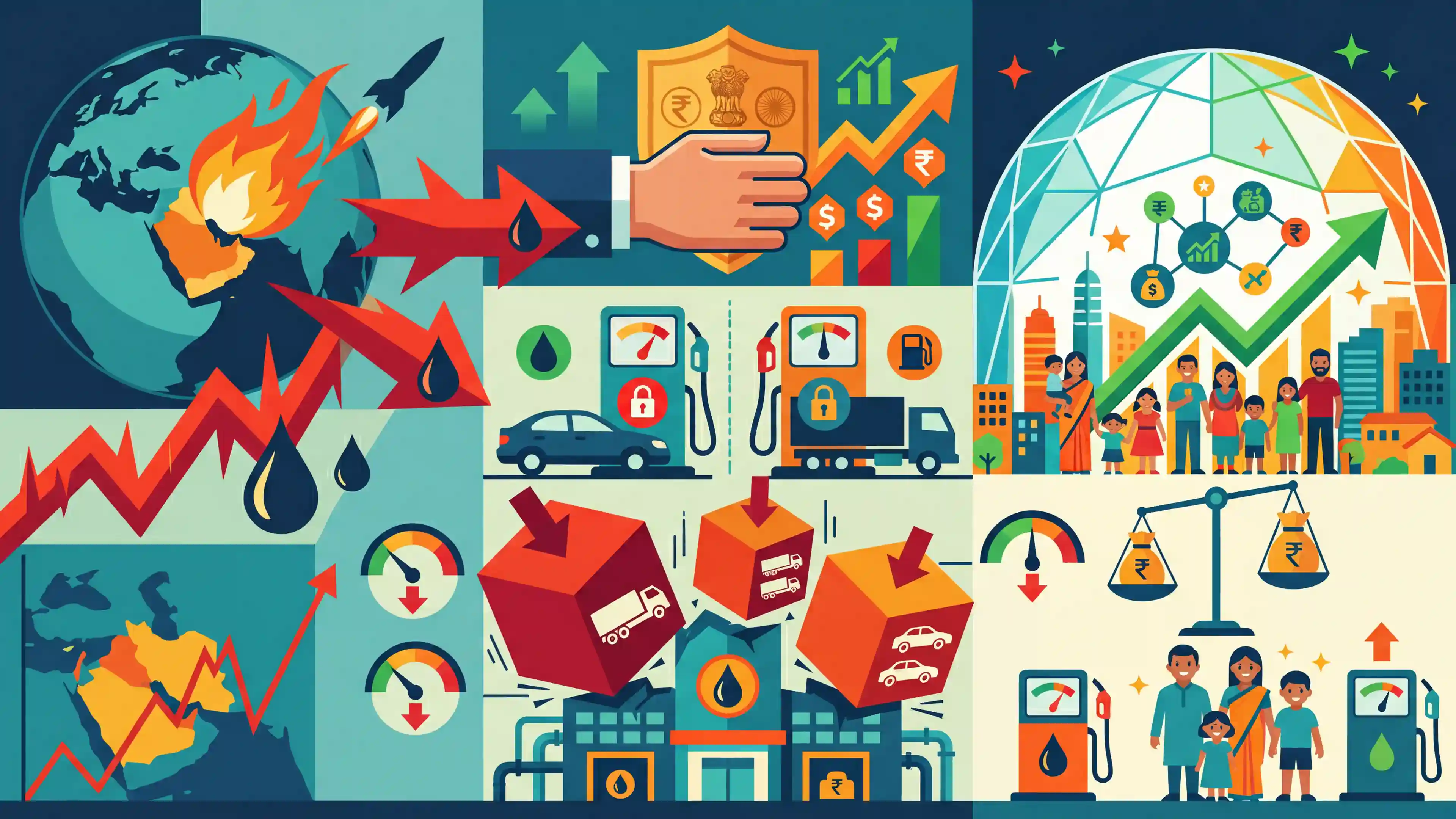
Fuel pricing is a critical determinant of macroeconomic stability in India. The freezing of retail prices amidst rising crude costs highlights the government's balancing act between controlling inflation, managing the fiscal health of OMCs, and securing energy supplies during geopolitical disruptions in West Asia.
Summary
The Ministry of Petroleum and Natural Gas has confirmed that there are no plans to increase regular petrol or diesel prices, despite the global surge in Brent crude costs triggered by the West Asia crisis. Consequently, Oil Marketing Companies (OMCs) are absorbing significant under-recoveries, losing ₹24.4 per litre on petrol and ₹104.99 per litre on diesel. Although the prices of premium fuel variants were marginally hiked on April 1, the government is deliberately shielding domestic consumers from global energy price shocks to manage inflation, prioritizing economic stability over OMC profitability.
Key Points
- The Petroleum Ministry stated there is no proposal to increase regular petrol and diesel prices since April 1.
- Prices for premium petrol variants (XP95, Power95, Speed) were hiked on April 1, but these constitute only 5% of total sales volume.
- Oil Marketing Companies (OMCs) are absorbing massive under-recoveries (₹24.4/litre on petrol and ₹104.99/litre on diesel) as domestic prices remain fixed despite surging Brent crude prices.
- The decision to freeze fuel prices comes amid a broader inter-ministerial assessment of the geopolitical crisis in West Asia and its impact on India's energy security.
Important Terms
Oil Marketing Companies (OMCs)

State-owned entities like IOCL, BPCL, and HPCL that manage refining, distribution, and retail sale of petroleum products. They serve as the primary interface between the oil industry and consumers.
UPSC context
GS Paper III (Economy); relevant for energy infrastructure, public sector undertakings (PSUs), and government fiscal policy discussions.
Under-recoveries
The revenue loss incurred by OMCs when the retail selling price of fuel is kept lower than the actual market cost (linked to international prices) to protect consumers.
UPSC context
GS Paper III (Economy); tests knowledge of subsidies, fiscal deficit, and pricing mechanisms in the energy sector.
Brent Crude
The leading global price benchmark for Atlantic basin crude oils. It is extracted from the North Sea and used to price two-thirds of the world's internationally traded crude.
UPSC context
GS Paper I (Geography) and GS III (Economy); crucial for understanding global trade, inflation, and India’s import bill.
Energy Security
Ensuring uninterrupted availability of energy sources at an affordable price. For India, it involves managing high import dependency (over 85%) and diversifying energy sources to sustain growth.
UPSC context
GS Paper III (Infrastructure/Energy); a recurring theme in strategic planning and sustainable development goals.
Deregulation of Fuel Prices
The policy shift to link domestic fuel prices with international market rates. While petrol (2010) and diesel (2014) are officially deregulated, the government often intervenes to stabilize prices.
UPSC context
GS Paper III (Economy); covers market reforms, administrative pricing mechanisms, and the balance between market efficiency and social welfare.
Ministry of Petroleum and Natural Gas
The nodal central ministry responsible for the exploration, production, refining, distribution, and marketing of petroleum, natural gas, and various petroleum products in India.
UPSC context
GS Paper II (Governance); relevant for executive bodies and policy implementation in the energy sector.
Prelims Trap
"Petrol and diesel prices in India are determined by the government under the Administered Pricing Mechanism."
Petrol and diesel were officially deregulated in 2010 and 2014. Pricing is legally market-linked, but the government exercises 'de facto' control by nudging OMCs to absorb losses.
Static Concepts Connected
How does India price its petroleum products?
- De jure deregulation: Petrol (2010) and Diesel (2014) are officially market-determined and no longer under the Administered Pricing Mechanism (APM).
- Trade Parity Pricing: OMCs use TPP (80% Import Parity Price + 20% Export Parity Price) to calculate the refinery gate price.
- Under-recoveries: The financial loss OMCs absorb when they sell fuel at retail prices lower than global market-determined costs due to informal government caps.
What is the macroeconomic impact of surging global crude oil prices on India?
- Imported Inflation: Creates cost-push inflation by raising freight and manufacturing costs, leading to 'imported inflation' that cascades into CPI.
- Twin Deficit risk: Higher import bills widen the Current Account Deficit (CAD). If the government compensates OMCs, it risks widening the Fiscal Deficit.
- Currency Depreciation: Increased demand for US Dollars to pay for more expensive oil imports exerts depreciating pressure on the Indian Rupee.
Cross-Topic Patterns
Imported Inflation & WPI/CPI weightages
Fuel freezes artificially suppress headline inflation. 'Fuel and Power' holds 13.2% weight in WPI, making retail pump prices a direct government lever for macroeconomic inflation management.
West Asia geopolitics & Twin Deficits
West Asian conflicts (e.g., Red Sea shipping disruptions, Iran-Israel tensions) directly translate to Indian economic vulnerability, explicitly linking IR (GS2) with Twin Deficit risks (GS3).

Expect a 2026 Prelims question testing de jure fuel deregulation vs de facto price controls alongside WPI/CPI weightages.
Linked PYQs · 3
Linked PYQs · 3
- 2025PrelimsGS1
Consider the following activities : I. Production of crude oil II. Refining, storage and distribution of petroleum III. Marketing and sale of petroleum products IV. Production of natural gas How many of the above activities are regulated by the Petroleum and Natural Gas Regulatory Board in our country?
- 2017MainsGS2
The question of India's Energy Security constitutes the most important part of India's economic progress. Analyze India's energy policy cooperation with West Asian countries.
- 2025MainsGS2
"Energy security constitutes the dominant kingpin of India's foreign policy, and is linked with India's overarching influence in Middle Eastern countries.” How would you integrate energy security with India's foreign policy trajectories in the coming years?
