ICMR Confirms No Novel H1N1 Strain Amid Rising Swine Flu Cases
Source:The Hindu ↗
આ શા માટે મહત્વનું છે
Understanding disease surveillance and the role of apex medical research bodies (like ICMR and NCDC) is a core component of the GS2 Health syllabus. Additionally, knowledge about viral strains and vaccine components directly addresses recurring Science & Technology questions in GS3 and Prelims.
સારાંશ
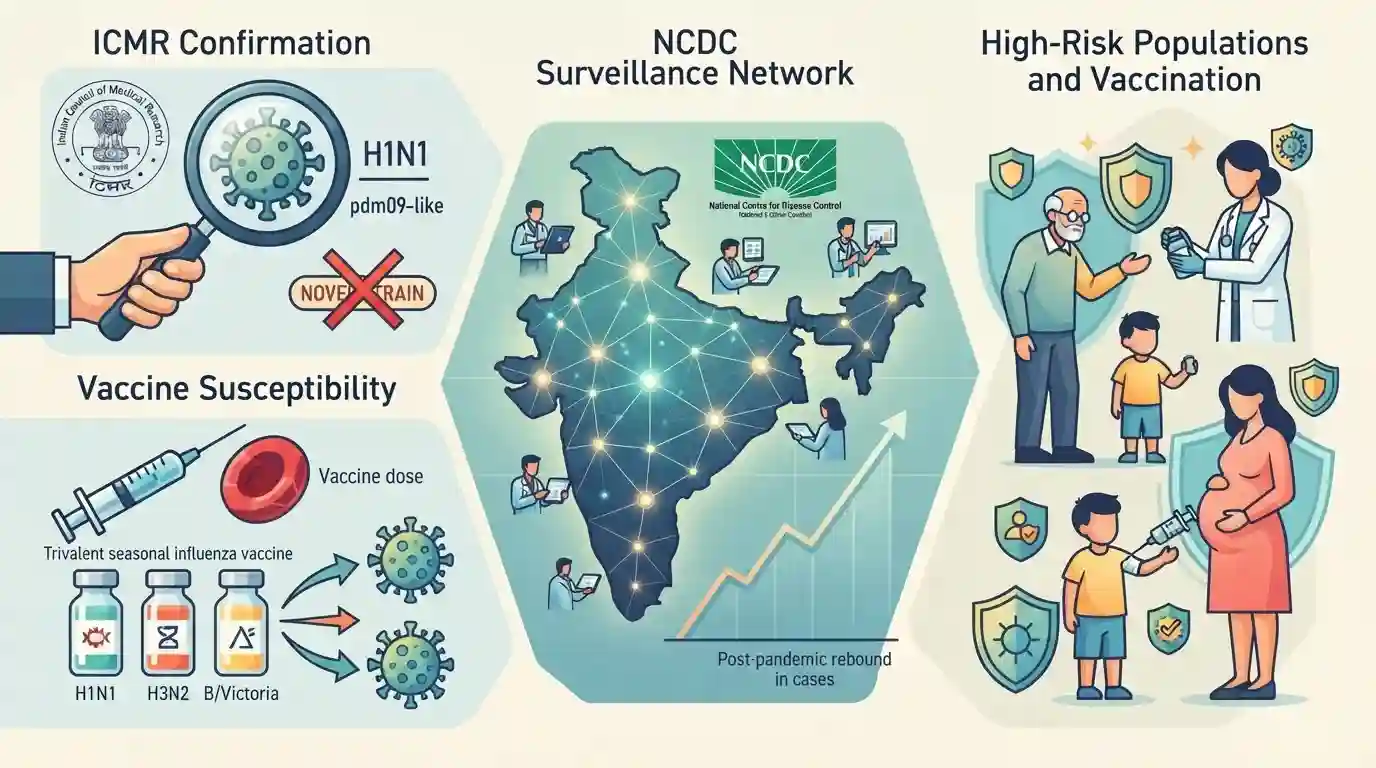
The Indian Council of Medical Research (ICMR) has confirmed that the recent rise in H1N1 (swine flu) cases across India is not caused by a novel strain. The current infections are driven by the A/Missouri/11/2025 (H1N1) pdm09-like virus strain, which remains highly susceptible to existing seasonal influenza vaccines. The National Centre for Disease Control (NCDC) is actively monitoring the disease spread through its nationwide surveillance network, particularly as cases have rebounded significantly since the COVID-19 pandemic. High-risk populations are advised to prioritize seasonal vaccinations, specifically the trivalent vaccine that targets H1N1, H3N2, and B/Victoria strains, to prevent severe complications.
મુખ્ય મુદ્દા
- The ICMR has assured that the recent spike in H1N1 cases is not due to a new strain, with circulating viruses belonging to the A/Missouri/11/2025 (H1N1) pdm09-like strain.
- The circulating strain belongs to clade 6B.1A.5a2a, subclade D.3.1.1, and aligns closely with currently recommended vaccines.
- For the 2025-2026 season, the recommended trivalent vaccine in India includes components for H1N1, H3N2, and B/Victoria.
- The National Centre for Disease Control (NCDC) is conducting nationwide surveillance, noting a post-pandemic rebound in cases starting from 2022.
- While the illness is typically self-limiting, vulnerable demographics such as the elderly, young children, and those with underlying medical conditions are advised to take annual flu vaccinations.
મહત્વપૂર્ણ શબ્દો
Indian Council of Medical Research (ICMR)

India's apex body for the formulation, coordination, and promotion of biomedical research. Under the Ministry of Health and Family Welfare, it drives national health policies, clinical trials, and disease management strategies.
UPSC context
GS Paper 2 & 3 (Health/Science). Crucial for questions on healthcare R&D, pandemic response, and public health infrastructure.
National Centre for Disease Control (NCDC)
The nodal agency under the Directorate General of Health Services (MoHFW) responsible for disease surveillance, investigating disease outbreaks, and facilitating the prevention and control of communicable diseases in India.
UPSC context
GS Paper 2 (Health). Essential for understanding India's disease surveillance networks, epidemiology, and outbreak management capabilities.
Trivalent Vaccine
A seasonal influenza vaccine that protects against three circulating flu strains: typically an A(H1N1) virus, an A(H3N2) virus, and one B/Victoria lineage virus. It is prioritized for high-risk populations.
UPSC context
GS Paper 3 (Biotechnology & Health). Relevant for understanding immunization strategies, vaccine formulation, and seasonal disease prevention frameworks.
A(H1N1)pdm09 (Swine Flu)
A strain of the influenza A virus that caused the 2009 global pandemic. Originating from a reassortment of swine, avian, and human viruses, it now circulates as a regular seasonal human flu strain.
UPSC context
GS Paper 3 (Science & Tech). Important for topics covering viral diseases, mutations, and biotechnology-driven public health challenges.
World Health Organization (WHO)
A specialized agency of the United Nations responsible for international public health. It coordinates global health responses, sets disease surveillance standards, and issues vaccination guidelines.
UPSC context
GS Paper 2 (Important International Institutions). Tests awareness of global health governance, international treaties, and coordinated pandemic responses.
પ્રિલિમ્સ ટ્રેપ
Influenza transmission in India peaks only once annually during the winter season.
India actually exhibits a bimodal seasonal pattern with two distinct peaks (winter and post-monsoon rainy season), unlike temperate countries which experience a single winter peak.
સંલગ્ન સ્થિર ખ્યાલો
What is the Integrated Disease Surveillance Programme (IDSP)?
- Origin: Launched in 2004 with World Bank assistance to strengthen disease surveillance for epidemic-prone diseases.
- Structure: It is a decentralized, state-based, IT-enabled network operating across the country.
- Nodal Agency: Managed by the National Centre for Disease Control (NCDC) under the Ministry of Health and Family Welfare.
How do Trivalent and Quadrivalent influenza vaccines differ?
- Trivalent vaccine: Protects against three strains: two Influenza A subtypes (H1N1, H3N2) and one Influenza B lineage.
- Quadrivalent vaccine: Offers broader protection by incorporating a second Influenza B lineage (such as B/Yamagata).
- Mechanism: They stimulate the immune system to produce antibodies against specific Hemagglutinin (H) and Neuraminidase (N) surface proteins.
આંતર-વિષય પેટર્ન
Zoonotic spillovers + One Health framework
H1N1 (swine flu) frequently links to India's National One Health Mission, which integrates human, animal, and environmental surveillance to detect and track zoonotic spillovers early.
IDSP + Health Emergency Governance
Post-COVID, the role of IDSP's decentralized network is often evaluated alongside the Epidemic Diseases Act and the Disaster Management Act in the context of national health emergency frameworks.

Expect a multi-statement question contrasting India's bimodal influenza seasonality with temperate zones, combined with IDSP functions.
સંલગ્ન PYQ · 3
સંલગ્ન PYQ · 3
- 2015PrelimsGS1
H1N1 virus is sometimes mentioned in the news with reference to which one of the following diseases?
- 2024MainsGS2
In a crucial domain like the public healthcare system the Indian State should play a vital role to contain the adverse impact of marketisation of the system. Suggest some measures through which the State can enhance the reach of public healthcare at the grassroots level.
- 2020MainsGS2
Critically examine the role of WHO in providing global health security during the Covid-19 pandemic.
