Fertilizer Supply Reserves and West Asia Conflict Risks
Source:The Hindu ↗
Why It Matters
Highlights India's vulnerability to global geopolitical shocks regarding critical upstream agricultural inputs like fertilizers and emphasizes the strategic importance of diversifying supply chains and maintaining adequate reserves.
Summary
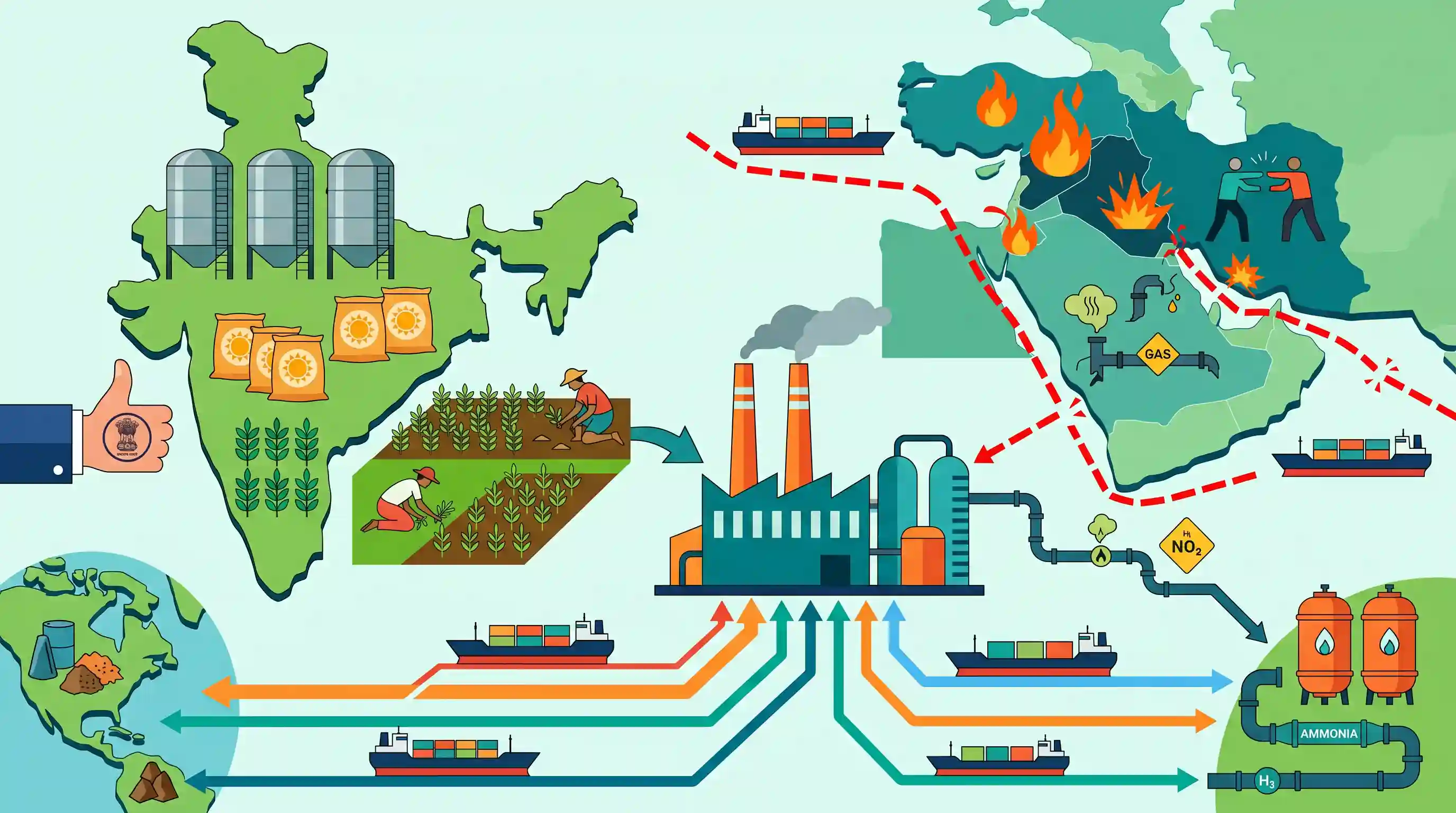
The Union government has assured the Lok Sabha that India possesses adequate fertilizer reserves for the upcoming Kharif season, despite threats of supply chain disruptions caused by the ongoing Iran-Israel conflict. The war in West Asia risks interrupting maritime routes and the supply of natural gas and ammonia to India, which could decrease domestic fertilizer production by 10-15%. To mitigate these geopolitical risks, the government is actively exploring new markets and diversifying supply sources for essential raw materials.
Key Points
- Union Minister J.P. Nadda assured the Lok Sabha that India has sufficient fertilizer reserves for the upcoming Kharif season, minimizing the need for panic.
- The ongoing Iran-Israel conflict in West Asia threatens to disrupt maritime trade routes and the critical supply of natural gas and ammonia to India.
- These supply chain disruptions risk reducing India's domestic fertilizer production by 10-15%.
- To mitigate this risk, the Indian government is proactively exploring new global markets to diversify the supply chain and secure necessary raw materials for fertilizers.
Important Terms
Kharif Season

India's primary cropping season, coinciding with the Southwest Monsoon (June to October), involving crops like rice, maize, and pulses that require high water and heat.
UPSC context
GS Paper 3: Agriculture. Tests knowledge of cropping patterns, food security, and the timing of agricultural input requirements.
Urea
The most widely used nitrogenous fertilizer in India, with its price strictly controlled by the government and heavily subsidized to ensure farmer affordability.
UPSC context
GS Paper 3: Economy/Agriculture. Relevant for discussions on fiscal deficit, subsidy leakages, and soil health (NPK ratio imbalance).
Nutrient-Based Subsidy (NBS) Scheme
A 2010 policy where the government provides a fixed subsidy per kg of nutrients (N, P, K, S) for non-urea fertilizers, allowing manufacturers to set retail prices.
UPSC context
GS Paper 3: Agriculture/Economy. Tests understanding of subsidy reforms and balanced fertilization vs. urea overuse.
Strait of Hormuz
A critical maritime chokepoint between the Persian Gulf and the Gulf of Oman, through which 20-30% of global oil and India's key fertilizer/LNG imports flow.
UPSC context
GS Paper 2: International Relations. Crucial for maritime security, energy security, and geopolitical risks to Indian supply chains.
Feedstock (Natural Gas)
Natural gas, primarily imported as LNG, used as the essential raw material to generate hydrogen for the synthesis of ammonia and urea in domestic plants.
UPSC context
GS Paper 3: Industrial Policy/Economy. Highlights the link between global energy prices and domestic agricultural production costs.
Di-Ammonium Phosphate (DAP)
The second most consumed fertilizer in India after urea, providing essential phosphorus and nitrogen primarily for root development in crops like wheat and pulses.
UPSC context
GS Paper 3: Agriculture. Important for understanding import dependency and the specific nutrient requirements of major Indian crops.
Ammonia
A chemical compound of nitrogen and hydrogen that serves as the immediate precursor for most nitrogen-based fertilizers; India relies heavily on its import and production.
UPSC context
GS Paper 3: Science & Tech/Agriculture. Tests understanding of industrial processes behind fertilizer manufacturing and raw material supply chains.
Prelims Trap
"India maintains long-term strategic buffer stocks for critical imported fertilizers like DAP and MOP."
Unlike food grains under FCI, India lacks a statutory long-term strategic buffer policy for DAP/MOP, relying instead on short-term operational stocks.
Static Concepts Connected
What is India's import dependency profile for key agricultural fertilizers?
- Urea: India imports approximately 20-25% of its demand. Domestic production relies heavily on imported Liquefied Natural Gas (LNG) as a primary feedstock.
- DAP: Diammonium Phosphate sees a 50-60% import dependency, leaving domestic agriculture highly vulnerable to global supply chain shocks.
- MOP: Muriate of Potash is 100% imported, as India currently lacks commercially viable domestic reserves of potash.
How does the Nutrient Based Subsidy (NBS) scheme differ from Urea pricing?
- Urea Pricing: Urea falls under statutory price control. Farmers buy at a fixed low MRP, and the Centre reimburses manufacturers for the production cost difference.
- NBS (P&K): Under NBS, MRP is decontrolled (fixed by companies). The Centre provides a fixed subsidy per kg of nutrient (Nitrogen, Phosphorus, Potash, Sulphur).
Cross-Topic Patterns
Geopolitics inflates Fiscal Deficit
Disruptions in the Strait of Hormuz spike global LNG and ammonia prices, directly inflating India's massive fertilizer subsidy bill and widening the fiscal deficit.
Green Ammonia and Energy Transition
India's vulnerability to imported natural gas for urea synthesis accelerates the National Green Hydrogen Mission's push to replace grey ammonia with domestic green ammonia.

Expect a 2026 Prelims question linking LNG import reliance for Urea feedstock with India's 100% import dependence for MOP (Potash).
Linked PYQs · 3
Linked PYQs · 3
- 2023MainsGS3
What are the direct and indirect subsidies provided to farm sector in India? Discuss the issues raised by the World Trade Organization (WTO) in relation to agricultural subsidies.
- 2017MainsGS3
How do subsidies affect the cropping pattern, crop diversity and economy of farmers? What is the significance of crop insurance, minimum support price and food processing for small and marginal farmers?
- 2025MainsGS3
Elaborate the scope and significance of supply chain management of agricultural commodities in India.
