Himachal Board Warns Schools Against Dummy Admissions
Source:uniindia ↗
Why It Matters
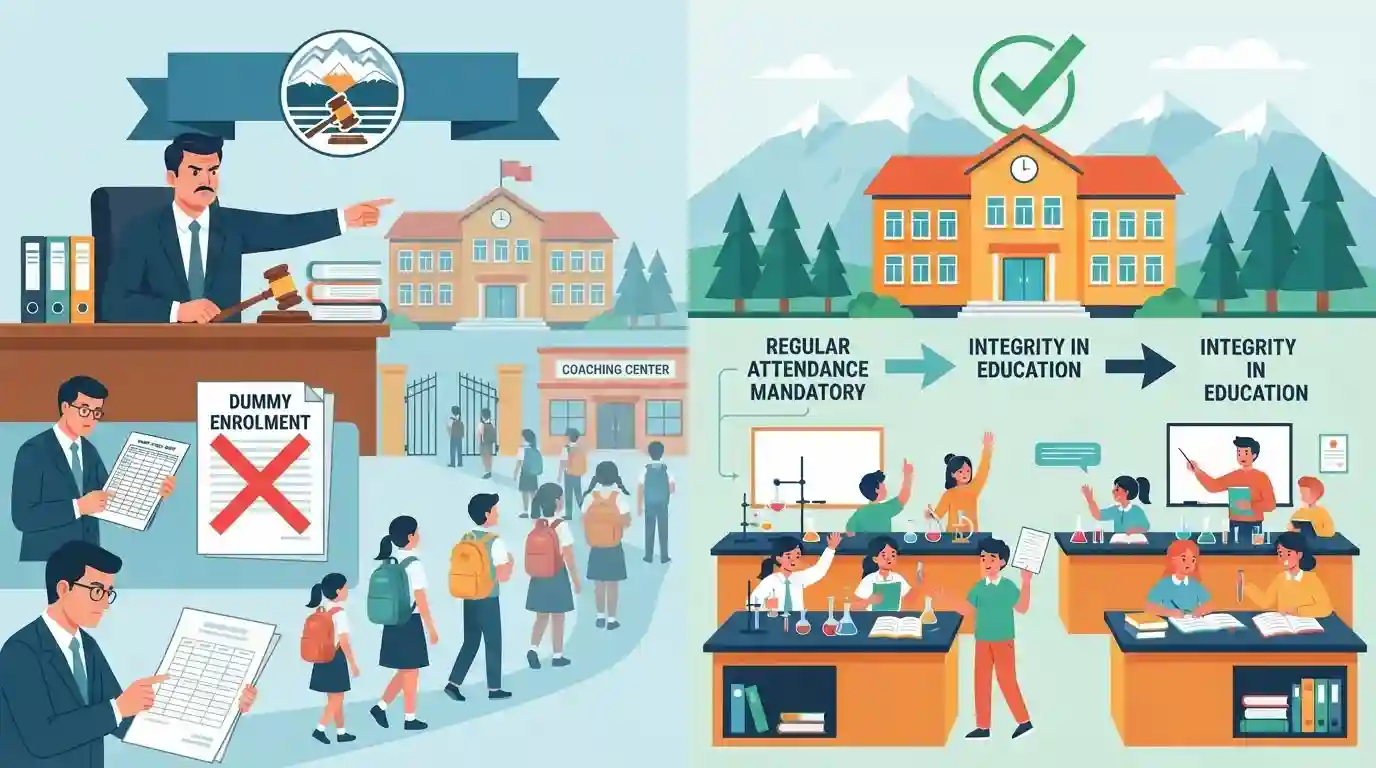
The crackdown on dummy admissions is a significant regulatory intervention to tackle the commercialized coaching culture bypassing formal schooling. It highlights the state's efforts to preserve the integrity of academic attendance, secondary education standards, and institutional accountability under state education boards.
Summary
The Himachal Pradesh Board of School Education (HPBOSE) has cracked down on 'dummy admissions' across affiliated schools, warning that enrolling students merely on paper to let them sit for exams without regular attendance is unacceptable. HPBOSE Chairman Dr. Rajesh Sharma directed schools to maintain exact attendance records and threatened strict regulatory action against violating institutions, addressing the growing trend of students bypassing regular classes to attend coaching centers.
Key Points
- The Himachal Pradesh Board of School Education (HPBOSE) has issued a stern warning against the practice of dummy admissions/paper enrolments in all affiliated schools.
- HPBOSE Chairman Dr. Rajesh Sharma stated that enrolling students purely on paper to boost enrolment statistics or to permit them to sit for board examinations while bypassing regular classes is unacceptable.
- School managements and principals have been directed to maintain up-to-date, accurate records of actual student physical attendance and academic engagement.
- The warning comes amid rising concern over students taking dummy admissions in schools to stay away from regular classes while preparing for competitive exams at coaching institutes.
- Any educational institution or exam centre found violating these norms after investigation will face strict disciplinary and regulatory action under the board’s guidelines.
Important Terms
Himachal Pradesh Board of School Education (HPBOSE)

The state agency established in 1969, headquartered in Dharamshala, responsible for prescribing curricula, textbooks, and conducting examinations for schools in Himachal Pradesh.
UPSC context
HPAS GS-II (Social Sector/Education); tests state-level educational governance, state administration, and regulatory frameworks.
Dummy Admissions
The practice of enrolling students in formal schools on paper only, allowing them to bypass mandatory attendance to attend competitive exam coaching classes.
UPSC context
HPAS GS-II (Issues in Education); tests understanding of regulatory loopholes, school attendance compliance, and education quality.
Shadow Education
Private supplementary tutoring operating outside the formal education system, replicating school curricula and consuming substantial household out-of-pocket expenditure.
UPSC context
HPAS GS-II (Social Sector/Education); tests commercialization of schooling, learning inequalities, and coaching industry regulation.
Enrolment Integrity
The administrative and ethical standard of ensuring school attendance records and registrations represent genuinely participating and regularly attending students.
UPSC context
HPAS GS-II (Governance and Public Policy); tests administrative oversight, institutional accountability, and policy enforcement.
Prelims Trap
HPBOSE directives against dummy admissions apply uniformly to all private and public schools operating in Himachal Pradesh, including CBSE-affiliated schools.
HPBOSE's regulatory jurisdiction and directives apply strictly to HPBOSE-affiliated institutions. Central boards (CBSE/ICSE) operating within Himachal Pradesh are governed by their respective national boards, not HPBOSE.
Static Concepts Connected
What is the statutory background and administrative history of HPBOSE?
- Origin and Act: Established in 1969 under the Himachal Pradesh Board of School Education Act, 1968.
- Headquarters shift: Initially established in Shimla, the board's headquarters were shifted to Dharamshala in January 1983.
- Primary mandate: Acts as the premier state agency to prescribe syllabi, courses of instruction, and conduct board examinations across Himachal Pradesh.
How does the National Education Policy (NEP) 2020 address the school-coaching divide?
- Exam reforms: Proposes transforming board exams to test conceptual clarity rather than rote learning, thereby discouraging the parallel coaching industry.
- Regulatory body: Recommends setting up an independent State School Standards Authority (SSSA) to regulate school operational transparency and prevent commercialization.
Cross-Topic Patterns
Shadow Education & Right to Education
The growth of dummy admissions highlights the conflict between 'shadow education' (coaching centers) and the RTE Act's mandate of holistic, institutionalized school-level learning.
State Education Reforms & Regulators
Strict HPBOSE affiliation norms align with state efforts to regulate private education, echoing the mandate of the HP Private Educational Institutions Regulatory Commission (HPPEIRC) at the higher-education level.

Mains GS-I/II HP-specific questions may ask to analyze the challenges of the 'coaching-school nexus' on the state's literacy quality.
Linked PYQs · 3
Linked PYQs · 3
- 2017HPAS_PRELIMSGS1
To improve the Gross Enrolment Ratio (GER) in Higher Education the Government of H.P. has adopted 'Rashtriya Uchtar Shikha Abhiyan' the centrally sponsored scheme in the year :
- 2016HPAS_PRELIMSGS1
As per Census 2011, literacy rate in Himachal Pradesh for male and female respectively is :
- 2025HPAS_PRELIMSGS1
Consider the following statements regarding public finance of Himachal Pradesh : (1) According to Budget Estimate for the year 2024-25, share of revenue expenditure out of total expenditure is around 80 percent. (2) Debt as a percentage of GSDP reached 75.33 during the year 2022-23. (3) State's own tax revenue as a percentage of total revenue for the year 2024-25 (BE) increased to 27.4. (4) During FY 2024-25 (BE) education and health sector were allocated Rs. 9995 and Rs. 8575 crores respectively. Choose the correct answer from the options given below :
