CBG Pricing Framework and Price Pooling Mechanism for Energy Security
Source:The Hindu ↗
কেন এটি গুরুত্বপূর্ণ
This article highlights a critical governance and public policy technique: how governments can bridge the cost gap of clean-energy transitions (which are typically more expensive in their initial phases) using innovative cost-pooling and targeted subsidies without causing localized inflation for end-consumers. This is extremely relevant for Mains GS3 (Energy, Infrastructure, Subsidies) and GS2 (Government Policies and Interventions).
সারসংক্ষেপ
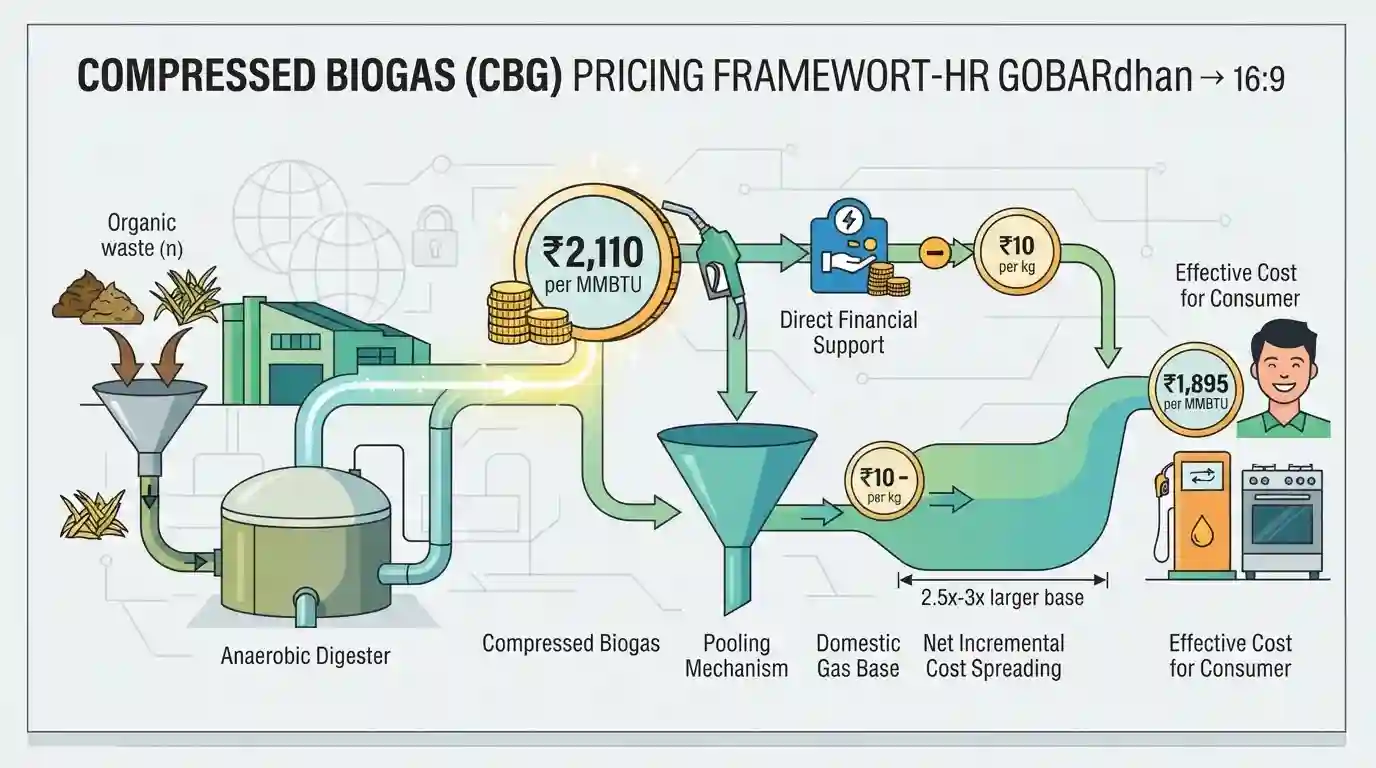
The Union Petroleum Ministry clarified that the revised offtake pricing framework for Compressed Biogas (CBG) under the GOBARdhan scheme secures the financial sustainability of CBG plants without raising fuel prices for consumers [1.1]. While the official CBG offtake price has been set at ₹2,110 per MMBTU, the government has cushioned the consumer impact using two key strategies: a direct financial support of ₹10 per kg of CBG (reducing the effective cost to ₹1,895 per MMBTU), and a pooling mechanism that spreads the net incremental cost across a domestic gas base that is 2.5 to 3 times larger than the previous base [1.1].
মূল বিষয়
- The Union Cabinet in August 2026 approved a CBG offtake price of ₹2,110 per MMBTU under the GOBARdhan scheme to make biogas plants commercially viable.
- To cushion consumers, the government will provide an affordability cushion of ₹10 per kg of CBG (about ₹215 per MMBTU for CBG with 95% methane content).
- This direct government support effectively reduces the net cost of CBG to ₹1,895 per MMBTU, representing a 28% increase over the previous price of ₹1,478 per MMBTU.
- To prevent a direct price hike on city-gas consumers, the incremental cost of CBG is blended and pooled within the wider domestic natural gas pool.
- The cost-pooling base has been expanded 2.5 to 3 times compared to the earlier framework (which was confined only to APM gas for CNG/PNG), rendering the final retail price impact negligible.
গুরুত্বপূর্ণ শব্দ
GOBARdhan Scheme

Galvanizing Organic Bio-Agro Resources Dhan; a flagship national circular bioenergy scheme that converts organic waste, like cattle dung and agricultural residues, into compressed biogas and organic manure.
UPSC context
GS Paper III (Energy & Environment); tests understanding of waste-to-wealth, circular economy, and renewable energy policies.
SATAT (Sustainable Alternative Towards Affordable Transportation)
Sustainable Alternative Towards Affordable Transportation; an initiative launched in 2018 to establish Compressed Biogas production plants and promote it as an alternative, clean transport fuel.
UPSC context
GS Paper III (Infrastructure & Energy Security); evaluates strategies for reducing fossil fuel imports, curbing emissions, and utilizing agricultural waste.
Compressed Biogas (CBG)
A purified and compressed biofuel derived from organic wastes (e.g., animal dung, crop residue) with over 90% methane content, chemically identical to conventional CNG.
UPSC context
GS Paper III (Renewable Energy/Climate Change); tests clean energy resources, circular bioeconomy, and national fuel blending targets.
Union Petroleum Ministry
The Indian ministry responsible for the exploration, production, distribution, marketing, and conservation of petroleum, natural gas, petroleum products, and liquefied natural gas.
UPSC context
GS Paper II (Government Policies & Ministries); assesses administrative execution of energy infrastructure, pricing frameworks, and fuel blending mandates.
Union Cabinet
The supreme executive decision-making body of the Government of India, consisting of the Prime Minister and cabinet-rank ministers, which approves major national policies and financial outlays.
UPSC context
GS Paper II (Polity & Governance); tests understanding of executive authority, cabinet decision-making processes, and constitutional provisions.
প্রিলিমস ফাঁদ
The National Circular Bioenergy Scheme (GOBARdhan) is implemented by the Ministry of Jal Shakti.
While GOBARdhan was originally launched by the Ministry of Jal Shakti, the newly restructured 10-year National Circular Bioenergy Scheme is under the Ministry of Petroleum and Natural Gas (MoPNG).
সংযুক্ত স্থির ধারণা
How does Compressed Biogas (CBG) differ chemically and operationally from CNG?
- Source and renewability: CNG is a finite geological fossil fuel, whereas CBG is a renewable fuel produced via anaerobic digestion of agricultural and organic waste.
- Chemical composition equivalence: Once purified to contain over 90% methane, CBG has the same calorific value and chemical properties as CNG, making them fully interchangeable.
What is India's Administered Price Mechanism (APM) gas pooling?
- Regulated pricing: APM refers to government-allocated domestic natural gas priced below market rates for priority sectors like fertilizer plants and city gas networks.
- Pooling mechanism: It aggregates cheaper domestic APM gas with costlier imported LNG to provide a weighted average price, cushioning retail consumers from extreme global volatility.
আন্তঃবিষয় প্যাটার্ন
CBG pricing vs Crop Residue Management
Remunerative CBG pricing incentivizes commercial biomass collection, directly mitigating North India's seasonal stubble burning crisis by transforming agricultural waste into energy assets.
Biogas mandate vs Balance of Payments
Mandatory CBG blending obligations substitute expensive, imported liquefied natural gas (LNG), preserving forex reserves and reducing vulnerability to external energy price shocks.

Statements on the 2026 GOBARdhan nodal ministry (MoPNG), mandatory blending targets, and pricing cushion are highly probable.
সংযুক্ত PYQ · 4
সংযুক্ত PYQ · 4
- 2020PrelimsGS1
According to India's National Policy on Biofuels, which of the following can be used as raw materials for the production of biofuels ? 1. Cassava 2. Damaged wheat grains 3. Groundnut seeds 4. Horse gram 5. Rotten potatoes 6. Sugar beet Select the correct answer using the code given below:
- 2022MainsGS3
Do you think India will meet 50 percent of its energy needs from renewable energy by 2030 ? Justify your answer. How will the shift of subsidies from fossil fuels to renewables help achieve the above objective ? Explain.
- 2025PrelimsGS1
Consider the following statements : Statement I: Circular economy reduces the emissions of greenhouse gases. Statement II: Circular economy reduces the use of raw materials as inputs. Statement III : Circular economy reduces wastage in the production process. Which one of the following is correct in respect of the above statements?
- 2023MainsGS3
Discuss several ways in which microorganisms can help in meeting the current fuel shortage.
