Punjab Government Assures Imminent Appointment of State Lokpal
Source:Indian Express ↗
Why It Matters
The functioning and timely appointment of anti-corruption bodies like the Lokpal and Lokayukta are key themes in UPSC GS-2. Understanding the institutional delays and the statutory framework governing these bodies helps aspirants analyze issues related to transparency, accountability, and state-level governance.
Summary
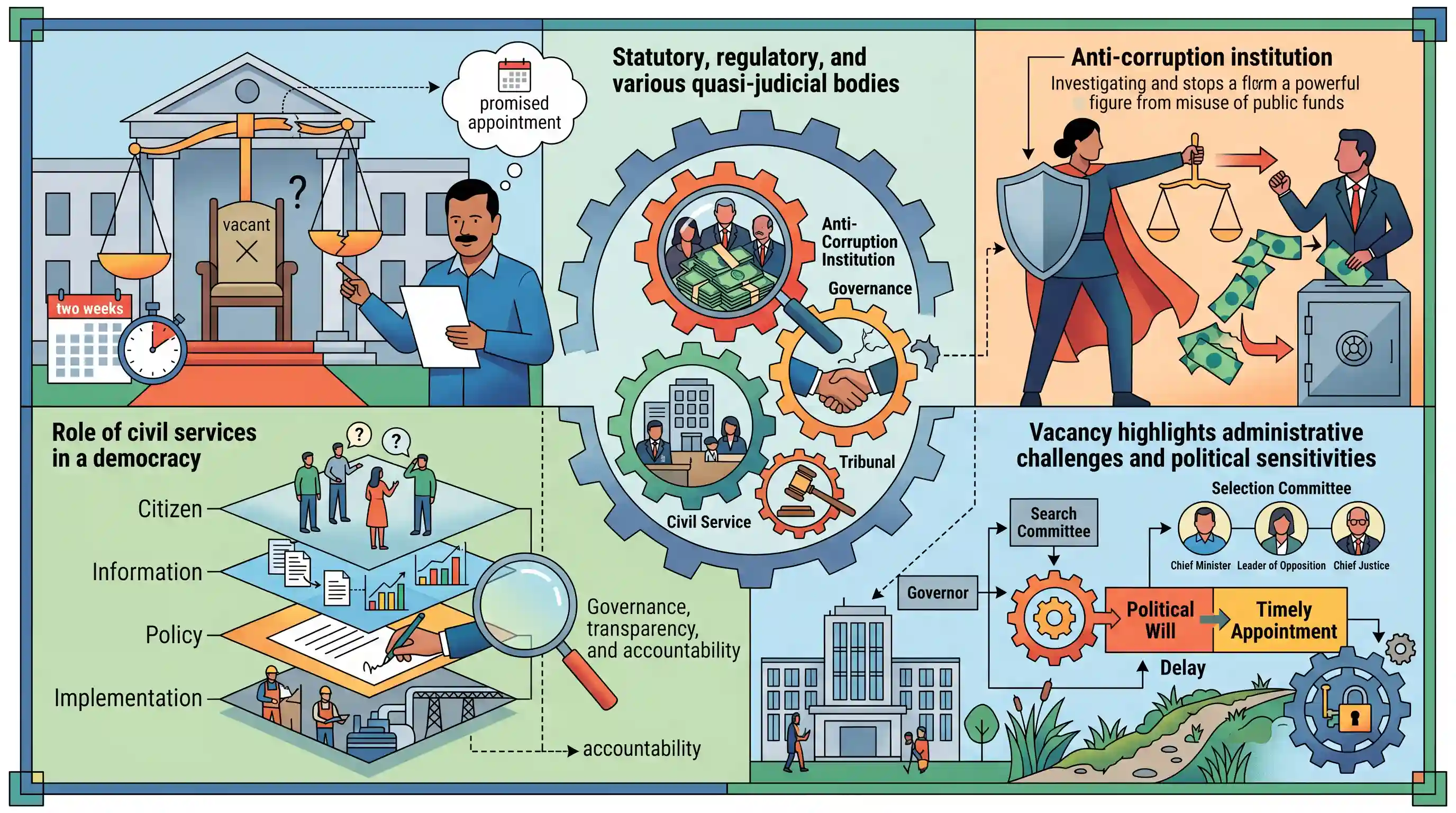
The Punjab government, led by the Aam Aadmi Party (AAP), has been operating without a state Lokpal for two weeks. While the government defended the relatively short delay and promised an imminent appointment, the vacancy highlights the administrative challenges and political sensitivities surrounding the timely appointment of anti-corruption ombudsmen. The Lokpal/Lokayukta institution is crucial for maintaining public accountability and investigating corruption at the highest levels of state governance.
Key Points
- The state of Punjab has been functioning without a Lokpal for the past two weeks following a vacancy.
- The ruling Aam Aadmi Party (AAP) has defended the timeline, stating that the delay is less than 15 days and assuring a swift appointment.
- The situation underscores the broader national issue of delays in filling vacancies in crucial anti-corruption and oversight bodies.
- A functional Lokpal/Lokayukta is essential to ensure accountability, investigate corruption allegations against public officials, and maintain administrative transparency at the state level.
Important Terms
Lokpal and Lokayuktas Act, 2013

A 2013 landmark legislation mandating the establishment of a central 'Lokpal' and state-level 'Lokayuktas' to investigate corruption allegations against public functionaries, including the Prime Minister and ministers.
UPSC context
GS Paper II: Statutory bodies and anti-corruption laws; essential for questions on institutional frameworks for accountability.
Lokayukta
The state-level anti-corruption ombudsman established under the 2013 Act to inquire into complaints against state ministers, legislators, and civil servants. In Punjab, this office is specifically named 'Lokpal'.
UPSC context
GS Paper II: Important aspects of governance; tests knowledge of state-level transparency mechanisms and their autonomy.
Ombudsman
An independent official appointed to investigate individuals' complaints against maladministration or corruption by public authorities. The Swedish concept (1809) is the global precursor to India's Lokpal system.
UPSC context
GS Paper II: Governance; tests the theoretical and historical foundations of public grievance redressal mechanisms.
Statutory Body
A non-constitutional body created by an Act of Parliament or State Legislature. Lokayuktas are statutory, meaning their powers and existence derive from specific laws rather than the Constitution.
UPSC context
GS Paper II: Regulatory and quasi-judicial bodies; tests classification and constitutional vs. legal standing of institutions.
Transparency and Accountability
Fundamental principles of good governance where 'transparency' ensures open decision-making and 'accountability' mandates that public officials remain answerable to the citizens for their actions.
UPSC context
GS Paper II: Governance; core themes for Mains ethics (GS IV) and governance (GS II) case studies.
Public Interest Litigation (PIL)
A legal mechanism allowing individuals or groups to file a petition in High Courts or the Supreme Court for the protection of public interest or constitutional rights.
UPSC context
GS Paper II: Judicial activism; used to challenge administrative delays like the vacancy in the Punjab Lokpal office.
Prelims Trap
The Lokpal and Lokayuktas Act, 2013 establishes a uniform structure and jurisdiction for Lokayuktas across all states.
The 2013 Act mandates setting up Lokayuktas but leaves their structure, jurisdiction, and powers—including whether to include the Chief Minister—entirely to the discretion of state legislatures.
Static Concepts Connected
How is the Lokayukta appointed and what is its typical jurisdiction?
- Appointment Process: Appointed by the state Governor, usually after mandatory consultation with the Chief Justice of the State High Court and the Leader of the Opposition in the assembly.
- State-Level Variations: Jurisdiction is not uniform across India. State legislatures determine the scope, meaning bodies like the Chief Minister's office are included in some states but excluded in others.
- Historical Origin: The First Administrative Reforms Commission (1966-70) recommended the institution. Maharashtra was the first state to establish it in 1971.
What are the key exemptions for the Prime Minister under the central Lokpal's jurisdiction?
- General Inclusion: The PM is broadly under the Lokpal's purview, unlike several state Chief Ministers who are excluded from their respective Lokayuktas.
- Specific Exemptions: Corruption allegations related to international relations, external/internal security, public order, atomic energy, and space are exempt from inquiry.
- Procedural Safeguards: Any inquiry against the PM requires the approval of a full Lokpal bench (at least two-thirds majority) and proceedings must be held in camera.
Cross-Topic Patterns
Asymmetric Anti-Corruption Architecture
The lack of a uniform Lokayukta model across states reflects India's federal structure, where states retain legislative autonomy over administrative vigilance and oversight mechanisms.
Institutional Vacancies & Accountability
Delays in Lokayukta appointments mirror the broader crisis of vacancies in tribunals, the CIC, and human rights commissions, collectively weakening the statutory architecture for public accountability.

Expect a multi-statement prelims question on Lokpal vs Lokayukta jurisdictions, emphasizing state-level non-uniformity and PM exemptions.
Linked PYQs · 1
Linked PYQs · 1
- 2025PrelimsGS1
Consider the following statements about Lokpal: I. The power of Lokpal applies to public servants of India, but not to the Indian public servants posted outside India. II. The Chairperson or a Member shall not be a Member of the Parliament or a Member of the Legislature of any State or Union Territory, and only the Chief Justice of India, whether incumbent or retired, has to be its Chairperson. III. The Chairperson or a Member shall not be a person of less than forty-five years of age on the date of assuming office as the Chairperson or Member, as the case may be. IV. Lokpal cannot inquire into the allegations of corruption against a sitting Prime Minister of India. Which of the statements given above is/are correct?
