US Domestic Protests and Foreign Policy Intersection in Midterms
Source:Indian Express ↗
Why It Matters
The stability of the United States and its foreign policy decisions directly impact global markets, international security, and regional stability in the Middle East. Understanding the dynamics of US domestic protests provides insight into the health of democratic institutions, comparative constitutionalism, and the role of civil society in checking executive power.
Summary
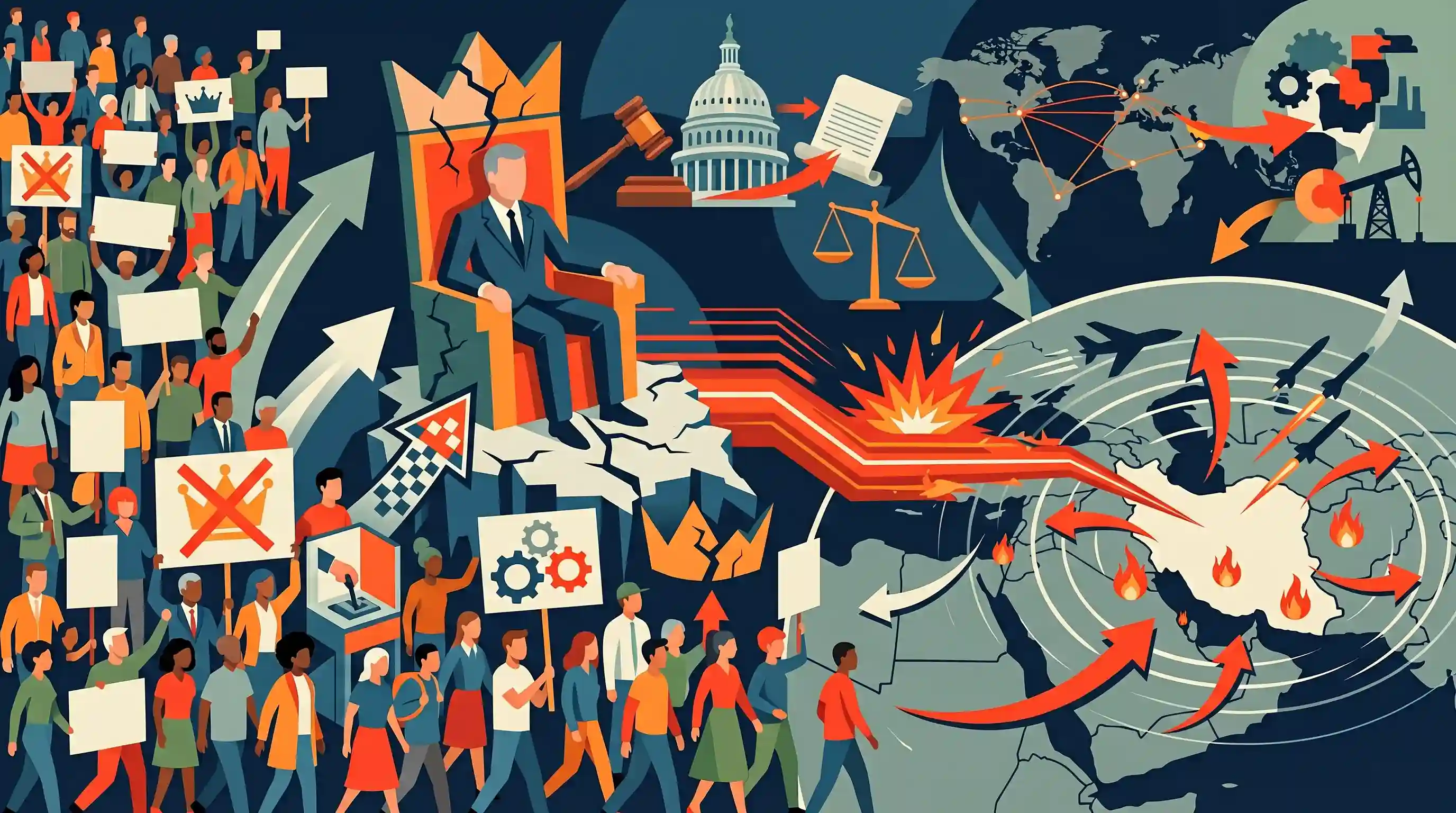
The article explores the context and significance of the "No Kings" protests in the United States, where approximately 9 million citizens are mobilizing against President Donald Trump ahead of the 2026 midterm elections. Driven by concerns over potential executive overreach and democratic backsliding, the civil unrest is heavily intensified by an ongoing conflict with Iran. This development highlights the deep interconnection between US domestic politics, civil society activism, and foreign policy, with significant implications for both American democratic institutions and Middle Eastern geopolitical stability.
Key Points
- An estimated 9 million Americans are participating in the 'No Kings' protests against President Donald Trump.
- The protests are framed as a defense of democratic institutions against perceived executive overreach ahead of the 2026 US midterm elections.
- A concurrent geopolitical crisis involving a US conflict with Iran is a significant driver of the domestic unrest.
- The situation highlights the profound impact that foreign policy decisions and international conflicts can have on domestic civil society mobilization and electoral politics.
Prelims Trap
"Like the US President, the Indian Prime Minister enjoys absolute immunity from criminal proceedings for official acts."
Article 361 grants immunity from criminal proceedings only to the President and Governors. The Prime Minister, as head of government, enjoys no such absolute immunity.
Static Concepts Connected
How do the pardoning powers of the US and Indian Presidents differ?
- Council of Ministers: The Indian President acts on the aid and advice of the Council of Ministers (Article 74), whereas the US President exercises pardoning power at their absolute discretion.
- Pre-emptive Pardons: The US President can pardon individuals pre-emptively before formal charges are even filed, a vast discretionary power completely absent in the Indian constitutional framework.
What is the strategic and economic significance of the Strait of Hormuz?
- Crucial Chokepoint: It links the Persian Gulf to the Arabian Sea, serving as the transit point for nearly 20% of global petroleum consumption and a third of seaborne oil.
- India's Vulnerability: A majority of India's crude oil imports traverse this strait. Any US-Iran conflict disruption directly threatens India's energy security and drives imported inflation.
Cross-Topic Patterns
Comparative executive accountability
The 'No Kings' protest, driven by SCOTUS immunity rulings, serves as a prime comparative constitution case study when contrasted with India's parliamentary checks on the Head of Government.
Energy security + Monetary policy
West Asian instability around the Strait of Hormuz threatens crude supplies, directly stressing India's Current Account Deficit (CAD) and complicating the RBI's inflation-targeting framework.

Expect a comparative constitution Mains question contrasting US Presidential discretionary powers and immunity with the Indian framework.
Linked PYQs · 3
Linked PYQs · 3
- 2025MainsGS2
Compare and contrast the President's power to pardon in India and in the USA. Are there any limits to it in both the countries? What are 'preemptive pardons'?
- 2025MainsGS2
Civil Society Organizations are often perceived as being anti-State actors than non-State actors. Do you agree? Justify.
- 2025MainsGS2
"The reform process in the United Nations remains unresolved, because of the delicate imbalance of East and West and entanglement of the USA vs. Russo-Chinese alliance.” Examine and critically evaluate the East-West policy confrontations in this regard.
