US Civil Society Protests and Executive Power Accountability
Source:Indian Express ↗
Why It Matters
The event is a prominent example of civil society mass mobilization serving as a check on executive power and expressing dissent in a mature democracy. It provides a contemporary context for understanding the US constitutional scheme, the limits of presidential power, and the dynamics of political polarization, which are relevant to GS Paper 2 topics on comparative constitutions and the role of civil society.
Summary
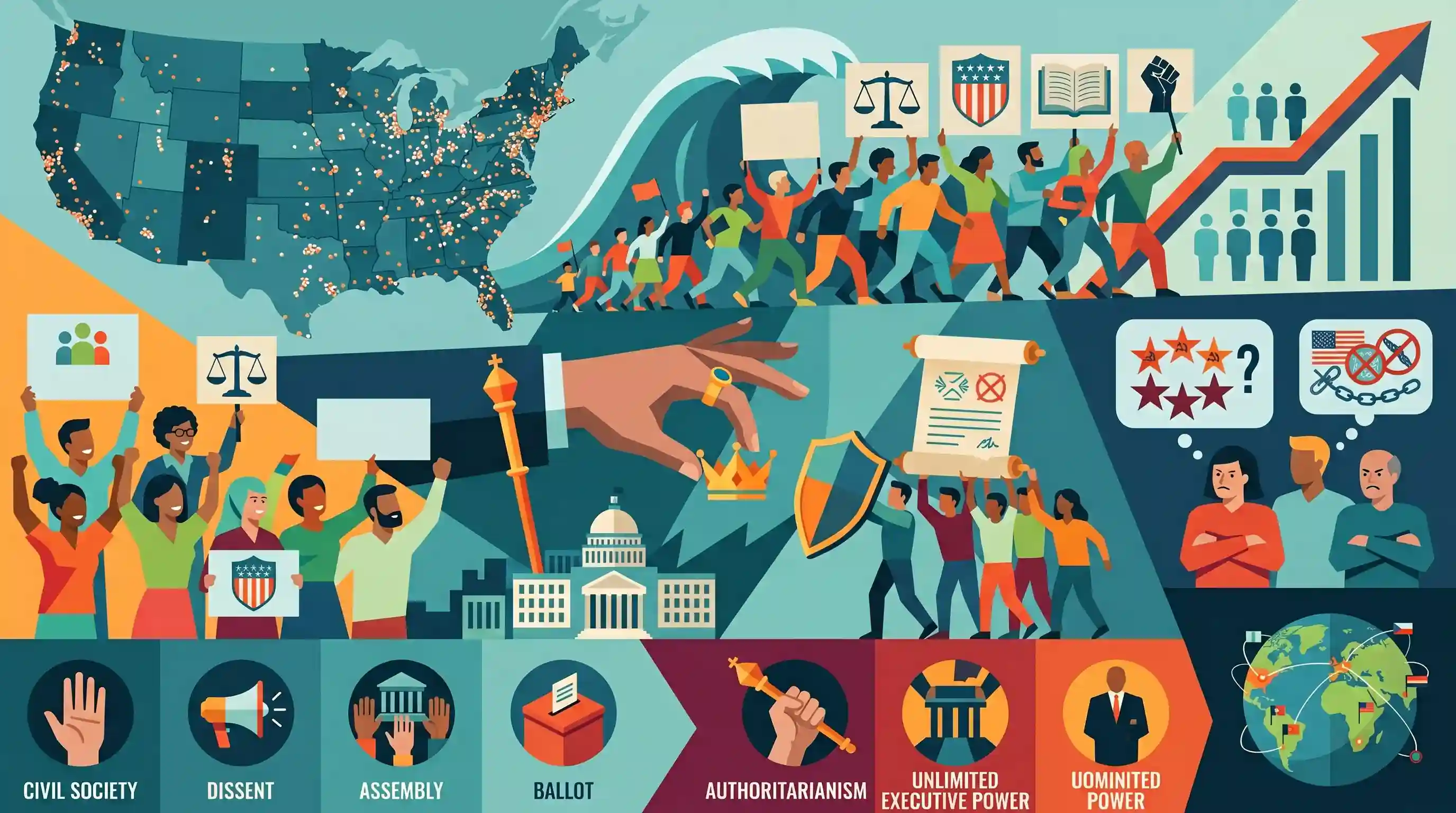
The 'No Kings' protests have mobilized millions across the United States in over 2,600 locations against President Donald Trump. Driven by concerns over perceived authoritarianism and a threat to democratic institutions, the rallies reflect deep political polarization. While organizers and Democratic leaders portray the movement as a necessary stand for constitutional values and civil liberties amidst an 18-day government shutdown, Republican officials have dismissed them as anti-American and Marxist-driven. The situation highlights the critical role of civil society and mass mobilization in expressing dissent and the broader debates surrounding executive power and constitutional morality in a democracy.
Key Points
- Millions of Americans are participating in the 'No Kings' protests across more than 2,600 locations, marking the third major mobilization since Donald Trump returned to the White House.
- Protesters and Democratic leaders frame the demonstrations as a defense of democracy, constitutional values, and civil liberties against perceived authoritarian overreach by the President.
- The protests coincide with an ongoing government shutdown, which has entered its 18th day, exacerbating political polarization and governance challenges.
- Republican leaders have strongly condemned the rallies, labeling them as 'Hate America' events driven by 'Marxists' and 'antifa types'.
Important Terms
Constitutional Morality

Adherence to the core principles and democratic values of a Constitution (like liberty and justice) rather than just its literal text, ensuring inclusive and ethical governance.
UPSC context
GS II (Constitution); tests the ability to interpret the spirit of democracy and judicial interpretations beyond literal law.
Civil Society
The collective of non-governmental organizations, social movements, and citizen groups that operate independently to influence policy, protect rights, and hold the government accountable.
UPSC context
GS II (Governance); essential for understanding the role of non-state actors in strengthening democracy and participatory governance.
Separation of Powers
A constitutional doctrine that divides government responsibilities into distinct branches (Executive, Legislative, Judicial) to provide checks and balances and prevent the concentration of absolute power.
UPSC context
GS II (Comparison of Schemes); foundational for comparing the US Presidential system with India’s Parliamentary model and its 'fused' executive.
Executive Power
The legal authority held by a head of government to enforce laws and manage administration; in the US, this power is concentrated in the President.
UPSC context
GS II (Comparison of Schemes); tests differences between the real executive (US President) and the nominal/real executive split in India.
Congress (US)
The bicameral federal legislature of the United States, comprising the House of Representatives and the Senate, responsible for law-making and providing a check on the executive.
UPSC context
GS II (Comparison of Schemes); tests understanding of legislative independence and the bicameral structure in a federal presidential republic.
Democratic Party (US)
One of the two major US political parties, typically advocating for social equality, liberal values, and government intervention in economic and social welfare programs.
UPSC context
GS II (International Affairs/Comparison); provides context for global political polarization and ideological comparisons in democratic party systems.
Republican Party (US)
A major US political party that generally supports conservative social values, free-market capitalism, and limited federal government intervention in the economy.
UPSC context
GS II (International Affairs/Comparison); relevant for analyzing the impact of conservative ideologies on constitutional and executive power debates.
Prelims Trap
"A government shutdown in the USA forces the executive to resign, similar to the defeat of a money bill in India."
In the US presidential system, strict separation of powers allows the President to survive appropriation failures, leading only to a 'shutdown', not resignation.
Static Concepts Connected
How does financial accountability differ between US and Indian constitutional schemes?
- Parliamentary Confidence: In India, the defeat of a budget or money bill implies a loss of legislative confidence, forcing the Council of Ministers to resign.
- Presidential Survival: In the USA, failure by Congress to pass appropriation bills causes a 'government shutdown,' but the President remains in office due to strict separation of powers.
What is 'Constitutional Morality' in the context of democratic governance?
- Beyond Legal Text: It demands adherence to the core ethical philosophy and spirit of the Constitution, rather than merely obeying its literal, legal text.
- Check on Power: Championed by B.R. Ambedkar, it serves as a behavioral check on high functionaries, ensuring they do not misuse their mandates for authoritarian executive overreach.
Cross-Topic Patterns
Civil society as anti-state adversaries
The political labeling of US protesters mirrors India's FCRA debates, where civil society organizations engaging in advocacy are often perceived as 'anti-state' adversaries rather than essential democratic watchdogs.
US shutdowns and Indian economic interests
An extended US government shutdown delays federal contracting and visas, which can stall India's IT sector exports and postpone bilateral investment agreements.

Expect a 2026 Prelims statement contrasting US government shutdowns with India's parliamentary rules on the defeat of appropriation bills.
Linked PYQs · 3
Linked PYQs · 3
- 2025MainsGS2
Civil Society Organizations are often perceived as being anti-State actors than non-State actors. Do you agree? Justify.
- 2025MainsGS2
Compare and contrast the President's power to pardon in India and in the USA. Are there any limits to it in both the countries? What are 'preemptive pardons'?
- 2025MainsGS2
"Constitutional morality is the fulcrum which acts as an essential check upon the high functionaries and citizens alike...." In view of the above observation of the Supreme Court, explain the concept of constitutional morality and its application to ensure balance between judicial independence and judicial accountability in India.
