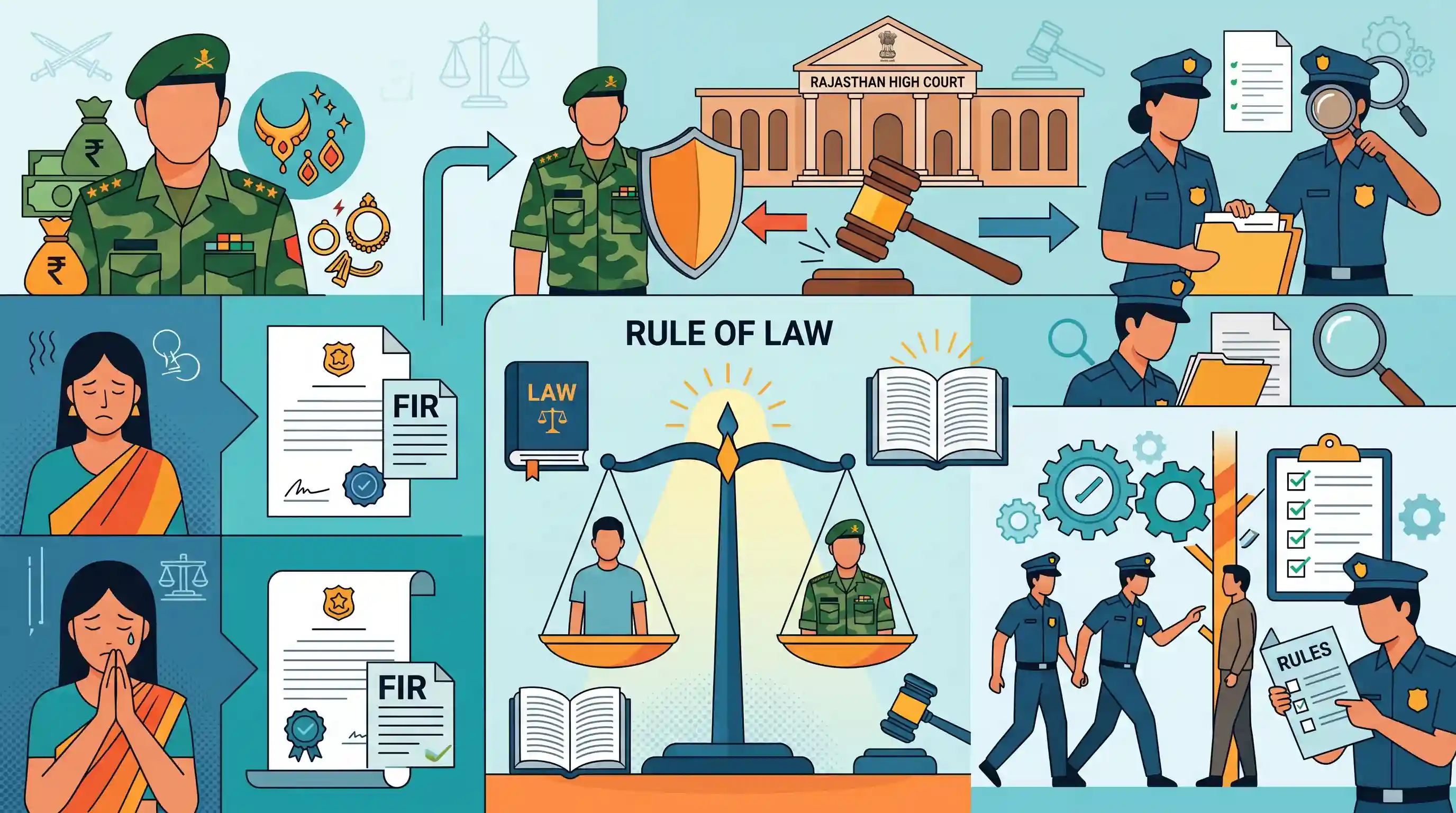
Military rank offers no immunity from criminal prosecution rules court
Source:Indian Express ↗
Why It Matters
This ruling highlights the foundational democratic principle of equality before the law, demonstrating that social or professional status cannot shield individuals from accountability in cases of gender-based violence. It also underscores the practical application of Supreme Court guidelines (like Arnesh Kumar) to balance victims' rights with safeguards against arbitrary arrest in matrimonial disputes.
Summary
The Rajasthan High Court dismissed a plea by an Indian Army Major to quash an FIR alleging dowry harassment, firmly stating that military rank offers no immunity from criminal prosecution. The FIR, filed under the Bharatiya Nyaya Sanhita (BNS) and the Dowry Prohibition Act, was upheld despite a nine-month delay in the complaint. Emphasizing the rule of law, the court allowed the investigation to continue but provided limited protection against arbitrary arrest by mandating that police strictly follow the Supreme Court's Arnesh Kumar guidelines for offences carrying less than a seven-year sentence.
Key Points
- The Rajasthan High Court ruled that a military rank does not confer immunity against criminal investigations, reaffirming the principle of equality before the law.
- The court refused to quash an FIR for dowry harassment against an Indian Army Major, rejecting the argument that a nine-month delay in filing invalidated the case.
- The FIR was registered under the Bharatiya Nyaya Sanhita (BNS) and the Dowry Prohibition Act.
- While allowing the probe to proceed, the court granted limited protection against automatic arrest by directing police to adhere to the Supreme Court's Arnesh Kumar guidelines for offences punishable by less than seven years imprisonment.
Important Terms
Bharatiya Nyaya Sanhita (BNS)

India's new penal code replacing the 1860 Indian Penal Code. It modernizes the criminal justice system, introducing community service and specific chapters for crimes against women and children.
UPSC context
GS Paper II (Governance/Social Justice). Tests knowledge of criminal law reforms and legislative shifts from colonial-era codes.
Dowry Prohibition Act, 1961
A 1961 law prohibiting the giving, taking, or demanding of dowry. It aims to eliminate social evils and financial exploitation associated with marriages in India.
UPSC context
GS Paper I (Social Issues) & II (Social Justice). Relevant for topics on gender justice and women's rights.
Arnesh Kumar Guidelines
Mandates that police must not automatically arrest individuals for offenses punishable by less than seven years' imprisonment. It requires written justification and judicial satisfaction before detention.
UPSC context
GS Paper II (Judiciary). Tests understanding of procedural safeguards, individual liberty, and checks on police power.
Rule of Law
The constitutional principle that every citizen is subject to the same laws, regardless of rank, status, or profession. It prevents arbitrary exercise of power.
UPSC context
GS Paper II (Polity). A core pillar of the Constitution; tests concept-based understanding of equality before law (Article 14).
Military Immunity
Legal protection for personnel against prosecution for acts done in the discharge of 'official duties' (under CrPC/AFSPA), which does not extend to personal criminal acts.
UPSC context
GS Paper II (Judiciary/Governance). Tests nuances of legal accountability for public servants and the scope of sovereign immunity.
Prelims Trap
Offences committed by military personnel can only be tried by Courts-Martial or the Armed Forces Tribunal.
Military personnel are subject to regular criminal courts for non-military and civil offences. The Armed Forces Tribunal handles service matters, not general civilian criminal cases.
Static Concepts Connected
What is the jurisdiction of the Armed Forces Tribunal (AFT)?
- Establishment: Created under the Armed Forces Tribunal Act, 2007 (empowered by Article 323A) to provide a dedicated judicial forum for military personnel.
- Core Mandate: Adjudicates disputes regarding commission, appointments, enrolment, and conditions of service for the Army, Navy, and Air Force.
- Jurisdictional Limits: Lacks jurisdiction over general criminal offences (like dowry harassment or civilian murder); regular criminal courts retain exclusive jurisdiction over these.
What are the core directives of the Arnesh Kumar guidelines?
- Applicability: Applies to offences punishable with imprisonment of seven years or less (e.g., dowry harassment cases).
- Anti-Arbitrary Arrest: Police cannot automatically arrest the accused; they must justify it using a necessity checklist (now formalized under Section 35 of BNSS).
- Magistrate Oversight: Magistrates are forbidden from authorizing detention casually; they must rigorously review the police's justification checklist before remanding the accused.
Cross-Topic Patterns
BNS transition & marital cruelty
The shift from IPC 498A to BNS maintains marital cruelty as a core offense. Judicial precedents on FIR delays remain relevant for GS-2 Social Justice answers on women's rights and judicial process.
Reverse Burden of Proof exceptions
Like the PMLA, UAPA, and NDPS Act, the Dowry Prohibition Act shifts the burden of proof to the accused, raising recurring Article 21 debates in GS-2 Judiciary questions.

Expect a Prelims question testing regular courts vs. military tribunals' jurisdiction, paired with BNSS arrest rules for <7-year crimes.
Linked PYQs · 4
Linked PYQs · 4
- 2018PrelimsGS1
Which of the following are regarded as the main features of the "Rule of Law"? 1. Limitation of powers 2. Equality before law 3. People's responsibility to the Government 4. Liberty and civil rights Select the correct answer using the code given below:
- 2023MainsGS2
Explain the constitutional perspectives of Gender Justice with the help of relevant Constitutional Provisions and case laws.
- 2020MainsGS2
Judicial Legislation is antithetical to the doctrine of separation of powers as envisaged in the Indian Constitution. In this context justify the filing of large number of public interest petitions praying for issuing guidelines to executive authorities.
- 2014MainsGS1
How does patriarchy impact the position of a middle class working woman in India?
