Etawah and Mainpuri regional development projects by UP government
Source:hindustan-times ↗
Why It Matters
This article illustrates the linkage between strong law and order (governance) and regional economic development, particularly within Uttar Pradesh. For UPPSC candidates, state-level development projects, infrastructure investments, and government initiatives promoting traditional industries are critical components of the syllabus.
Summary
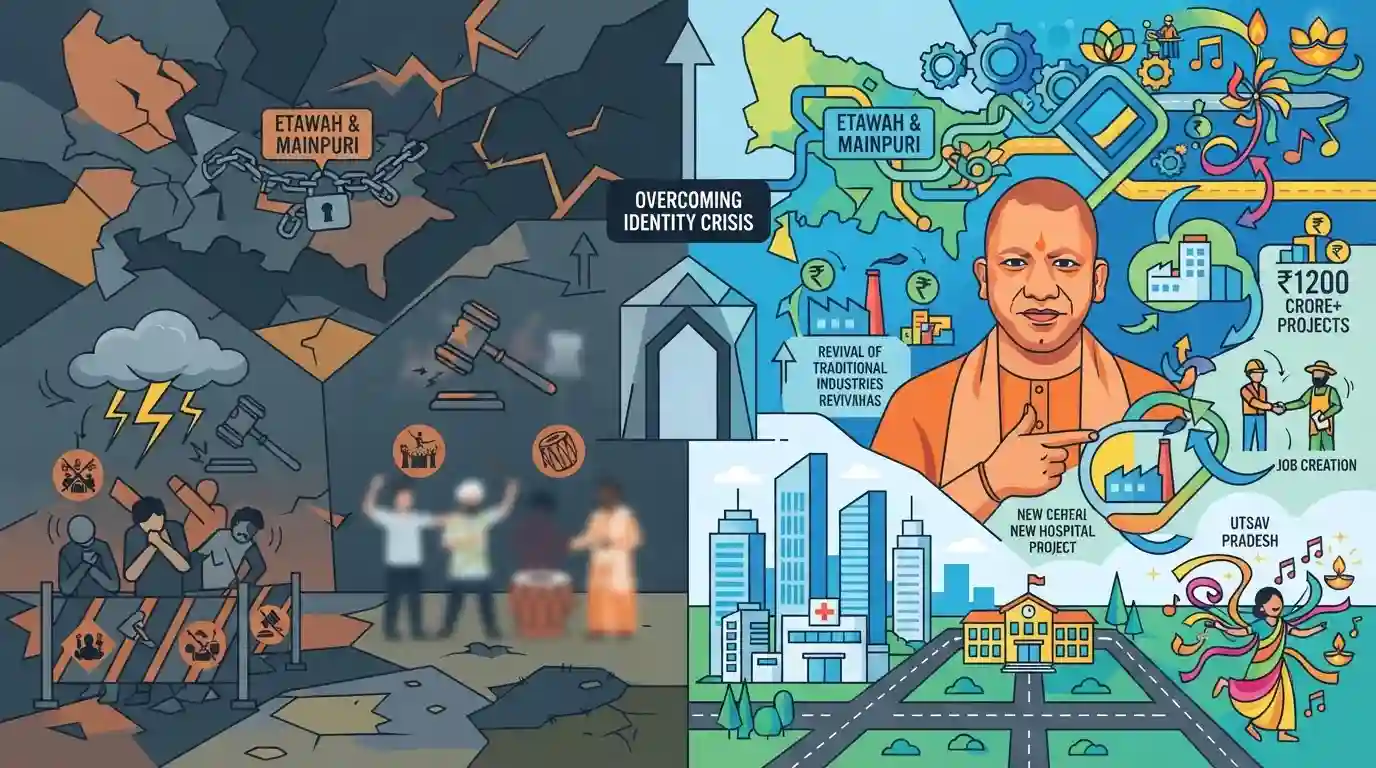
Uttar Pradesh Chief Minister Yogi Adityanath recently visited Etawah and Mainpuri to inaugurate and lay the foundation stones for various developmental projects totaling over ₹1,200 crore. In his address, he emphasized that the regions have successfully overcome their past 'identity crisis'—once characterized by fear and lawlessness—due to the state government's strict zero-tolerance policy against crime. Contrasting the current administration with the previous Samajwadi Party regime, Adityanath criticized the latter for corruption, poor law and order, and obstructing cultural events. He concluded by highlighting Uttar Pradesh's transformation into a peaceful 'Utsav Pradesh,' marked by significant infrastructure growth, revival of traditional industries, and extensive job creation.
Key Points
- UP Chief Minister Yogi Adityanath inaugurated and laid the foundation stones for development projects worth ₹604 crore in Etawah and ₹682 crore in Mainpuri/Karhal.
- The CM credited the BJP government's zero-tolerance policy towards crime for eliminating fear and an identity crisis previously associated with Etawah and Mainpuri.
- He asserted that UP has transformed from a state known for disturbances and curfews into an Utsav Pradesh (State of Festivals).
- Adityanath criticized the previous Samajwadi Party government for corruption, deteriorating law and order, and creating obstacles for religious events like the Kanwar Yatra.
- He highlighted the state's economic progress, including the revival of traditional industries and the creation of over nine lakh government jobs for the youth.
Important Terms
One District One Product (ODOP)

A scheme launched by the Uttar Pradesh government to promote micro, small and medium enterprises by identifying and supporting one signature product, such as traditional crafts, in each of the state's districts.
UPSC context
Relevant for GS Paper 2 (Government Policies) and GS Paper 3 (Economic Development, MSMEs). Tests knowledge of regional economic initiatives and employment generation.
Samajwadi Party
A major political party in India, particularly influential in Uttar Pradesh. Founded in 1992, it positions itself as a socialist party advocating for backward classes and minorities.
UPSC context
Relevant for GS Paper 2 (Indian Polity). Tests understanding of regional political dynamics, party systems, and state-level governance in India.
Bharatiya Janata Party (BJP)
One of the two major political parties in India, currently the ruling party at the national level and in several states, including Uttar Pradesh, espousing conservative and nationalist ideologies.
UPSC context
Relevant for GS Paper 2 (Indian Polity). Important for understanding the national political landscape, federal relations, and ruling party policies.
Prelims Trap
Mainpuri Tarkashi is a GI-tagged craft involving silver filigree work on metal sheets.
Mainpuri Tarkashi specifically involves inlaying brass, copper, or silver wire into a wooden base, distinct from Odisha's silver filigree (Chandi Tarkasi) which is metal-on-metal.
Static Concepts Connected
What is the "One District One Product" (ODOP) initiative and its governance structure?
- Origin & Objective: Launched by UP in 2018, later scaled nationally by DPIIT to preserve traditional crafts, generate local employment, and promote rural entrepreneurship.
- Integration with DEH: Integrated with the 'Districts as Export Hubs' initiative under the Foreign Trade Policy to resolve supply-chain bottlenecks and boost district-level exports.
What are the legal mechanisms for civil asset forfeiture and attachment under organized crime laws in India?
- Legal Mechanism: State-level anti-gangster laws allow attachment of properties acquired through organized crime, acting as deterrence by dismantling the economic base of criminal syndicates.
- Constitutional Balance: Property attachment must respect Article 300A (right to property) and follow strict judicial oversight to prevent arbitrary executive action.
Cross-Topic Patterns
GI Tags and Export Promotion
Linking local GI crafts like Mainpuri Tarkashi with the 'Districts as Export Hubs' initiative shows how cultural preservation directly feeds into India's foreign trade policy goals.
Rule of Law as Capital Catalyst
Standard economic theory and GS-3 security topics demonstrate that reducing organized crime (via acts like the Gangsters Act) is a prerequisite for attracting major infrastructure investment.

Questions may target GI-tagged crafts of UP (like Tarkashi) or contrast state-level internal security laws with federal police reforms.
Linked PYQs · 2
Linked PYQs · 2
- 2025UPPSC_PRELIMSGS1
As per the One District One Product (ODOP) scheme of Uttar Pradesh, Moonj products are associated with which of the following districts? 1. Amethi 2. Sultanpur 3. Sant Kabir Nagar Select the correct answer from the code given below:
- 2023UPPSC_PRELIMSGS1
Which of the following Scheme/Programme is not the Central Government Programme and it is Uttar Pradesh Government's Programme?
