Pakistan Afghanistan Border Conflict and Regional Security Dynamics
Source:The Hindu ↗
Why It Matters
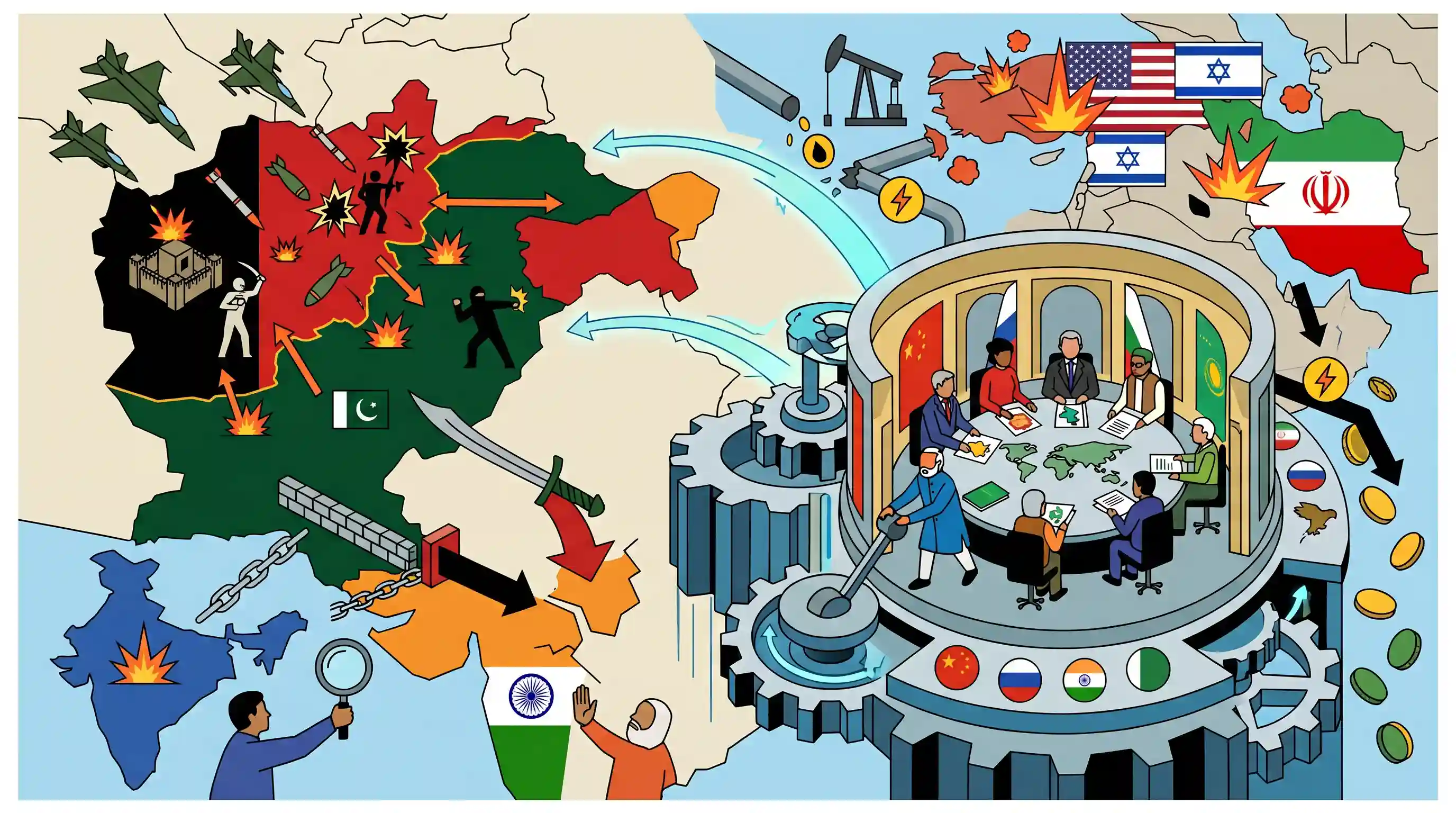
The shifting dynamics between Pakistan and the Taliban are crucial for India's regional security calculus. As Pakistan faces a two-front military dilemma, India's strategy to navigate cross-border terrorism and utilize multilateral platforms like the SCO gains paramount importance in maintaining regional stability.
Summary
The editorial analyses the escalating conflict between Pakistan and Afghanistan, marked by recent Pakistani airstrikes in Kabul targeting alleged Tehreek-e-Taliban Pakistan (TTP) bases. These clashes along the Durand Line highlight the ironic reality of Pakistan now facing cross-border terrorism—a tactic it has long employed against India. While India has strongly condemned the strikes and sought an international inquiry, its direct diplomatic avenues remain limited given frozen ties with Islamabad and informal relations with the Taliban. Consequently, the piece recommends that India leverage the Shanghai Cooperation Organisation (SCO) to engage regional powers to mitigate the conflict, especially since the broader region is already reeling from the economic and energy shocks of the US-Israel war against Iran.
Key Points
- Escalating clashes along the Durand Line recently culminated in Pakistani airstrikes destroying an Afghan rehabilitation centre in Kabul.
- Pakistan accuses the Taliban of harbouring the Tehreek-e-Taliban Pakistan (TTP), a claim that highlights Pakistan's own vulnerabilities to cross-border terrorism.
- India strongly condemned the airstrikes on civilian targets as a 'massacre' and called for an international inquiry.
- Facing a complex two-front security challenge against India and Afghanistan, Pakistan's geopolitical instability offers a nuanced strategic environment for New Delhi.
- India's direct diplomatic leverage is restricted, suggesting New Delhi should rally SCO members to contain the conflict and prevent further regional volatility.
Important Terms
Durand Line

The 2,640-km international boundary established in 1893 between Afghanistan and Pakistan. It remains largely unrecognised by Afghan regimes, leading to persistent territorial disputes and border skirmishes.
UPSC context
GS Paper 2 (Neighbourhood Relations) and GS Paper 3 (Border Management). Tests understanding of colonial legacies and current regional security challenges.
Tehreek-e-Taliban Pakistan (TTP)
A militant Islamist umbrella organization, also known as the 'Pakistani Taliban', which seeks to overthrow the Pakistani state and impose Sharia law. It frequently uses Afghan territory as a sanctuary.
UPSC context
GS Paper 3 (Internal Security). Relevant for studying the role of non-state actors in regional instability and cross-border terrorism.
Shanghai Cooperation Organisation (SCO)
A Eurasian political, economic, and security alliance comprising major regional powers including India, China, Russia, and Pakistan. It focuses on regional security and counter-terrorism through its RATS mechanism.
UPSC context
GS Paper 2 (International Relations). Tests knowledge of regional groupings and India's diplomatic avenues for stabilizing its extended neighborhood.
Cross-border Terrorism
A form of unconventional warfare where a country's soil is used by state or non-state actors to carry out attacks in a neighboring nation to achieve political or ideological goals.
UPSC context
GS Paper 3 (Internal Security). Core topic regarding challenges to India’s security and the management of porous borders.
Taliban
An Islamic fundamentalist political and military organisation that regained control of Afghanistan in August 2021. Their governance has led to regional shifts and challenges regarding recognition and humanitarian aid.
UPSC context
GS Paper 2 (International Relations). Crucial for analyzing India’s 'Neighbourhood First' policy and security implications in Central and South Asia.
Prelims Trap
India formally recognises the Taliban government and maintains a fully operational embassy in Kabul.
India does not formally recognise the Taliban regime. It only maintains a pragmatic "technical mission" in Kabul to facilitate humanitarian aid and monitor security.
Static Concepts Connected
What is the historical basis of the Durand Line dispute?
- Origin: Drawn in 1893 by British civil servant Mortimer Durand and Afghan Amir Abdur Rahman Khan.
- Afghan rejection: Afghanistan officially rejects the line, claiming it arbitrarily divides ethnic Pashtun territories and was imposed by colonial force.
- De facto boundary: It serves as the heavily contested de facto border, frequently witnessing clashes between Pakistani forces and TTP/Taliban insurgents.
How does the SCO framework address regional counter-terrorism?
- RATS Framework: The Regional Anti-Terrorist Structure (RATS), headquartered in Tashkent, coordinates member-state efforts against terrorism, separatism, and extremism.
- India's strategic use: India leverages SCO-RATS to build regional consensus on Afghan stability, track terror financing, and highlight cross-border terrorism without requiring direct bilateral engagement with Pakistan.
Cross-Topic Patterns
Asymmetric warfare and strategic blowback
Pakistan's current two-front crisis illustrates the blowback of state-sponsored cross-border terrorism, a core GS-3 internal security theme regarding the management of non-state actors.
Eurasian security via the SCO
With West Asia destabilised by conflict (US-Israel-Iran), India's reliance on the SCO to mitigate the Pak-Afghan frontier crisis highlights the rising strategic necessity of Eurasian multilateralism.

Durand Line history + SCO RATS mandate + India's 'technical mission' status in Kabul is highly probable as a 2026 prelims question.
Linked PYQs · 3
Linked PYQs · 3
- 2016MainsGS2
Increasing cross-border terrorist attacks in India and growing interference in the internal affairs of several member-states by Pakistan are not conducive for the future of SAARC (South Asian Association for Regional Cooperation)." Explain with suitable examples.
- 2021MainsGS2
Critically examine the aims and objectives of SCO. What importance does it hold for India?
- 2021MainsGS3
Analyse the multidimensional challenges posed by external state and non-state actors, to the internal security of India. Also discuss measures required to be taken to combat these threats.
