Government Stance on Air Pollution and Respiratory Illnesses
Source:The Hindu ↗
Why It Matters
This article is highly relevant for GS3 (Environment) and GS2 (Health/Governance) as it highlights the recurring political debates over the health impacts of air pollution versus established scientific consensus. It also evaluates the efficacy of newly created statutory bodies like the CAQM and the role of the judiciary in environmental enforcement.
Summary
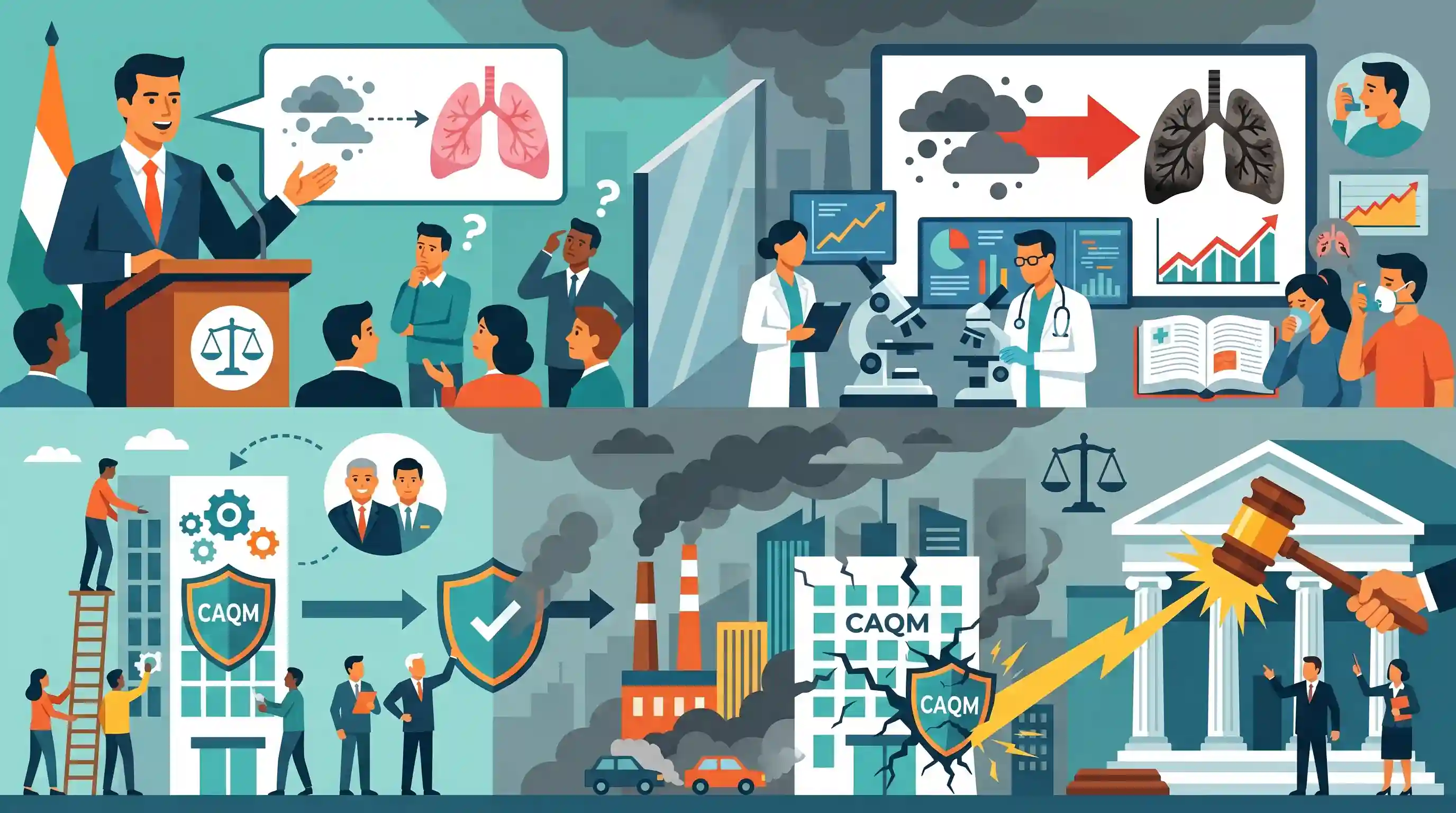
A recent statement by the Minister of State for Environment and Climate Change claimed there is no 'direct correlation' between high Air Quality Index (AQI) levels and lung diseases, though admitting pollution is a triggering factor. This stance contrasts with established medical literature, which relies on associative epidemiological studies linking air pollution to conditions like asthma and COPD. The government defended its track record by pointing to the creation of the Commission for Air Quality Management (CAQM) in 2020, despite recent severe criticism from the Supreme Court regarding the statutory body's failure to effectively curb pollution in the Delhi-NCR region.
Key Points
- The Minister of State for Environment stated there is no conclusive data establishing a 'direct correlation' between higher Air Quality Index (AQI) levels and lung diseases, though acknowledging it as a 'triggering factor'.
- Medical and scientific communities widely agree on the link between air pollution and respiratory conditions like asthma and COPD, often relying on robust associative epidemiological studies rather than direct experimental exposure.
- The government highlighted the establishment of the Commission for Air Quality Management (CAQM) in 2020 as its primary institutional response to tackling pollution in the NCR.
- The Supreme Court recently criticized the CAQM, labeling its efforts to curb pollution in Delhi-NCR a 'total failure'.
Important Terms
Air Quality Index (AQI)

A numeric tool (0-500) simplifying complex air quality data into six color-coded categories (Good to Severe). It monitors eight key pollutants, including PM2.5, PM10, NO2, and Ozone.
UPSC context
GS Paper 3 (Environment); tests knowledge of environmental monitoring and government initiatives to communicate public health risks.
Commission for Air Quality Management (CAQM)
A statutory body established in 2021 to manage air quality in Delhi-NCR and adjoining areas. It possesses overarching powers to issue binding directions, superseding other environmental authorities.
UPSC context
GS Paper 2 (Statutory Bodies) & GS 3 (Environment); tests institutional mechanisms for regional environmental governance.
Right to a Clean Environment
A fundamental right derived by the Supreme Court from Article 21 (Right to Life). It allows judicial intervention to protect citizens from pollution-related health hazards and executive negligence.
UPSC context
GS Paper 2 (Polity); tests understanding of judicial activism and the expansion of fundamental rights under the Constitution.
Epidemiological Studies
Research analyzing health distribution in populations. In pollution contexts, these studies establish statistical associations between toxic air exposure and chronic conditions like asthma, COPD, and premature mortality.
UPSC context
GS Paper 3 (Health/Science); tests ability to evaluate scientific evidence vs. policy claims in public health discourse.
Particulate Matter (PM)
Microscopic solids or liquid droplets (e.g., PM2.5, PM10) suspended in air. PM2.5 is highly hazardous, as its size allows it to penetrate deep into the lungs and bloodstream.
UPSC context
GS Paper 3 (Environment/Health); fundamental to understanding the mechanics of air pollution and its physiological impacts.
Statutory Body
A non-constitutional body created by an Act of Parliament (e.g., CAQM). These organizations derive their powers from legislation to regulate, monitor, and enforce compliance in specific sectors.
UPSC context
GS Paper 2 (Governance); core concept for distinguishing between types of government organizations and their legal mandates.
Prelims Trap
CAQM has pan-India jurisdiction and replaced the Central Pollution Control Board (CPCB) to enforce the Graded Response Action Plan.
CAQM is a statutory body with jurisdiction strictly limited to the NCR and adjoining areas. It replaced the EPCA, not the CPCB, to manage regional air quality.
Static Concepts Connected
What are the 8 pollutants measured under India's National Air Quality Index (AQI)?
- Particulates & Gases: PM10, PM2.5, NO2, SO2, CO, and Ozone (O3) are tracked. Note that Carbon Dioxide (CO2) is explicitly excluded from the AQI.
- Metals & Ammonia: Lead (Pb) and Ammonia (NH3) complete the list of eight pollutants used to calculate the daily air quality sub-indices.
What are the powers and mandate of the Commission for Air Quality Management (CAQM)?
- Statutory Origin: Created under a 2021 Act, replacing the 22-year-old Supreme Court-mandated EPCA to institutionalize air quality management.
- Regional Jurisdiction: Exclusively oversees the National Capital Region (NCR) and adjoining areas (Punjab, Haryana, Rajasthan, UP).
- Overriding Authority: Its orders and directions supersede those of the respective State Pollution Control Boards in case of any conflict.
Cross-Topic Patterns
Article 21 & Environmental Jurisprudence
The SC's harsh critique of CAQM reflects the continuous reliance on judicial review to enforce the fundamental right to a pollution-free environment under Article 21, offsetting executive inaction.
Evidence-based policy and executive accountability
The Minister's semantic distinction between 'triggering factor' and 'direct correlation' mirrors past global debates on climate change liability and tobacco regulation, where epidemiological evidence faces political resistance.

A 2026 Prelims question will likely contrast National AQI pollutants vs WHO guidelines, combined with CAQM's specific statutory powers.
Linked PYQs · 3
Linked PYQs · 3
- 2021MainsGS3
Describe the key points of the revised Global Air Quality Guidelines (AQGs) recently released by the World Health Organisation (WHO). How are these different from its last update in 2005? What changes in India's National Clean Air Programme are required to achieve these revised standards?
- 2022PrelimsGS1
In the context of WHO Air Quality Guidelines, consider the following statements: 1. The 24-hour mean of PM2.5 should not exceed 15 µg/m³ and annual mean of PM2.5 should not exceed 5 µg/m³. 2. In a year, the highest levels of ozone pollution occur during the periods of inclement weather. 3. PM10 can penetrate the lung barrier and enter the bloodstream. 4. Excessive ozone in the air can trigger asthma. Which of the statements given above are correct?
- 2016PrelimsGS1
In the cities of our country, which among the following atmospheric gases are normally considered in calculating the value of Air Quality Index? 1. Carbon dioxide 2. Carbon monoxide 3. Nitrogen dioxide 4. Sulfur dioxide 5. Methane Select the correct answer using the code given below.
