Union government stance on air pollution health impacts in Parliament
Source:The Hindu ↗
Why It Matters
The government's stance on air pollution-related mortality is a critical issue for UPSC aspirants, touching upon environmental policy (GS3), public health outcomes (GS2), and data interpretation in governance. It highlights the intersection of flagship schemes (NCAP, PMUY) and their intended vs. claimed health outcomes, an area frequently tested in both Prelims and Mains.
Summary
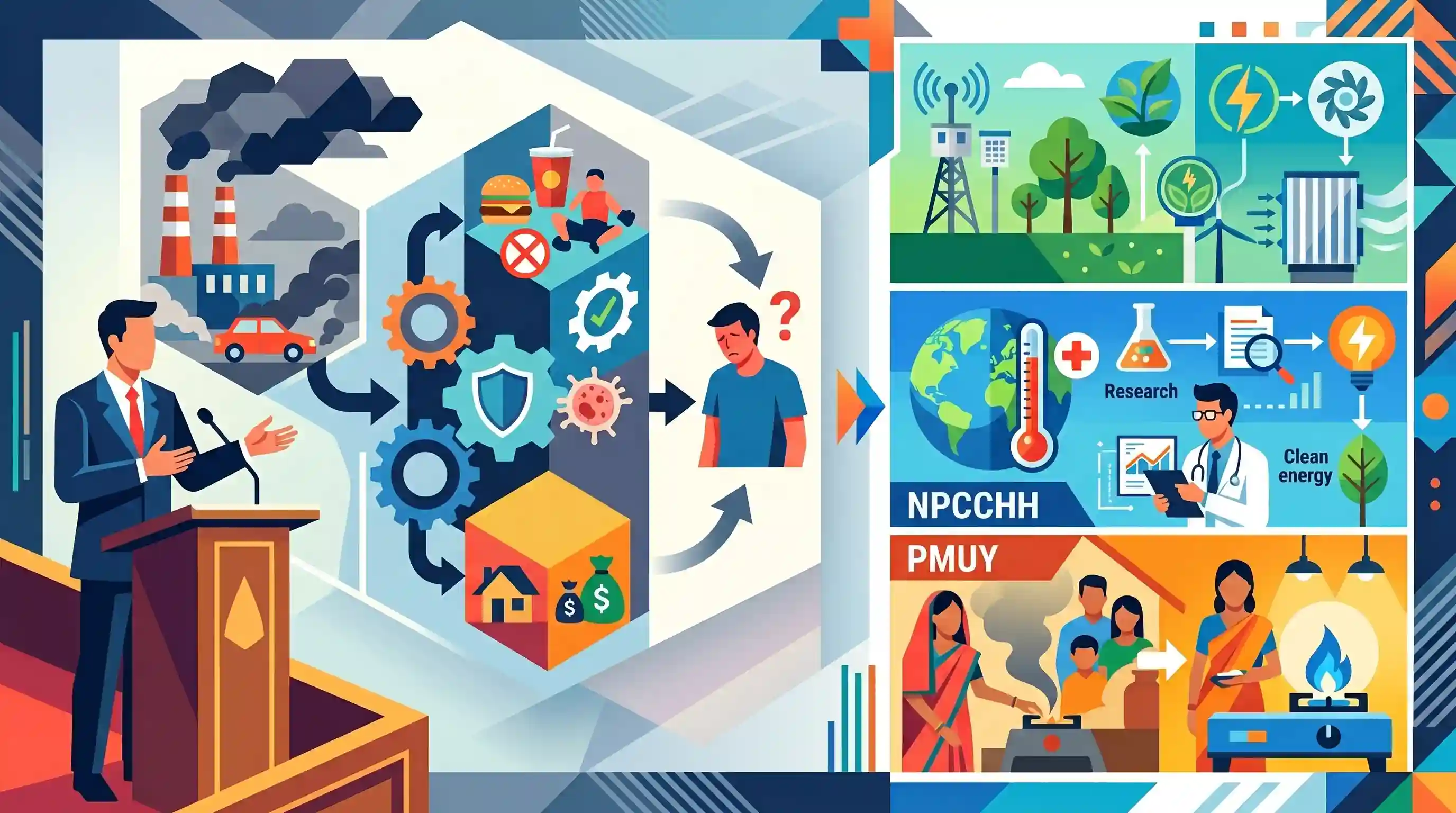
The Union Health Ministry informed Parliament that there is no conclusive data proving deaths or diseases are exclusively caused by air pollution, attributing such health impacts to a 'synergistic manifestation' of factors like lifestyle, immunity, and socio-economic status. Despite this, the government emphasized ongoing interventions to tackle air pollution and its health effects, including the National Programme for Climate Change and Human Health (NPCCHH), the National Clean Air Programme (NCAP), and the Pradhan Mantri Ujjwala Yojana (PMUY) which provides clean cooking fuel.
Key Points
- The Union Health Ministry informed the Rajya Sabha that there is no conclusive data to establish a direct correlation of death or disease exclusively due to air pollution.
- The health impacts of air pollution are described as a 'synergistic manifestation' of multiple factors, including food habits, occupational hazards, immunity, medical history, and socio-economic status.
- The government highlighted the National Programme for Climate Change and Human Health (NPCCHH) under the National Health Mission, which focuses on creating awareness, capacity building, and healthcare preparedness for climate-sensitive illnesses.
- Several flagship schemes, such as the Pradhan Mantri Ujjwala Yojana (PMUY) for clean cooking fuel, the Swachh Bharat Mission, and the National Clean Air Programme (NCAP), were presented as key interventions to curb pollution and mitigate its health impacts.
Important Terms
National Programme for Climate Change and Human Health (NPCCHH)

A 2019 MoHFW initiative to protect health from climate-sensitive diseases (CSDs) like air pollution and heatwaves through awareness, capacity building, and strengthening healthcare systems.
UPSC context
GS Paper 2 (Health) and GS Paper 3 (Environment); tests adaptation strategies for climate-induced health crises.
National Clean Air Programme (NCAP)
A time-bound national strategy launched in 2019 to reduce particulate matter (PM2.5 and PM10) concentrations by 20-30% (revised to 40% by 2026) in 131 cities.
UPSC context
GS Paper 3 (Pollution); tests air quality governance, targets, and institutional mechanisms like the PRANA portal.
Pradhan Mantri Ujjwala Yojana (PMUY)
A social welfare scheme providing deposit-free LPG connections to women from low-income households to replace traditional biomass fuels, thereby reducing indoor air pollution and respiratory illnesses.
UPSC context
GS Paper 2 (Schemes) and GS Paper 3 (Energy/Health); tests the intersection of energy access and public health outcomes.
Non-Attainment Cities
Cities identified by the CPCB that consistently fail to meet the National Ambient Air Quality Standards (NAAQS) for five consecutive years.
UPSC context
GS Paper 3 (Pollution); a technical categorization critical for understanding urban air quality monitoring and NCAP fund allocation.
State Action Plan on Climate Change and Human Health (SAPCCHH)
A decentralized framework where States/UTs prepare specific health adaptation strategies for climate-sensitive diseases, including dedicated chapters on managing regional air pollution impacts.
UPSC context
GS Paper 2 (Governance/Health); tests federal cooperation and localized planning for climate resilience.
Swachh Bharat Mission (SBM)
A national cleanliness campaign that indirectly addresses air pollution through solid waste management (preventing open burning) and initiatives like the Swachh Vayu Survekshan air quality rankings.
UPSC context
GS Paper 2 (Welfare); tests the convergence of sanitation, waste management, and environmental pollution control.
Prelims Trap
"The Union government officially recognizes air pollution as a direct and exclusive cause of mortality in India."
Aspirants conflate global WHO/Lancet reports—which estimate millions of pollution deaths—with official Govt of India data, which insists health impacts are a 'synergistic manifestation' of multiple factors.
Static Concepts Connected
What is the National Clean Air Programme (NCAP)?
- Target: Aims for a 40% reduction in particulate matter (PM10) concentrations by 2025-26, using 2017 as the base year.
- Coverage: Applies to 131 'non-attainment cities' that consistently failed to meet National Ambient Air Quality Standards (NAAQS) for 5 consecutive years.
- PRANA Portal: Developed by the Central Pollution Control Board (CPCB) to track the implementation and funding of city-specific air action plans.
What is the National Programme for Climate Change and Human Health (NPCCHH)?
- Nodal Agency: Implemented under the National Health Mission by the Ministry of Health and Family Welfare (MoHFW).
- Objective: Focuses on healthcare preparedness, capacity building, and awareness for climate-sensitive illnesses like heat stress and vector-borne diseases.
Cross-Topic Patterns
NCAP vs WHO Air Quality Guidelines
UPSC frequently tests India's National Ambient Air Quality Standards (NAAQS) thresholds and NCAP targets against the much stricter World Health Organization (WHO) air quality guidelines updated in 2021.
PMUY as an Environmental Scheme
Pradhan Mantri Ujjwala Yojana (PMUY) is heavily pitched as women's empowerment, but its core ecological and health function is mitigating deadly indoor air pollution from biomass burning.

Expect a Prelims assertion-reason question contrasting global WHO mortality data on air pollution with the Indian govt's official stance.
Linked PYQs · 4
Linked PYQs · 4
- 2020MainsGS3
What are the key features of the National Clean Air Programme (NCAP) initiated by the Government of India?
- 2021MainsGS3
Describe the key points of the revised Global Air Quality Guidelines (AQGs) recently released by the World Health Organisation (WHO). How are these different from its last update in 2005? What changes in India's National Clean Air Programme are required to achieve these revised standards?
- 2022PrelimsGS1
In the context of WHO Air Quality Guidelines, consider the following statements: 1. The 24-hour mean of PM2.5 should not exceed 15 µg/m³ and annual mean of PM2.5 should not exceed 5 µg/m³. 2. In a year, the highest levels of ozone pollution occur during the periods of inclement weather. 3. PM10 can penetrate the lung barrier and enter the bloodstream. 4. Excessive ozone in the air can trigger asthma. Which of the statements given above are correct?
- 2025PrelimsGS1
Artificial way of causing rainfall to reduce air pollution makes use of
