India trade strategy amid US protectionism and supply chain shocks
Source:The Hindu ↗
Why It Matters
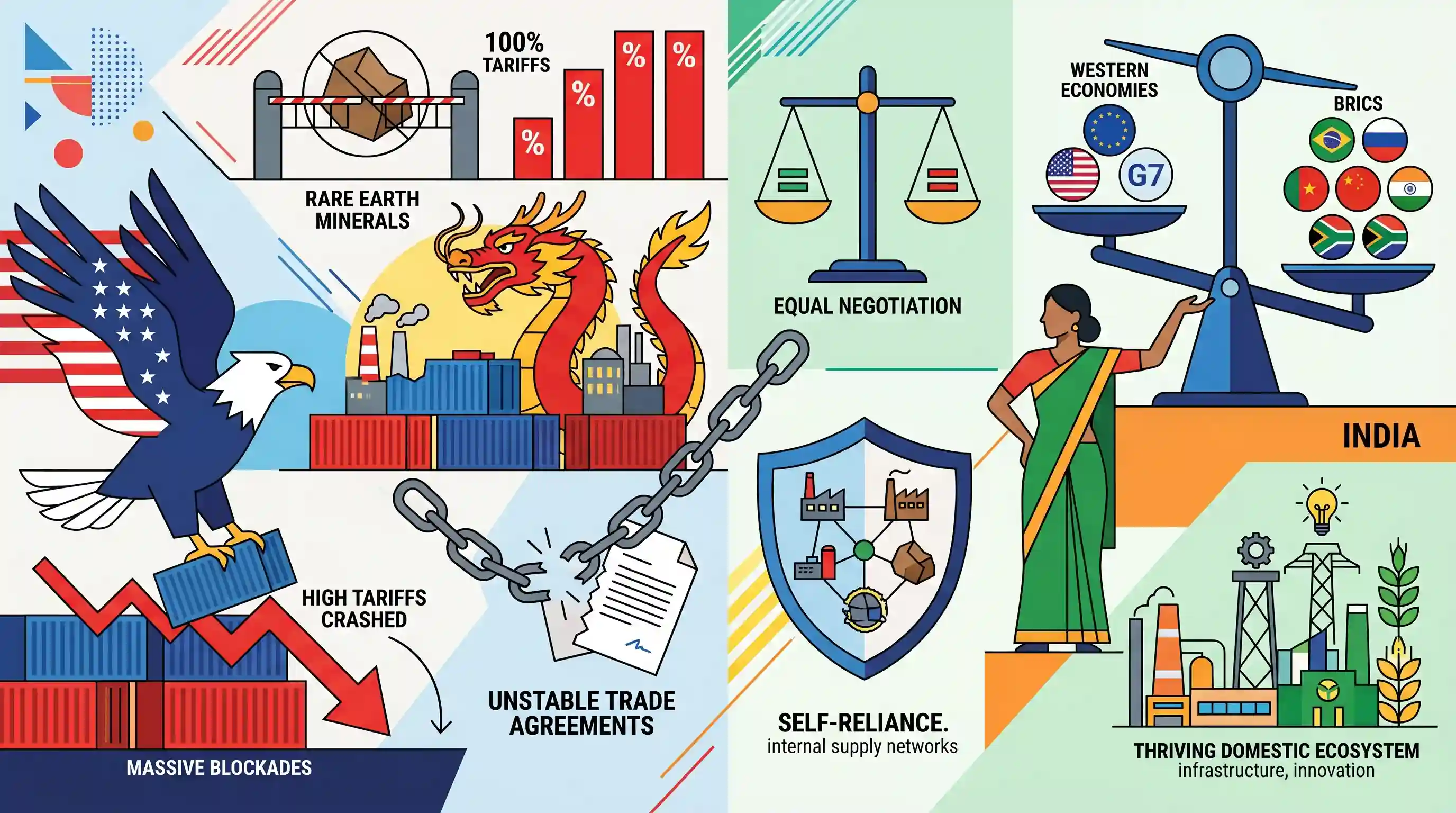
The escalating tariff war and export controls on critical minerals highlight the vulnerability of global supply chains. For UPSC aspirants, this underscores the importance of India's strategic autonomy in foreign trade, balancing Western partnerships with BRICS, and fostering domestic self-reliance to insulate the economy from global protectionist shocks.
Summary
Following the U.S. decision to impose 100% tariffs on Chinese goods in retaliation for Beijing's rare earth export controls, trade experts warn that trade agreements with the U.S. are inherently volatile. Former DGFT Ajay Srivastava advised that India must secure its own trade interests by negotiating on equal terms, building self-reliance, and strategically balancing its economic ties between Western economies and the BRICS bloc.
Key Points
- U.S. President Donald Trump announced a 100% tariff on Chinese goods, raising the overall tariff rate to approximately 130%.
- The U.S. tariffs were a retaliatory response to Beijing's decision to impose new export controls on rare earth minerals.
- Trade analysts emphasize that the escalation shows no trade deal with the U.S. is ever permanently settled.
- India is advised to negotiate carefully with the U.S. on equal terms, prioritizing self-reliance and domestic capacity building.
- India must maintain strategic autonomy in trade by balancing its economic engagements between Western nations and the BRICS bloc.
Important Terms
Directorate General of Foreign Trade (DGFT)

An attached office of the Ministry of Commerce and Industry that formulates and implements India's Foreign Trade Policy (FTP). It regulates and facilitates exports and imports to boost national trade.
UPSC context
GS Paper II (Governance) & GS III (Economy). Tests knowledge of trade facilitation, EXIM policy, and institutional frameworks.
BRICS
A group of major emerging economies—originally Brazil, Russia, India, China, and South Africa—that expanded in 2024. It seeks to promote South-South cooperation and challenge Western-dominated global governance.
UPSC context
GS Paper II (International Relations). Essential for topics on global groupings, multipolarity, and India's role in the Global South.
Rare Earth Elements (REEs)
A group of 17 metallic elements critical for high-tech industries, defense, and green energy. They are essential for manufacturing magnets, batteries, and electronics, with supply chains currently dominated by China.
UPSC context
GS Paper I (Geography/Resources) & GS III (Economy/Security). Relevant for India’s Critical Mineral Mission and strategic self-reliance.
Strategic Autonomy
India's foreign policy principle of making independent sovereign decisions based on national interest, without being constrained by external pressures or formal alliances with major powers.
UPSC context
GS Paper II (International Relations). A foundational concept for analyzing India's relations with the US, Russia, and China.
Supply Chain Resilience Initiative (SCRI)
A trilateral pact between India, Japan, and Australia launched in 2021. It aims to reduce dependence on China by diversifying and strengthening supply chains across the Indo-Pacific region.
UPSC context
GS Paper II (International Relations) & GS III (Economy). Tests understanding of regional economic security and "China Plus One" strategies.
Trade Protectionism
Economic policies aimed at shielding domestic industries from foreign competition through tools like tariffs, quotas, and subsidies. It represents a shift away from free-market globalization.
UPSC context
GS Paper III (Economy). Key for evaluating the impact of global trade wars and "Atmanirbhar Bharat" on macroeconomic stability.
Prelims Trap
China holds a complete monopoly as the only global producer and reserve holder of rare earth minerals.
China dominates the processing of rare earths (almost 90%), but countries like India, Australia, and the US have significant reserves. India has the 5th largest reserves.
Static Concepts Connected
What are Rare Earth Elements (REEs) and their status in India?
- Composition: 17 elements (15 lanthanides, plus scandium and yttrium) vital for modern electronics, EVs, and green tech.
- Indian Reserves: Found heavily in monazite sands along the coastal states of Kerala, Tamil Nadu, and Odisha.
- Processing Gap: Despite large reserves, India relies heavily on imports due to domestic extraction and processing capability bottlenecks.
What is the role of the Directorate General of Foreign Trade (DGFT)?
- Nodal Ministry: Functions as an attached office under the Ministry of Commerce and Industry.
- Policy Formulation: Responsible for drafting and implementing India's Foreign Trade Policy (FTP) to boost exports and economic growth.
- Regulation & Facilitation: Issues Import Export Codes (IEC) and regulates trade, shifting recently from a regulator to a trade facilitator.
Cross-Topic Patterns
Rare Earths + Mineral Security Partnership
China's export weaponization provides direct context for India's strategic entry into the 14-nation Mineral Security Partnership (MSP) to secure critical supply chains.
US Tariffs + China Plus One + PLI
Aggressive US protectionism against Beijing accelerates the 'China Plus One' shift, directly validating India's Production Linked Incentive (PLI) push to capture migrating global manufacturing.

Expect a 2026 multi-statement question linking China's rare-earth processing monopoly, India's monazite sands, and the US-led MSP.
Linked PYQs · 3
Linked PYQs · 3
- 2025MainsGS3
What are the challenges before the Indian economy when the world is moving away from free trade and multilateralism to protectionism and bilateralism? How can these challenges be met?
- 2018MainsGS3
How would the recent phenomena of protectionism and currency manipulations in world trade affect macroeconomic stability of India?
- 2024MainsGS2
‘The West is fostering India as an alternative to reduce dependence on China's supply chain and as a strategic ally to counter China's political and economic dominance.’ Explain this statement with examples.
