India Rejects US Agricultural Import Pacts Protecting Domestic Farmers
Source:The Hindu ↗
Why It Matters
The issue underscores the intersection of international diplomacy, trade protectionism, and domestic agricultural policy. It highlights India's ongoing challenge to balance its strategic autonomy (purchasing Russian oil) with managing trade relations with the US, while simultaneously protecting domestic farmers from cheap agricultural imports.
Summary
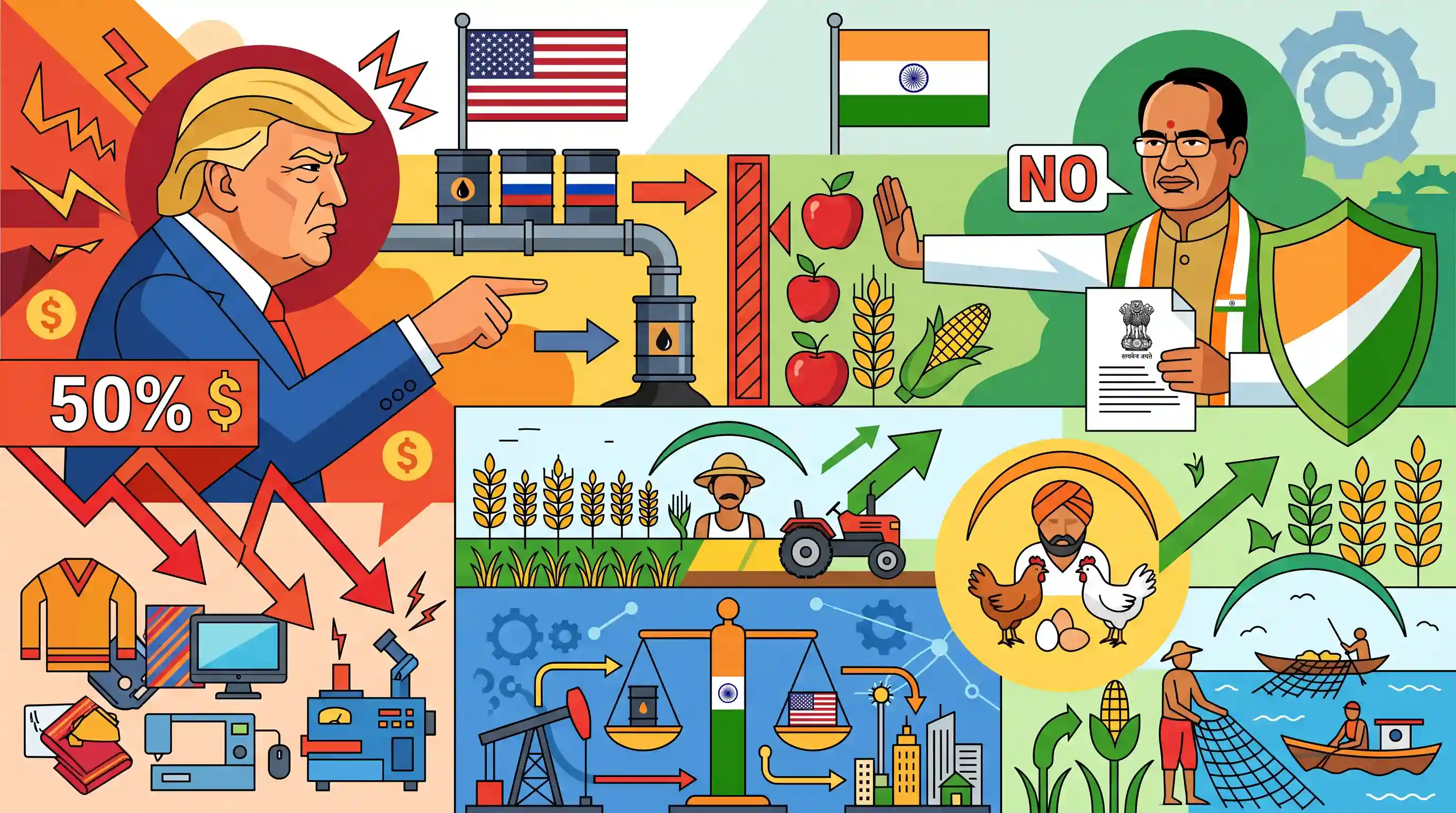
Union Agriculture Minister Shivraj Singh Chouhan has firmly stated that India will not enter into any agricultural import agreements with the US if they adversely impact domestic farmers. This declaration comes amid deteriorating India-US trade relations after US President Donald Trump imposed a 50% tariff on Indian goods in response to India's continued procurement of Russian crude oil. Rejecting opposition claims that the US tariff pressures influenced domestic GST alterations, Chouhan reaffirmed the government's commitment to prioritizing national interests and safeguarding the welfare of local farmers, poultry breeders, and fishermen.
Key Points
- Union Agriculture Minister Shivraj Singh Chouhan declared that India will not agree to any agricultural import deal with the US that jeopardizes the livelihoods of Indian farmers.
- The assertion follows a recent diplomatic strain after US President Donald Trump doubled tariffs on Indian goods to 50%, including a 25% additional duty.
- The US tariff hike was implemented in retaliation against India's ongoing purchases of Russian crude oil.
- Chouhan rejected opposition claims that the US tariff shock caused recent changes to India's GST structure, emphasizing the government's firm commitment to protecting local farmers, poultry breeders, fishermen, and the poor.
Important Terms
Goods and Services Tax (GST) Council

A constitutional body (Article 279A) chaired by the Union Finance Minister that makes recommendations on GST rates, exemptions, and administrative procedures.
UPSC context
GS Paper II/III: Constitutional bodies and fiscal federalism; tests understanding of Centre-State financial relations.
Strategic Autonomy
A nation's ability to pursue its national interests and adopt preferred foreign policy choices without being constrained by other states.
UPSC context
GS Paper II: International Relations; critical for understanding India’s balanced stance between the West and Russia/China.
Protectionism
Economic policies involving tariffs or quotas to restrain trade between nations, designed to protect domestic industries from foreign competition.
UPSC context
GS Paper III: Indian Economy; relates to global trade wars, WTO rules, and impact on domestic manufacturing/agriculture.
Reciprocal Tariff
A trade policy where a country imposes tariffs on imports from another country at the same rate that the other country imposes on its goods.
UPSC context
GS Paper III: External Sector; tests knowledge of trade barriers and bilateral negotiations under ‘Trump-era’ trade policies.
Energy Security
The uninterrupted availability of energy sources at an affordable price, often involving diversification of suppliers to mitigate geopolitical risks.
UPSC context
GS Paper III: Infrastructure and Energy; explores India’s dependence on crude oil imports and strategic petroleum reserves.
Prelims Trap
"US tariff impositions over Russian oil imports are WTO-authorized countervailing measures."
These are unilateral, geopolitical retaliatory tariffs. Under WTO rules, countervailing duties strictly counter specific foreign government subsidies, not sovereign foreign policy or energy procurement choices.
Static Concepts Connected
What are the core pillars of the WTO Agreement on Agriculture (AoA)?
- Market Access: The conversion of non-tariff barriers (like quotas) into equivalent custom duties (tariffication) and their progressive reduction.
- Domestic Support: Categorization of domestic agricultural subsidies into Amber (trade-distorting), Blue (distorting but with production limits), and Green (non-distorting) boxes.
- Export Competition: Commitments to reduce and ultimately eliminate direct subsidies on agricultural exports to prevent artificial global price distortion.
How do Sanitary and Phytosanitary (SPS) measures regulate international agricultural trade?
- Core Purpose: Regulations designed to protect human, animal, or plant health from imported pests, diseases, or toxins.
- WTO Mandate: Under WTO rules, SPS measures must be based on scientific principles (like Codex Alimentarius standards) and not function as disguised protectionism.
- Non-Tariff Barrier: India frequently uses SPS standards (e.g., rejecting unapproved GM feeds or demanding specific dairy certifications) to protect both biosafety and local farmers.
Cross-Topic Patterns
Strategic Autonomy via Energy Economics
India's discounted Russian oil purchases, despite US tariff retaliation, demonstrate how domestic macroeconomic inflation-targeting relies heavily on an independent, non-aligned foreign policy.
GM Policies as Trade Shields
India’s strict biosafety regulations against genetically modified crops act as effective non-tariff barriers, shielding domestic dairy and poultry sectors from subsidized US agribusiness imports.

Expect a 2026 Prelims question linking WTO's Agreement on Agriculture, non-tariff SPS measures (like GM bans), and unilateral tariffs.
Linked PYQs · 3
Linked PYQs · 3
- 2012MainsGS2
Discuss the likely negative impact of the protectionist measures proposed by the US on India's software industry.
- 2023MainsGS3
What are the direct and indirect subsidies provided to farm sector in India? Discuss the issues raised by the World Trade Organization (WTO) in relation to agricultural subsidies.
- 2025MainsGS2
"With the waning of globalization, post-Cold War world is becoming a site of sovereign nationalism.” Elucidate.
