Implementation Challenges in Karnataka Anti Conversion Legislation
Source:Indian Express ↗
Why It Matters
This article illustrates the constitutional and practical frictions surrounding state-level anti-conversion laws. It highlights the importance of 'locus standi' in criminal jurisprudence, the limits of third-party interference in personal liberties, and the political complexities involved in repealing contentious state legislation.
Summary
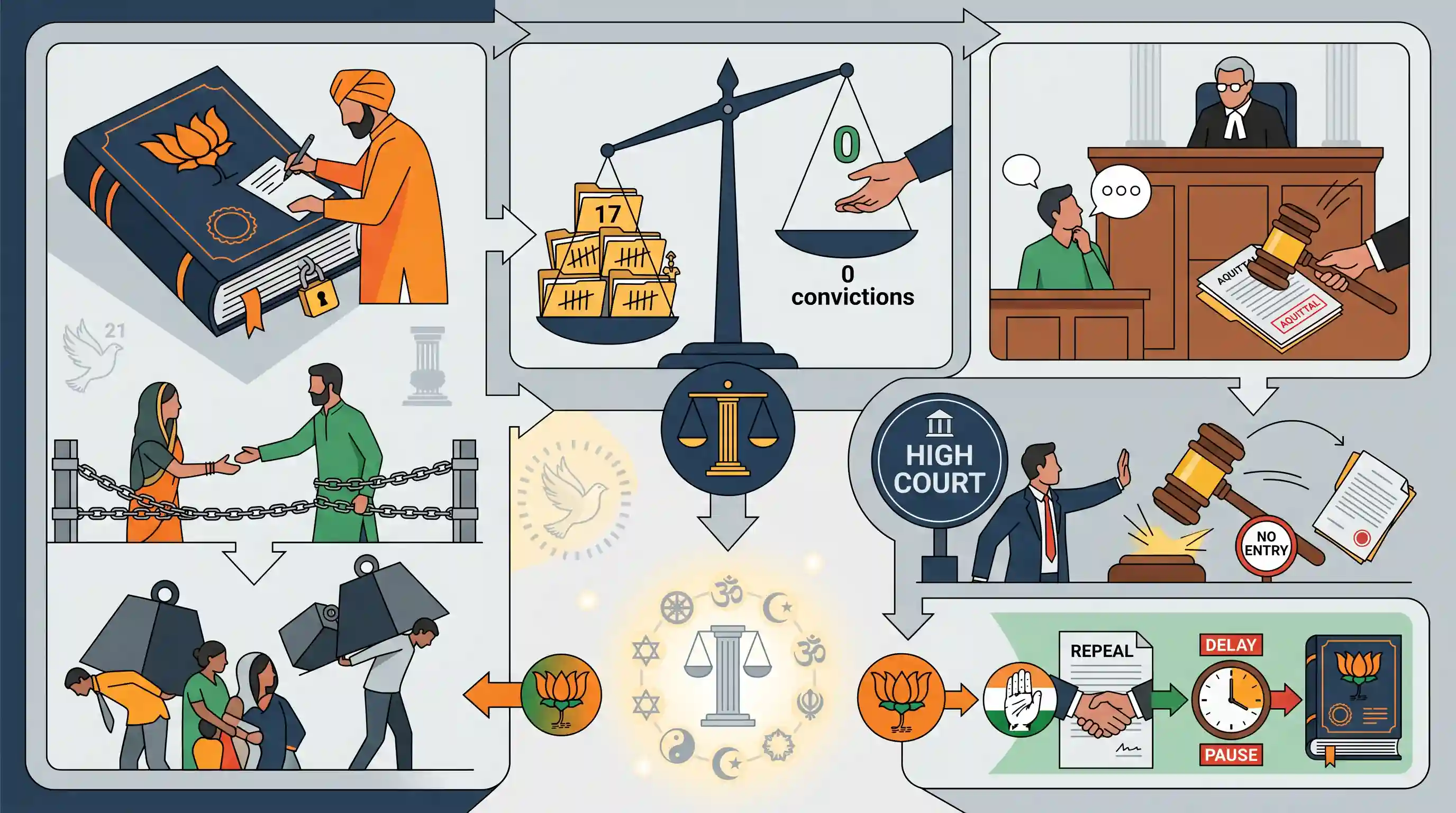
Karnataka has registered 17 cases under its 2022 anti-conversion law, but none have resulted in convictions so far. The first trial ended in an acquittal due to hostile witnesses, while the Karnataka High Court quashed another case because the third-party complainant lacked locus standi. Although the Congress government promised to repeal the BJP-enacted law in 2023, it has yet to do so. The legislation mandates strict regulations on inter-religious marriages involving conversion and imposes stringent penalties for conversions involving marginalized groups.
Key Points
- The Karnataka Protection of Right to Freedom of Religion Act, 2022, remains active despite the incumbent Congress government's promise to repeal it.
- Of the 17 cases registered under the anti-conversion law since 2023, there have been zero convictions to date.
- The first case to go to trial resulted in an acquittal after key witnesses turned hostile and reached a compromise.
- The Karnataka High Court quashed a separate case under the Act, ruling that a third-party complainant lacked the locus standi required under Section 4 to file an FIR.
- The law mandates rigorous procedures for religious conversion, including 30-day advance declarations, and prescribes severe punishments (up to 10 years) for converting minors, women, or SC/ST individuals.
Important Terms
Karnataka Protection of Right to Freedom of Religion Act, 2022

A state law prohibiting religious conversion via misrepresentation, force, fraud, or allurement. It mandates declarations to District Magistrates and prescribes higher penalties for converting women, minors, or SC/ST individuals.
UPSC context
GS Paper II: Government policies, Fundamental Rights (Art 25), and secularism. Tests understanding of state-level 'anti-conversion' or 'Love Jihad' legislations.
Locus Standi
The legal right of a party to bring a case to court. Under this Act, only the person converted, their family, or close associates typically have the right to file a complaint.
UPSC context
GS Paper II: Judiciary. Tests the principle of who can invoke criminal law, particularly in sensitive cases involving individual autonomy and third-party interference.
Hostile Witness
A witness who, during a trial, provides testimony that contradicts their earlier statements or supports the opposing party, often leading to the collapse of the prosecution's case.
UPSC context
GS Paper II: Criminal Justice System. Relevant for discussions on judicial delays, witness protection, and the low conviction rate in sensitive criminal trials.
Article 25 of the Indian Constitution
Guarantees the freedom of conscience and the right to freely profess, practice, and propagate religion, subject to public order, morality, and health.
UPSC context
GS Paper II: Fundamental Rights. Central to the debate on whether the 'right to propagate' includes a right to convert others.
Repeal of Laws
The formal process by which a legislature withdraws or nullifies an existing law. A law remains valid and enforceable until it is officially repealed by a subsequent Act.
UPSC context
GS Paper II: State Legislature. Tests knowledge of legislative procedures and the political-legal gap when a government fails to act on manifesto promises.
Prelims Trap
"Article 25 of the Constitution explicitly grants citizens the fundamental right to convert another person to their own religion."
The Supreme Court (Rev. Stanislaus case, 1977) clarified that the right to 'propagate' does not include the right to convert another person, protecting freedom of conscience.
Static Concepts Connected
What is the constitutional scope of religious freedom under Article 25?
- Article 25 Scope: Guarantees the freedom of conscience and the right to freely profess, practice, and propagate religion.
- Rev. Stanislaus Case: The SC ruled that 'propagate' means transmitting tenets, but does not grant the right to force or fraudulently convert someone.
- Reasonable Restrictions: The right is not absolute and is subject to public order, morality, and health.
Under which constitutional provision do States enact anti-conversion laws?
- State List: Anti-conversion laws are enacted under the ambit of 'Public Order', which is Entry 1 of the State List.
- No Central Law: There is no central legislation regulating or restricting religious conversions in India.
Cross-Topic Patterns
Locus Standi exceptions in Special Acts
While general criminal law allows anyone to file an FIR, special acts like anti-conversion laws strictly define who can initiate proceedings, restricting third-party or vigilante interference.
Puttaswamy vs Advance Declarations
Mandates requiring 30-day advance notice for religious conversion or marriage are increasingly challenged for violating the Right to Privacy and personal autonomy under Article 21 (Puttaswamy and Hadiya cases).

Expect a Prelims question mixing Article 25 limits (Stanislaus case), locus standi exceptions, and State jurisdiction over 'Public Order'.
Linked PYQs · 3
Linked PYQs · 3
- 2024MainsGS2
Discuss India as a secular state and compare with the secular principles of the US constitution.
- 2020MainsGS2
Judicial Legislation is antithetical to the doctrine of separation of powers as envisaged in the Indian Constitution. In this context justify the filing of large number of public interest petitions praying for issuing guidelines to executive authorities.
- 2024PrelimsGS1
Under which of the following Articles of the Constitution of India, has the Supreme Court of India placed the Right to Privacy ?
