Supreme Court Ruling on Legislative Lawmaking Powers and Contempt
Source:The Hindu ↗
Why It Matters
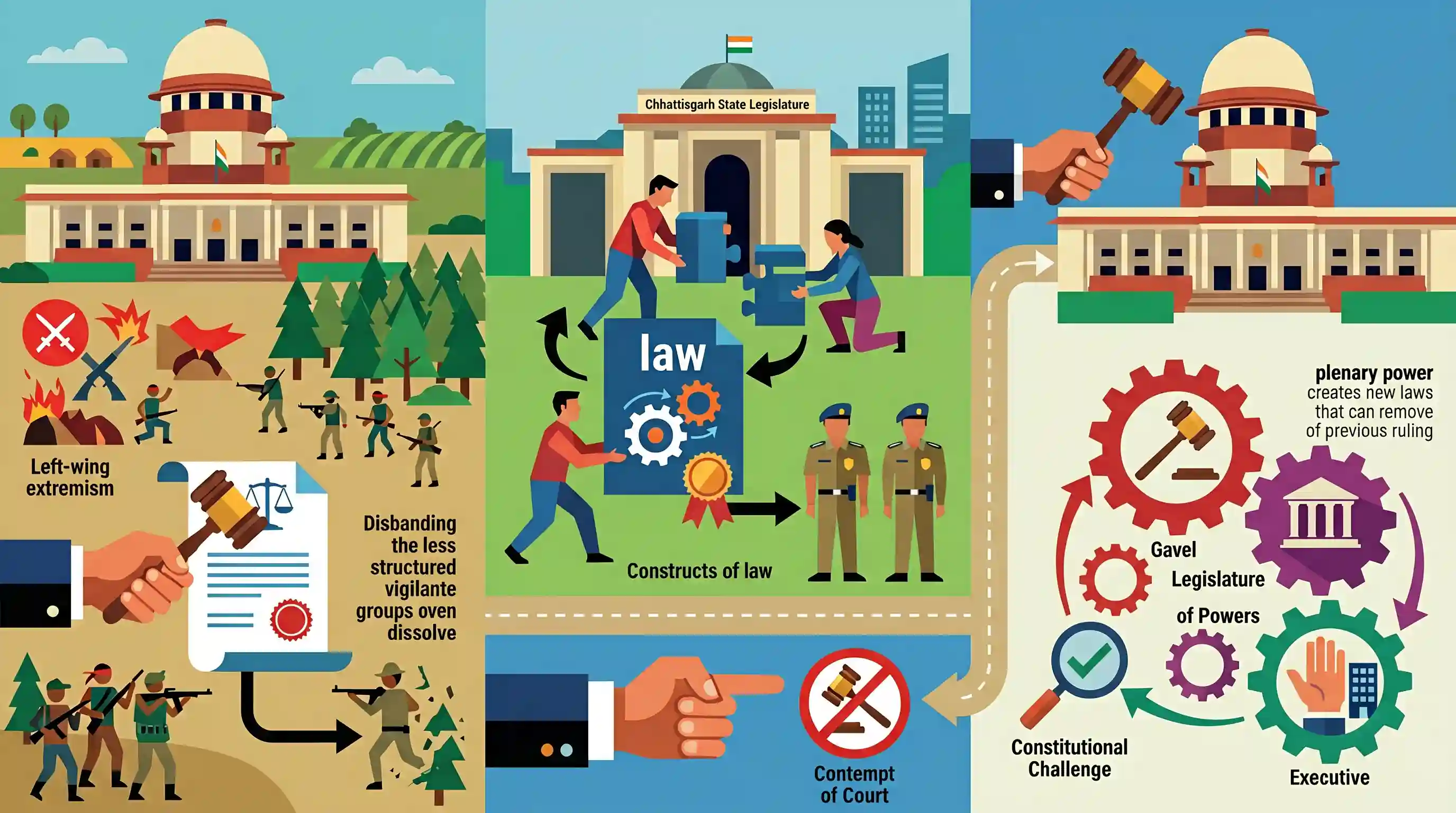
This ruling sets an important precedent on the boundaries between the judiciary and the legislature, reiterating that law-making—even when overriding a judicial decision—is a legitimate legislative function protected by the doctrine of separation of powers.
Summary
The Supreme Court of India ruled that the enactment or amendment of laws by Parliament or a State legislature cannot be construed as contempt of court. This judgment came while dismissing a 2012 contempt petition against the Chhattisgarh government for enacting the Chhattisgarh Auxiliary Armed Police Force Act, 2011, which regularised Special Police Officers (SPOs) despite a 2011 SC order to disband Salwa Judum vigilantes. The Court reaffirmed that legislative bodies possess plenary powers to enact laws that may even remove the basis of a previous judicial ruling. This mechanism forms the core of the doctrine of separation of powers and checks and balances. The validity of such laws must be challenged on grounds of legislative competence or constitutionality, rather than through contempt proceedings.
Key Points
- The Supreme Court ruled that Parliament or State legislatures cannot be held in contempt of court simply for enacting or amending a law.
- The observation was made while dismissing a 2012 contempt plea which alleged that the Chhattisgarh government circumvented a 2011 SC order to disband Salwa Judum vigilantes by passing the Chhattisgarh Auxiliary Armed Police Force Act, 2011 to regularise Special Police Officers (SPOs).
- The Court upheld the plenary power of the legislature to pass laws, including those that remove the basis of a prior judicial judgment or validate a struck-down law.
- Such legislative actions are central to the doctrine of separation of powers and the constitutional principle of checks and balances.
- A legislative enactment can only be challenged on grounds of legislative competence or constitutional validity, not via contempt proceedings.
Important Terms
Salwa Judum

A state-backed anti-Naxalite civilian militia in Chhattisgarh, active from 2005. The Supreme Court declared it unconstitutional in 2011 for violating fundamental rights and arming ill-trained civilians.
UPSC context
GS Paper III: Internal Security; GS Paper II: Judiciary's role in protecting fundamental rights against state-sponsored vigilantism.
Special Police Officers (SPOs)
Personnel recruited for counter-insurgency assistance. Initially part of Salwa Judum, their frontline deployment was banned by the SC (2011) due to inadequate training and violations of Articles 14 and 21.
UPSC context
GS Paper II: Statutory bodies and executive power; Paper III: Internal security challenges and police reforms.
Chhattisgarh Auxiliary Armed Police Force Act, 2011
Legislation enacted to regularize Special Police Officers into a formal auxiliary force. The Supreme Court recently ruled that its enactment was a valid legislative exercise and not contempt of court.
UPSC context
GS Paper II: State Legislature and the power to enact laws that remove the basis of judicial rulings.
Contempt of Court
Legal proceedings against individuals or authorities for wilful disobedience of court orders (Civil) or lowering the court's authority (Criminal). Protected under Articles 129 and 215 of the Constitution.
UPSC context
GS Paper II: Judiciary/Constitutional powers; tests the balance between judicial authority and legislative/executive functions.
Separation of Powers
The constitutional doctrine dividing governance into Legislative, Executive, and Judicial branches. The SC reaffirmed that legislatures have independent power to enact laws within their competence without committing contempt.
UPSC context
GS Paper II: Basic Structure of the Constitution; checks and balances between the three organs of the State.
Plenary Powers
The absolute and complete authority of a legislative body to enact laws on subjects within its constitutional jurisdiction, including the power to retrospectively remove the legal basis of a court judgment.
UPSC context
GS Paper II: Distribution of legislative powers; tests the understanding of legislative supremacy versus judicial review.
Article 315
Constitutional provision for the establishment of Public Service Commissions. Cited in the recent ruling regarding the State's duty to ensure proper recruitment-related rehabilitation and peace.
UPSC context
GS Paper II: Constitutional Bodies; understanding its context in state recruitment and administrative duties.
Nandini Sundar v. State of Chhattisgarh
A landmark 2011 Supreme Court case that outlawed state-sponsored militias (Salwa Judum) and emphasized that human rights cannot be sacrificed at the altar of counter-insurgency operations.
UPSC context
GS Paper II: Important Judgments; focuses on Article 14, Article 21, and judicial activism in internal security.
Prelims Trap
"Legislatures are constitutionally barred from enacting laws that retrospectively alter the basis of a Supreme Court judgment."
Legislatures possess plenary powers to alter the underlying statute retrospectively to cure defects pointed out by courts. This is valid, not contempt.
Static Concepts Connected
How can the legislature legally overcome a judicial decision?
- Removing the basis: Legislatures can amend the underlying law (often retrospectively) to cure the specific legal defect pointed out by the court's judgment.
- Direct overruling prohibited: A legislature cannot simply issue a declaration stating that a judicial decision is invalid without altering the underlying substantive law.
- Subject to review: Any such validating or amending law remains subject to judicial review for legislative competence and violations of Fundamental Rights.
What are the constitutional bases for Contempt of Court?
- Constitutional backing: Articles 129 and 215 designate the Supreme Court and High Courts as Courts of Record, granting them inherent power to punish for contempt.
- Statutory framework: The Contempt of Courts Act, 1971 provides the statutory framework, categorizing contempt into civil (willful disobedience) and criminal (scandalizing the court).
Cross-Topic Patterns
Salwa Judum & internal security strategy
The state's attempt to arm local tribal youth against Maoists raised Article 21 concerns, highlighting the clash between internal security tactics and constitutional human rights guarantees.
Judicial review vs legislative plenary powers
This mirrors the continuous friction seen in the Tribunalisation debate and the NJAC ruling, where boundaries between judicial review and legislative plenary powers are frequently tested by UPSC.

Multi-statement question linking Article 129, validating legislations, and the doctrine of separation of powers is probable for 2026.
Linked PYQs · 4
Linked PYQs · 4
- 2019MainsGS2
Do you think that Constitution of India does not accept principle of strict separation of powers rather it is based on the principle of 'checks and balance'? Explain.
- 2020MainsGS2
Judicial Legislation is antithetical to the doctrine of separation of powers as envisaged in the Indian Constitution. In this context justify the filing of large number of public interest petitions praying for issuing guidelines to executive authorities.
- 2019MainsGS2
From the resolution of contentious issues regarding distribution of legislative powers by the courts, 'Principle of Federal Supremacy' and 'Harmonious Construction' have emerged. Explain.
- 2022MainsGS3
Naxalism is a social, economic and developmental issue manifesting as a violent internal security threat. In this context, discuss the emerging issues and suggest a multilayered strategy to tackle the menace of Naxalism.
