No-Confidence Motion Against Lok Sabha Speaker Om Birla
Source:The Hindu ↗
Why It Matters
The removal of a sitting Lok Sabha Speaker is a rare constitutional procedure. It directly touches upon UPSC themes regarding the impartiality of the Speaker's office, the conduct of parliamentary business, and the balance of power between the ruling party and the opposition in a parliamentary democracy.
Summary
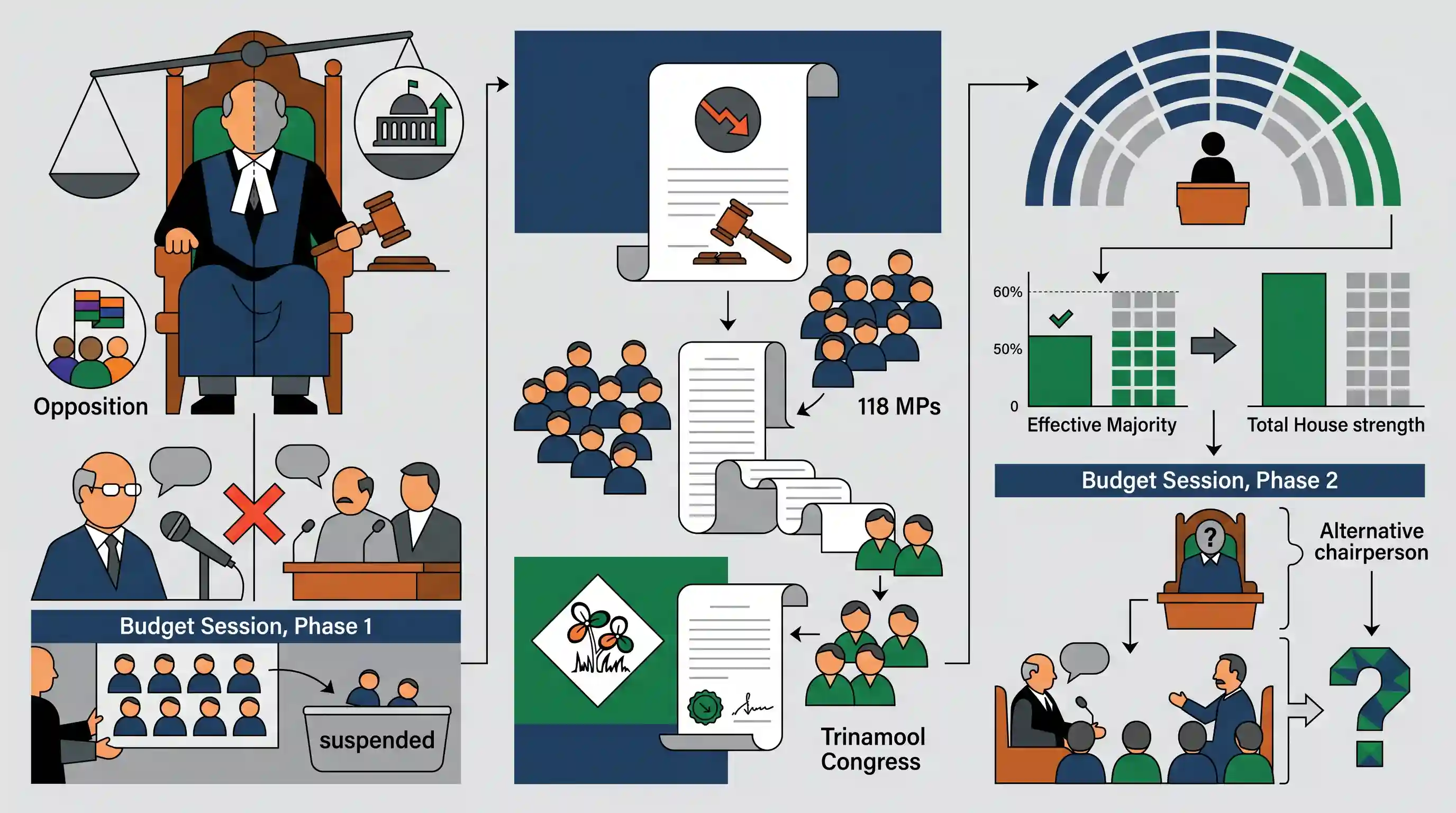
The Trinamool Congress has decided to support a resolution moved by the Opposition to remove Lok Sabha Speaker Om Birla. The notice, submitted by at least 118 MPs, accuses the Speaker of a 'blatantly partisan' approach, specifically pointing to his refusal to let Opposition leaders, including Rahul Gandhi, speak on the Motion of Thanks to the President's address, and the suspension of eight MPs in the first phase of the Budget session. The resolution has been listed for the second phase of the Budget session.
Key Points
- The Trinamool Congress (TMC) will support the Opposition's no-confidence motion to remove Lok Sabha Speaker Om Birla.
- The resolution was submitted by at least 118 Opposition MPs, accusing the Speaker of acting in a blatantly partisan manner.
- The Opposition cited the Speaker's refusal to allow LoP Rahul Gandhi and others to speak on the Motion of Thanks to the President's address.
- The suspension of eight MPs during the first phase of the Budget session was also cited as a reason for the resolution.
Important Terms
Speaker of the Lok Sabha

Constitutional head of the Lok Sabha (Article 93) responsible for maintaining order, interpreting rules, and certifying Money Bills. They are elected from among members.
UPSC context
GS-II: Parliament and State Legislatures. Essential for understanding parliamentary neutrality and presiding officer powers.
Resolution for Removal of Speaker
The process under Article 94(c) to remove the Speaker via a resolution passed by an 'effective majority' after at least 14 days' notice.
UPSC context
GS-II: Constitutional Posts. Tests knowledge of specific removal procedures and the concept of 'all the then members'.
Motion of Thanks
A parliamentary debate on the President's special address (Article 87) at the year's first session. Failure to pass it signals the government's loss of confidence.
UPSC context
GS-II: Parliamentary functioning. Tests understanding of executive accountability and constitutional conventions during the opening session.
Suspension of MPs
Disciplinary action under Lok Sabha Rules 373, 374, or 374A for 'grossly disorderly' conduct, barring members from House proceedings for a specific period.
UPSC context
GS-II: Conduct of Business. Tests knowledge of the Speaker's discretionary powers and parliamentary rules versus constitutional rights.
Effective Majority
A majority of more than 50% of the 'then members' of the House, meaning total strength minus existing vacancies (Article 94).
UPSC context
GS-II: Parliament. Crucial technical distinction from Simple or Absolute majorities required for specific constitutional removals.
Budget Session
The first and longest annual parliamentary session, traditionally held in two phases, focused on the presentation, discussion, and passing of the Union Budget.
UPSC context
GS-II: Parliamentary Sessions. Tests knowledge of the legislative calendar and the importance of financial business in Parliament.
Prelims Trap
The Speaker can exercise a casting vote if there is a tie on the resolution for their removal.
Under Article 96, the Speaker can vote in the first instance on their removal resolution but CANNOT exercise a casting vote in case of a tie—the exact opposite of their normal voting power.
Static Concepts Connected
What is the constitutional procedure to remove a Lok Sabha Speaker?
- Advance Notice: A resolution for removal can only be moved after giving at least 14 days' advance notice.
- Effective Majority: It requires an 'effective majority'—a majority of all the then members of the House, not just those present and voting (Article 94c).
- Restricted Presiding: The Speaker cannot preside over the House but has the right to speak, participate, and vote in the first instance (Article 96).
How do suspension powers differ between the Lok Sabha Speaker and Rajya Sabha Chairman?
- Lok Sabha (Automatic): Under Rule 374A, the Speaker can automatically suspend an MP for grave misconduct for five sittings or the remainder of the session.
- Rajya Sabha (Motion-based): The Chairman lacks automatic suspension powers. Suspending a Rajya Sabha member requires a formal motion to be adopted by the House under Rule 256.
Cross-Topic Patterns
Speaker's dual role & Tenth Schedule
Debates on the Speaker's partisanship frequently bleed into their quasi-judicial role under the Tenth Schedule. The Supreme Court has repeatedly suggested creating an independent tribunal to handle anti-defection cases.
Motion of Thanks as an accountability tool
Refusal to allow the LoP to speak on the Motion of Thanks touches upon Article 87. A defeat of this motion in the Lok Sabha equates to a defeat of the government.

Expect a 2026 prelims statement comparing Speaker vs. Chairman powers, specifically targeting automatic suspension and voting during removal.
Linked PYQs · 4
Linked PYQs · 4
- 2024PrelimsGS1
With reference to the Speaker of the Lok Sabha, consider the following statements : While any resolution for the removal of the Speaker of the Lok Sabha is under consideration 1. He/She shall not preside. 2. He/She shall not have the right to speak. 3. He/She shall not be entitled to vote on the resolution in the first instance. Which of the statements given above is/are correct?
- 2025PrelimsGS1
Consider the following statements : I. On the dissolution of the House of the People, the Speaker shall not vacate his/her office until immediately before the first meeting of the House of the People after the dissolution. II. According to the provisions of the Constitution of India, a Member of the House of the People on being elected as Speaker shall resign from his/her political party immediately. III. The Speaker of the House of the People may be removed from his/her office by a resolution of the House of the People passed by a majority of all the then Members of the House, provided that no resolution shall be moved unless at least fourteen days' notice has been given of the intention to move the resolution. Which of the statements given above are correct?
- 2020MainsGS2
Once a Speaker, Always a Speaker' ! Do you think this practice should be adopted to impart objectivity to the office of the Speaker of Lok Sabha ? What could be its implications for the robust functioning of parliamentary business in India?
- 2023MainsGS2
Discuss the role of Presiding Officers of state legislatures in maintaining order and impartiality in conducting legislative work and in facilitating best democratic practices.
