Uncertainty over next Quad summit raises strategic questions
Source:The Hindu ↗
Why It Matters
The Quad is a critical pillar of India's Indo-Pacific strategy aimed at ensuring a free and open region. Uncertainty over its summit-level engagement directly impacts India's strategic calculations and highlights the complexities of multilateral balancing amidst shifting U.S.-China relations.
Summary
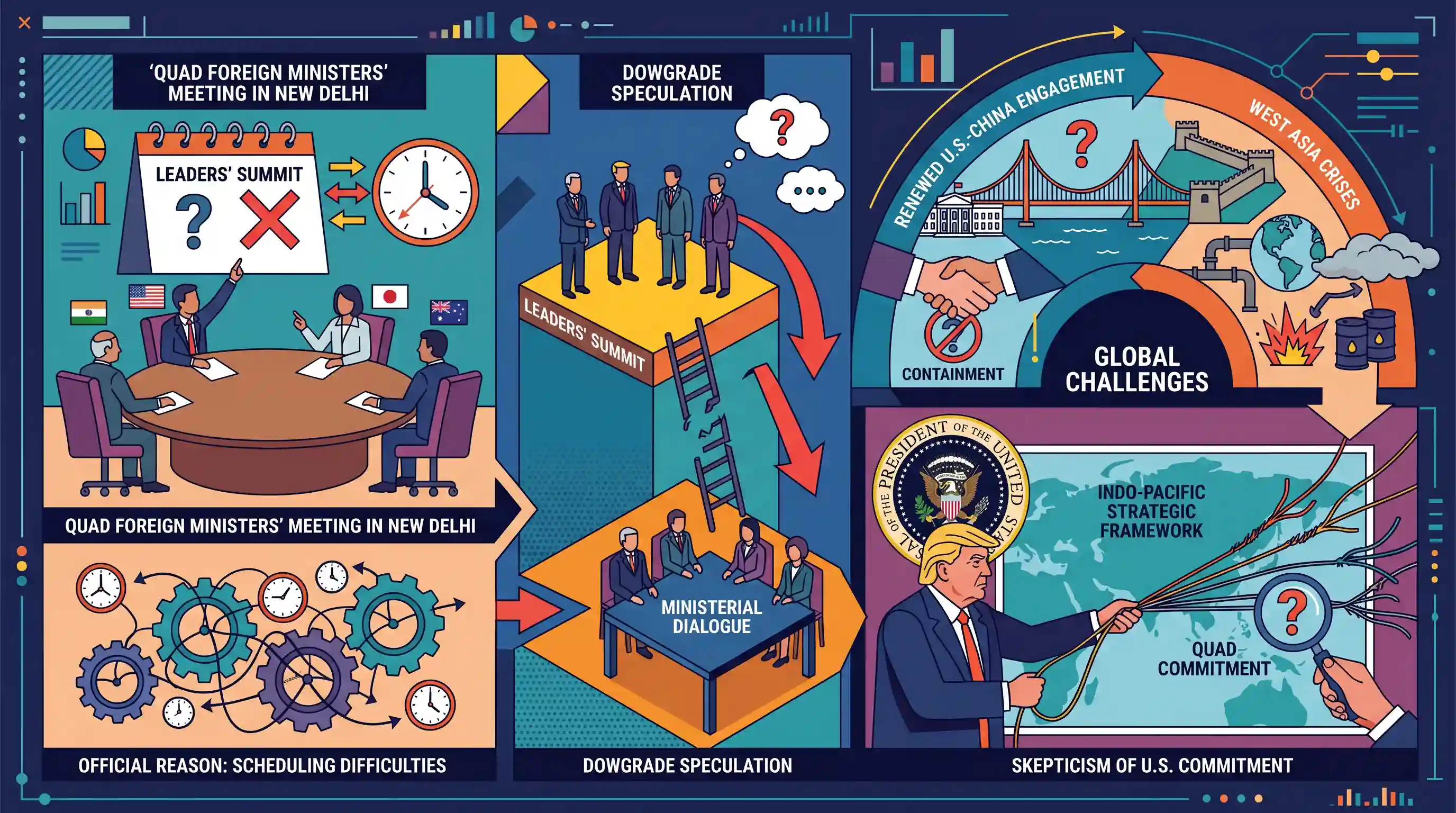
The recent Quad Foreign Ministers' meeting in New Delhi ended without setting a date for the upcoming leaders' summit, raising questions about the grouping's future. Official statements cited scheduling difficulties among the leaders of India, Australia, Japan, and the U.S. However, the lack of clarity has led to speculation that the Quad may be downgraded back to a ministerial dialogue. Amidst a renewed U.S.-China engagement and ongoing crises in West Asia, there is growing skepticism regarding the ongoing commitment of the U.S. under President Donald Trump to the Quad's strategic framework in the Indo-Pacific.
Key Points
- The Quad Foreign Ministers' meeting in New Delhi concluded without determining a date for the next leaders' summit, originally slated to be hosted by India.
- The lack of a scheduled summit has fueled speculation that the Quad might revert to a ministerial-level dialogue, stepping down from its 2021 upgrade.
- While scheduling conflicts among leaders are officially cited, skepticism exists regarding the U.S. commitment under President Donald Trump, especially given his forthcoming bilateral engagements with China's Xi Jinping.
- Australia is set to host the next Foreign Ministers' meeting, and any potential Quad Summit may be sidelined to margins of other multilateral events like the UN General Assembly or the G-20 Summit.
Important Terms
Quad (Quadrilateral Security Dialogue)

An informal strategic dialogue between India, USA, Japan, and Australia focused on ensuring a "Free and Open Indo-Pacific" and enhancing regional maritime security.
UPSC context
GS Paper 2 (International Relations); relevant for Indo-Pacific geopolitics and India's shift toward issue-based alignments.
G-7 (Group of Seven)
An informal forum of seven advanced economies—Canada, France, Germany, Italy, Japan, the UK, and the USA—addressing global economic governance, security, and energy.
UPSC context
GS Paper 2 (International Relations); tests knowledge of global governance and India's engagement as a frequent outreach guest.
UN General Assembly (UNGA)
The main deliberative and representative organ of the United Nations, where all 193 member states discuss global issues with equal voting power.
UPSC context
GS Paper 2 (International Relations); fundamental for multilateral diplomacy, UN reforms, and international law topics.
G-20 (Group of Twenty)
The premier forum for international economic cooperation, comprising 19 major countries, the European Union, and the African Union, representing 85% of global GDP.
UPSC context
GS Paper 2 (International Relations/Economic Development); essential for questions on global economic steering and the Global South.
Ministry of External Affairs (MEA)
The Indian government ministry responsible for managing foreign relations, executing diplomatic policy, and representing the nation in international organizations.
UPSC context
GS Paper 2 (Indian Polity/International Relations); critical for understanding the institutional framework of India’s diplomacy.
Prelims Trap
"The Quad is a formal military alliance with a permanent secretariat coordinating Indo-Pacific security."
The Quad is an informal minilateral dialogue. It explicitly lacks a foundational treaty, charter, or permanent secretariat, and denies being an "Asian NATO" or military alliance.
Static Concepts Connected
What distinguishes 'minilateralism' from traditional multilateralism?
- Narrow Focus: They are informal coalitions of a small number of states focused on specific, targeted shared interests rather than universal global issues.
- Institutional Structure: Minilaterals lack formal treaties, charters, or permanent secretariats, which allows for greater flexibility and lower bureaucratic overhead.
- Strategic Agility: They enable faster decision-making, deliberately avoiding the consensus-based gridlock frequently seen in broad multilateral bodies like the UN or WTO.
How does the Quad's mandate differ from AUKUS in the Indo-Pacific?
- Fundamental Nature: AUKUS is a binding trilateral military and security pact, whereas the Quad is an informal, non-military strategic dialogue.
- Core Mandate: AUKUS focuses strictly on advanced defense technology sharing (nuclear submarines, AI), while the Quad spans civilian domains like vaccines, climate, and tech standards.
- Membership Profiles: While both group democracies addressing Indo-Pacific stability, India and Japan are foundational to the Quad but are excluded from AUKUS.
Cross-Topic Patterns
Multi-alignment and overlapping groupings
India actively balances its Quad membership with participation in non-Western platforms like SCO and BRICS, showcasing a foreign policy driven by issue-based alignment rather than bloc politics.
Economic statecraft in the Indo-Pacific
The Quad’s evolving mandate connects to broader regional de-risking strategies, tested alongside the Indo-Pacific Economic Framework (IPEF) and the Supply Chain Resilience Initiative (SCRI).

Expect a prelims question contrasting the informal, non-military nature of the Quad and I2U2 with the formal security pact of AUKUS.
Linked PYQs · 1
Linked PYQs · 1
- 2020MainsGS2
Quadrilateral Security Dialogue (Quad)' is transforming itself into a trade bloc from a military alliance, in present times - Discuss.
