Andes Hantavirus Transmission Risks and WHO Surveillance
Source:The Hindu ↗
Why It Matters
Zoonotic diseases and rare viral outbreaks are critical areas for UPSC GS3 (Science & Technology - Health) as global pandemics and epidemic preparedness have become central to health governance. The Andes hantavirus specifically highlights the mechanisms of human-to-human viral transmission and the role of global health bodies like the WHO in monitoring genomic mutations and coordinating emergency responses.
Summary
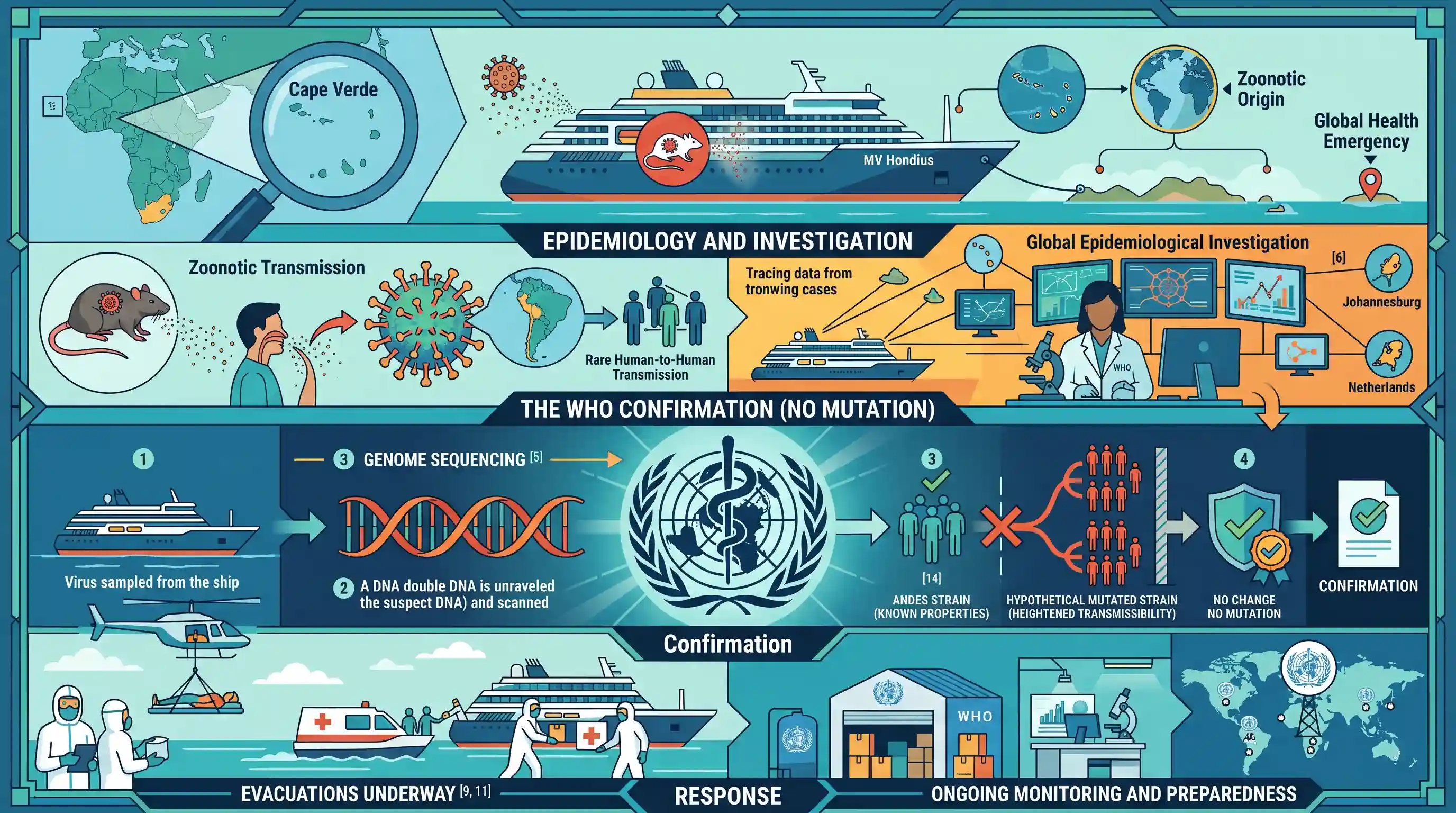
The World Health Organization (WHO) has confirmed that the Andes strain of the hantavirus, currently affecting passengers and crew on the MV Hondius cruise ship off Cape Verde, has not mutated to become more transmissible. While the Andes strain is a rare variant known to allow human-to-human transmission, genome sequencing indicates no changes that would heighten its infectiousness. Evacuations of infected individuals from the ship are underway.
Key Points
- An outbreak of the rare Andes strain of hantavirus has occurred on the cruise ship MV Hondius, anchored off Cape Verde.
- The Andes strain is notable for being capable of human-to-human transmission.
- The World Health Organization (WHO) stated that there are no sequence changes to the virus that would indicate it has become more transmissible.
- Patients are currently being evacuated from the stricken ship for medical attention.
Important Terms
World Health Organization (WHO)

A specialized United Nations agency established in 1948 to coordinate international public health, set global health standards, and monitor emerging infectious disease threats.
UPSC context
GS Paper 2: International Relations; important for understanding global health governance and the mandate of UN-affiliated bodies.
Zoonotic Disease
Any infectious disease that is naturally transmissible from vertebrate animals to humans; examples include Rabies, Nipah, and Hantavirus.
UPSC context
GS Paper 3: Science & Technology and Environment; tests knowledge of disease spillover and its link to biodiversity loss.
Andes Hantavirus
A specific viral strain primarily found in South America, unique among hantaviruses for its documented (though rare) ability to spread directly between humans.
UPSC context
GS Paper 3: Science & Technology; relevant for emerging viral threats and specific pathogen characteristics in public health.
Genome Sequencing
The laboratory process of determining the complete DNA or RNA sequence of an organism, used to track mutations and identify the source of outbreaks.
UPSC context
GS Paper 3: Science & Technology; a core topic regarding biotechnological applications in healthcare and epidemiology.
International Health Regulations (IHR)
A legally binding international framework (revised 2005) requiring countries to report specific disease outbreaks to the WHO to prevent international spread.
UPSC context
GS Paper 2: International Relations/Governance; vital for understanding legal obligations and protocol during global health emergencies.
Human-to-Human Transmission
The spread of a pathogen from one person to another via droplets, aerosols, or direct contact, a critical factor in determining an outbreak's pandemic potential.
UPSC context
GS Paper 3: Science & Technology; crucial for understanding epidemiological risk assessment and public health containment strategies.
Prelims Trap
Hantaviruses are exclusively transmitted via insect vectors, and no strain allows human-to-human transmission.
Hantaviruses spread via aerosolized rodent excreta, not insects. While most strains do not spread between humans, the Andes strain is a natural exception.
Static Concepts Connected
How does Hantavirus transmission differ from vector-borne diseases like Dengue?
- Rodent reservoirs: Transmitted to humans primarily through the aerosolization and inhalation of infected rodent urine, feces, or saliva.
- Non-arthropod: Unlike Dengue, Malaria, or Zika, hantaviruses do not rely on mosquito or tick arthropod vectors.
- Human transmission: Generally incapable of spreading between people, with the Andes Orthohantavirus being a rare, natural exception.
Why is genome sequencing critical during viral disease outbreaks?
- Tracking mutations: Identifies genetic changes in the virus's RNA/DNA that could heighten infectiousness or alter disease severity.
- Transmission mapping: Helps epidemiologists trace the exact origin and spread pathways of the pathogen globally.
- Countermeasure development: Provides the genetic blueprint necessary to develop targeted diagnostic tests, vaccines, and therapeutic countermeasures.
Cross-Topic Patterns
Cruise ships as global outbreak vectors
Closed maritime environments act as rapid incubators for pathogens, creating jurisdictional challenges under International Health Regulations for quarantines and evacuations.
Single-stranded RNA virus stability
Being RNA viruses, Hantaviruses are closely monitored by the WHO for rapid mutations, tying into broader syllabus themes of biotechnology and viral genomics.

Expect a multi-statement Prelims question contrasting the transmission mechanisms of emerging viral strains (Hantavirus vs. Nipah/Dengue).
Linked PYQs · 4
Linked PYQs · 4
- 2023PrelimsGS1
'Wolbachia method' is sometimes talked about with reference to which one of the following?
- 2019PrelimsGS1
Which one of the following statements is not correct?
- 2017PrelimsGS1
Consider the following statements: 1. In tropical regions, Zika virus disease is transmitted by the same mosquito that transmits dengue. 2. Sexual transmission of Zika virus disease is possible. Which of the statements given above is/are correct?
- 2020MainsGS2
Critically examine the role of WHO in providing global health security during the Covid-19 pandemic.
