Small savings schemes interest rates unchanged for eighth quarter
Source:The Hindu ↗
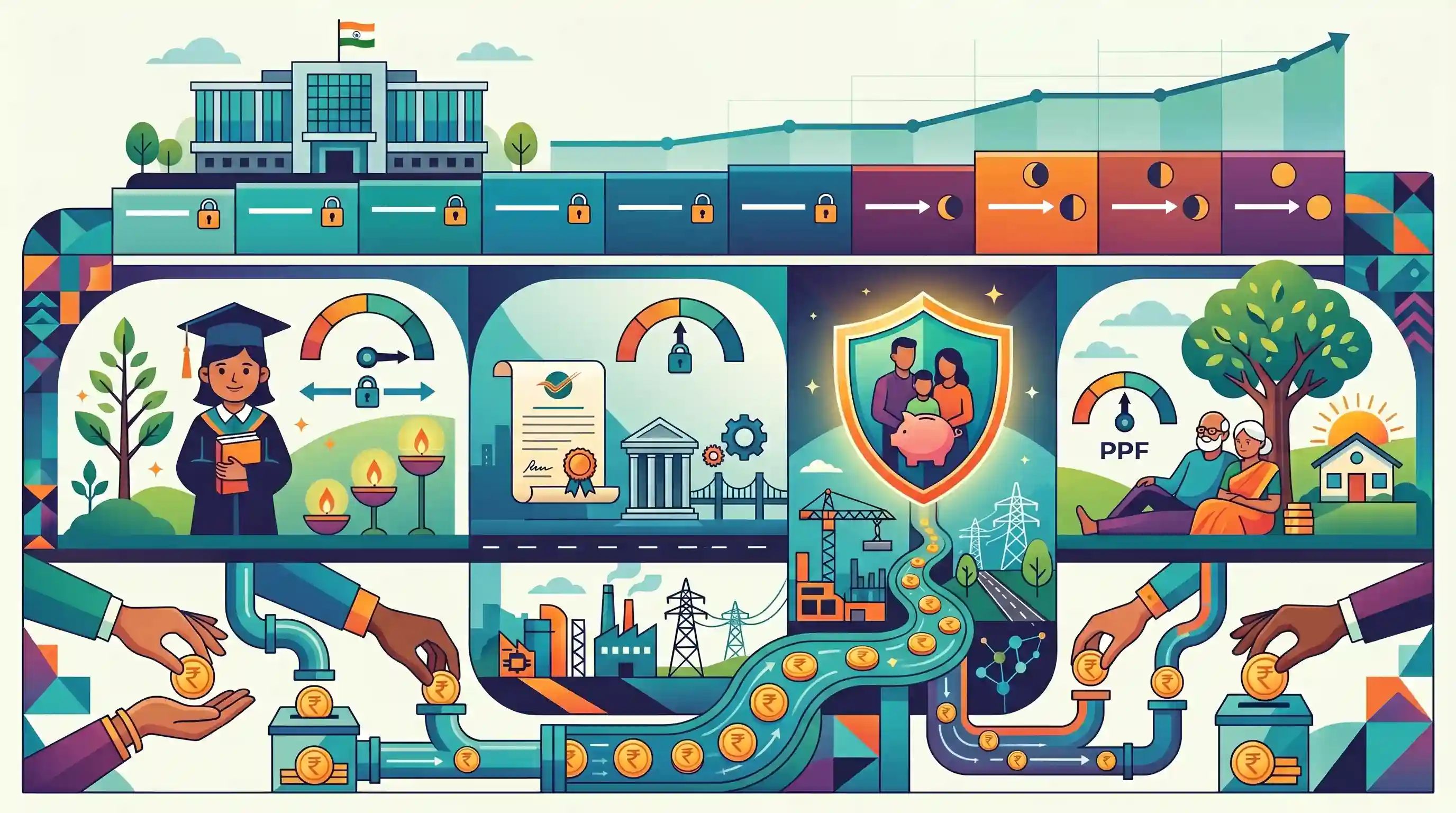
Why It Matters
Small savings schemes are foundational to India's financial inclusion framework and domestic resource mobilization. The National Small Savings Fund (NSSF) channels these deposits into government borrowing. UPSC frequently tests the specific features, objectives, and targeted demographics of components like the Sukanya Samriddhi Yojana (women's empowerment) and PPF (long-term savings).
Summary
The Union Finance Ministry has announced that interest rates on small savings schemes will remain unchanged for the first quarter of the financial year 2026-27 (April 1 to June 30). This is the eighth straight quarter with no revisions. Key schemes like the Sukanya Samriddhi Scheme will continue to yield 8.2%, the Public Provident Fund (PPF) will earn 7.1%, and the National Savings Certificate (NSC) will offer 7.7%. The rates, which provide secure investment avenues for retail investors and help the government mobilize domestic savings, are reviewed quarterly.
Key Points
- The Government of India has maintained the interest rates on small savings schemes unchanged for the first quarter of FY 2026-27 (April 1 to June 30).
- This marks the eighth consecutive quarter without any revision in these interest rates.
- The Sukanya Samriddhi Scheme and the Senior Citizen Savings Scheme continue to offer the highest returns at 8.2%.
- The Public Provident Fund (PPF) and three-year term deposits remain at 7.1%, while the National Savings Certificate (NSC) yields 7.7%.
- The Kisan Vikas Patra (KVP) interest rate remains at 7.5%, with a maturity period of 115 months.
Important Terms
Small Savings Schemes

Government-backed investment instruments (like PPF, NSC) designed to encourage retail savings and mobilize domestic resources for public expenditure.
UPSC context
GS III: Mobilization of Resources. Tests understanding of non-market borrowing and internal debt.
Public Provident Fund (PPF)
A 15-year voluntary savings-cum-tax-reduction social security instrument offering guaranteed returns and EEE (Exempt-Exempt-Exempt) tax status.
UPSC context
GS III: Social Security. Relevant for long-term household savings and fiscal policy.
Sukanya Samriddhi Account (SSA)
A flagship savings scheme for girl children under 10, launched under the 'Beti Bachao Beti Padhao' campaign to meet education and marriage expenses.
UPSC context
GS II: Welfare Schemes for vulnerable sections. Focuses on social empowerment and financial inclusion.
National Savings Certificate (NSC)
A fixed-income post office savings bond with a five-year maturity, used by low-to-mid income investors for small savings and tax deductions.
UPSC context
GS III: Economic Development. Tests knowledge of household financial assets and resource mobilization.
Senior Citizen Savings Scheme (SCSS)
A government-backed retirement program for individuals aged 60+, providing regular quarterly income through a lump-sum deposit with tax benefits.
UPSC context
GS III: Social Security. Relevant for demographic transition and welfare of the elderly.
Kisan Vikas Patra (KVP)
A post office savings certificate that doubles the initial investment over a fixed tenure, providing a low-risk, fixed-interest avenue.
UPSC context
GS III: Mobilization of Resources. Tests awareness of diverse financial inclusion and savings tools.
Prelims Trap
Deposits under Small Savings Schemes form part of the Consolidated Fund of India.
They are credited to the National Small Savings Fund (NSSF) under the Public Account of India, not the CFI. The government acts as a banker for these funds.
Static Concepts Connected
What is the National Small Savings Fund (NSSF) and how is it utilized?
- Public Account: Established in 1999 within the Public Account of India to pool all small savings collections, keeping them distinct from the Consolidated Fund of India.
- Deficit Financing: Balances are primarily invested in Central and State Government securities, serving as a critical non-market internal borrowing source to fund the fiscal deficit.
- Rate Formula: Interest rates are administered quarterly by the Finance Ministry, linked to comparable G-Sec yields based on Shyamala Gopinath Committee recommendations.
How do the maturity rules of major small savings schemes differ?
- PPF Maturity: Comes with a strict 15-year maturity period, which can be extended in blocks of five years, acting as a long-term retirement and tax-saving net.
- SSY Lock-in: Matures 21 years from account opening, or upon the marriage of the girl child after she turns 18, under the Beti Bachao Beti Padhao campaign.
- KVP Dynamics: Guarantees doubling of the principal amount. Its maturity period (currently 115 months) fluctuates dynamically based on the prevailing interest rate fixed by the government.
Cross-Topic Patterns
Fiscal Deficit & Non-Market Borrowing
NSSF collections are a crucial source of internal borrowing for the government, shifting reliance from pure market loans (G-Secs) to Public Account liabilities to bridge the fiscal gap.
Monetary Policy Transmission Hurdles
Rigidly high administered rates on small savings schemes often hinder the RBI's monetary transmission, as commercial banks struggle to lower their deposit rates when competing with lucrative government schemes.

Expect a multi-statement Prelims question linking NSSF's Public Account status, fiscal deficit financing, and G-Sec yield linkages.
Linked PYQs · 3
Linked PYQs · 3
- 2024PrelimsGS1
Consider the following: 1. Exchange-Traded Funds (ETF) 2. Motor vehicles 3. Currency swap Which of the above is/are considered financial instruments?
- 2024PrelimsGS1
With reference to the Pradhan Mantri Shram Yogi Maan-dhan (PM-SYM) Yojana, consider the following statements : 1. The entry age group for enrolment in the scheme is 21 to 40 years. 2. Age specific contribution shall be made by the beneficiary. 3. Each subscriber under the scheme shall receive a minimum pension of ₹ 3,000 per month after attaining the age of 60 years. 4. Family pension is applicable to the spouse and unmarried daughters. Which of the statements given above is/are correct?
- 2024PrelimsGS1
With reference to the Pradhan Mantri Jan Dhan Yojana (PMJDY), which of the following statements is/are correct? 1. The scheme aims to open bank accounts for unbanked households. 2. There is a minimum balance requirement for accounts opened under this scheme. 3. Beneficiaries get a Rupay Debit Card with an inbuilt accident insurance cover. Select the correct answer using the code given below.
