केंद्रीय बजट में राजकोषीय विवेक और लोकलुभावनवाद से बचाव
स्रोत:इंडियन एक्सप्रेस ↗
क्यों मायने रखता है
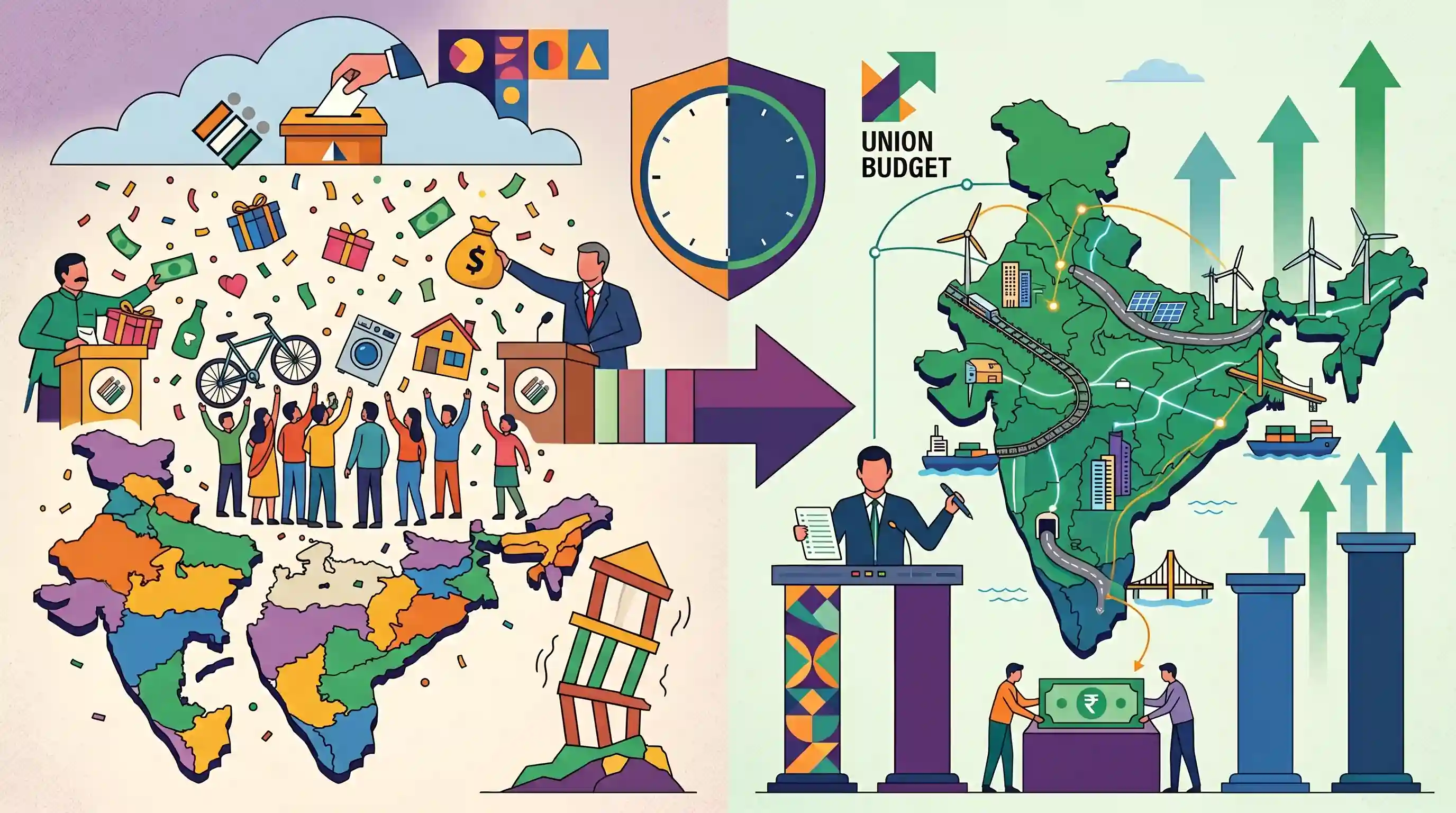
Highlights the critical tension between macroeconomic fiscal prudence and electoral populism, which is a recurrent theme in India's political economy and public finance management.
सारांश
The Union Budget 2026 marks a departure from traditional pre-election budgeting by avoiding big-ticket sops or specific economic packages for poll-bound states. This shift highlights a focus on broader fiscal consolidation, macroeconomic stability, and long-term capital expenditure over short-term electoral populism. It also reflects an evolving political strategy that attempts to distance the central budget from the competitive "freebie" (revdi) culture, instead focusing on a pan-India economic narrative. This dynamic is highly relevant to debates on public expenditure management, fiscal prudence, and evolving Centre-State financial relations.
मुख्य बिंदु
- The Union Budget 2026 avoids announcing state-specific economic packages or populist "sops" for states heading to the polls, breaking a long-standing political tradition.
- The move signals the government's commitment to fiscal prudence, prioritizing deficit reduction and long-term capital expenditure over immediate electoral gains.
- This development brings attention to the ongoing debates around the "freebie" (revdi) culture and how electoral populism complicates public expenditure management.
- It subtly reshapes Centre-State financial relations by centralizing the budget's narrative around pan-India macroeconomic growth rather than state-specific electoral appeasement.
महत्वपूर्ण शब्द
Union Budget 2026-27

India's annual financial statement for FY 2026-27, emphasizing "Action over Ambivalence" and long-term growth. It prioritizes infrastructure-led expansion and strategic reforms over short-term electoral sops or "freebies."
UPSC context
GS Paper 3: Government Budgeting. Essential for understanding current economic priorities and the transition from populism to stability.
Fiscal Consolidation
Policy measures aimed at reducing the government's fiscal deficit and public debt as a percentage of GDP. It involves revenue enhancement and disciplined expenditure to ensure long-term macroeconomic stability.
UPSC context
GS Paper 3: Indian Economy. Key concept for fiscal policy, FRBM Act targets, and debt sustainability.
Revdi Culture (Populism)
A colloquial term used in India to describe the practice of political parties offering free goods, services, or cash transfers (freebies) to voters to secure electoral support, often at the cost of fiscal health.
UPSC context
GS Paper 2: Governance & Elections. Relevant for debates on ethical campaigning versus sustainable welfare and public expenditure management.
Centre-State Financial Relations
The constitutional division of financial powers between the Union and States. It involves tax devolution, grants-in-aid, and borrowing limits, primarily governed by Articles 268-293 and Finance Commission recommendations.
UPSC context
GS Paper 2: Federalism. Critical for questions on fiscal federalism, devolution (vertical/horizontal), and state financial autonomy.
Capital Expenditure (Capex)
Government spending on the creation of physical and social assets like roads, railways, and hospitals. It is considered "productive" as it generates future income and improves economic efficiency.
UPSC context
GS Paper 3: Budgeting. Key indicator of the government’s growth strategy and its multiplier effect on the economy.
FRBM Act (2003)
A statutory framework enacted in 2003 to institutionalize fiscal discipline by setting targets for reducing fiscal and revenue deficits, aiming for long-term debt sustainability.
UPSC context
GS Paper 3: Economic Development. The primary legal benchmark for measuring the government's commitment to fiscal prudence.
16th Finance Commission
A constitutional body (Article 280) that recommends the distribution of net tax proceeds between the Centre and States (vertical) and among States (horizontal) for five-year periods.
UPSC context
GS Paper 2: Constitutional Bodies. Vital for current affairs questions regarding tax devolution shares and federal grants.
प्रारंभिक ट्रैप
"The Election Commission has statutory powers under the RPA, 1951 to ban political parties from promising irrational freebies."
Under the S. Subramaniam Balaji judgment (2013), the SC ruled that manifesto promises do not constitute 'corrupt practices' under the Representation of the People Act, 1951.
संबंधित अवधारणाएँ
How does Capital Expenditure differ from Revenue Expenditure?
- Capital Expenditure: Creates physical or financial assets, or reduces financial liabilities (e.g., infrastructure, loan repayment).
- Revenue Expenditure: Incurred for day-to-day operations and consumption without asset creation (e.g., salaries, subsidies, poll sops).
- Multiplier Effect: Capex has a significantly higher macroeconomic multiplier effect, crowding in private investment and creating long-term growth capacity compared to revenue sops.
What distinguishes 'freebies' from legitimate welfare measures?
- Constitutional mandate: Legitimate welfare measures (PDS, MNREGA, health) fulfill the state's obligations under Part IV (Directive Principles) of the Constitution.
- Irrational freebies: Freebies generally involve distributing private consumer goods (TVs, laptops) that distort the electoral playing field without creating public assets or long-term capacity.
- Judicial scrutiny: A 2022 SC petition proposed treating irrational freebies as a violation of the constitutional mandate of free and fair elections, demanding strict ECI guidelines.
अंतर-विषय पैटर्न
State debt and RBI's risk warnings
The Centre's fiscal prudence contrasts with highly indebted states. RBI frequently flags states' off-budget borrowings, guarantees, and return to Old Pension Scheme (OPS) as significant macroeconomic risks.
Conditional borrowing and Article 293
The Centre controls state fiscal profligacy by linking extra borrowing limits (under Article 293) to specific sectoral reforms, such as power sector revamps and capital expenditure targets.

Expect a Mains GS2/GS3 question evaluating the legal and economic boundaries between DPSP-driven welfare schemes and irrational freebies.
संबद्ध PYQ · 3
संबद्ध PYQ · 3
- 2019MainsGS3
The public expenditure management is a challenge to the Government of India in the context of budget making during the post-liberalization period. Clarify it.
- 2025MainsGS2
Examine the evolving pattern of Centre-State financial relations in the context of planned development in India. How far have the recent reforms impacted the fiscal federalism in India?
- 2024MainsGS2
Examine the need for electoral reforms as suggested by various committees with particular reference to "one nation one election" principle.
