Navi Mumbai Airport Launch and Project Affected Persons Rehabilitation
Source:Indian Express ↗
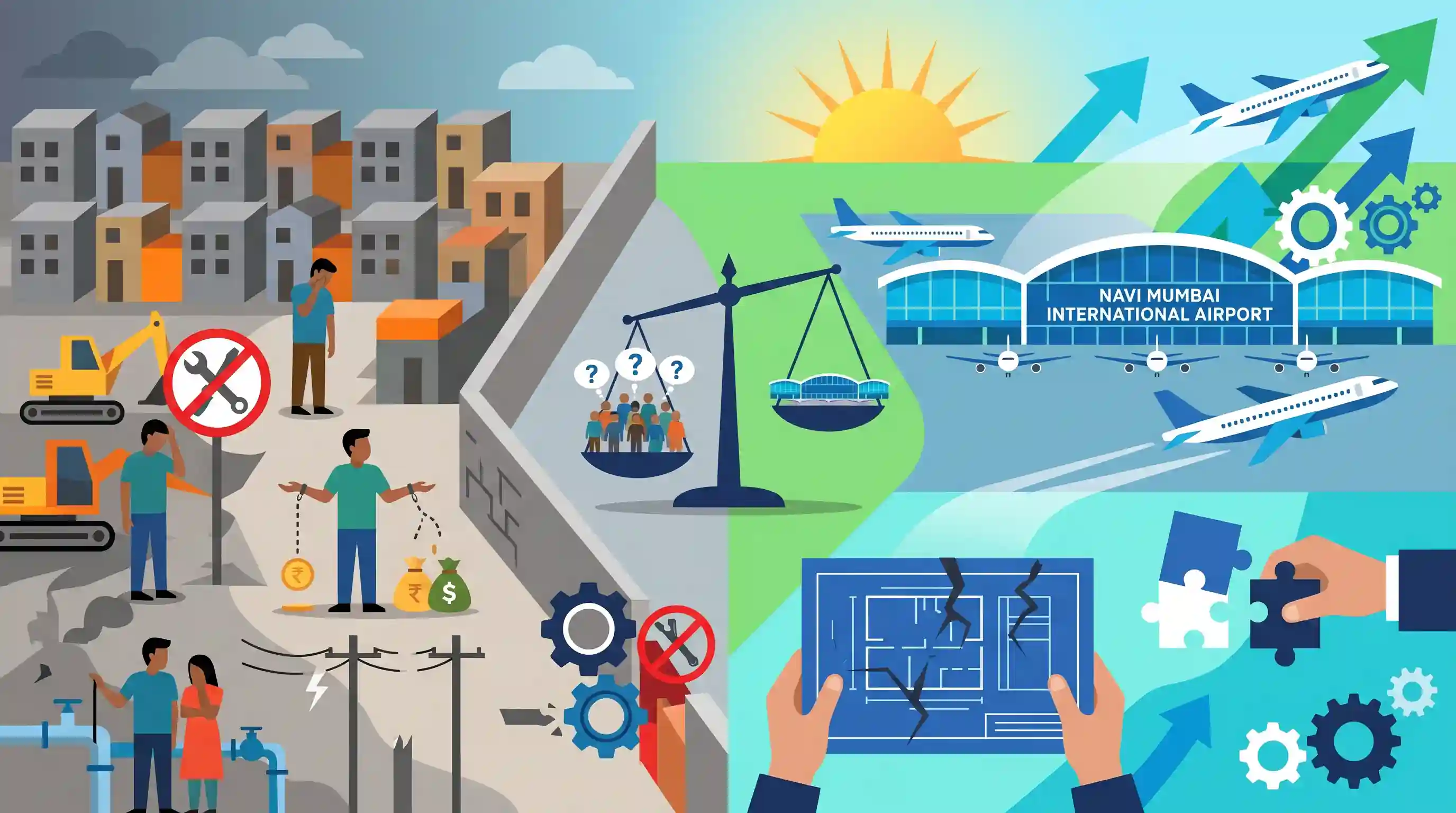
Why It Matters
The article highlights the human and social costs associated with mega-infrastructure projects. It provides a real-world case study on the gaps between statutory rehabilitation policies and ground realities, essential for evaluating inclusive growth and infrastructure planning in GS Paper 3 and social impact in GS Paper 1.
Summary
While test flights at the Navi Mumbai International Airport (NMIA) have commenced, signaling major progress in the infrastructure project, the Project Affected Persons (PAPs) displaced by land acquisition continue to face unfulfilled promises. Many relocated families are still awaiting promised employment opportunities, adequate compensation, and basic civic amenities in their resettlement areas. This ongoing disparity underscores the systemic challenges and socio-economic trade-offs inherent in large-scale infrastructure development, raising critical concerns regarding inclusive growth and the effective implementation of rehabilitation policies.
Key Points
- The Navi Mumbai International Airport (NMIA) is nearing operational readiness, marked by the commencement of initial test flights.
- The greenfield airport project necessitated the acquisition of land from multiple villages, displacing locals who are designated as Project Affected Persons (PAPs).
- Despite the rapid development of the aviation infrastructure, promises regarding comprehensive compensation, guaranteed local employment, and essential civic amenities in resettlement nodes remain largely unfulfilled.
- The persistent delays in rehabilitation highlight systemic flaws in executing Resettlement and Rehabilitation (R&R) frameworks, pitting rapid infrastructural growth against the socio-economic welfare of displaced communities.
Important Terms
Right to Fair Compensation and Transparency in Land Acquisition, Rehabilitation and Resettlement Act, 2013

A 2013 law replacing the 1894 Act to ensure fair compensation, transparency, and mandatory rehabilitation for individuals displaced by land acquisition for public or private projects.
UPSC context
GS II & III; tests knowledge of land reforms and balancing industrial growth with social justice.
Project Affected Persons (PAPs)
Individuals or families losing land, residence, or primary livelihoods due to project-induced displacement, entitled to legal protections and compensation under national R&R policies.
UPSC context
GS II (Social Justice); critical for understanding the human cost of infrastructure and vulnerable sections.
Social Impact Assessment (SIA)
A mandatory study under the 2013 Act to evaluate a project's impact on communities, livelihoods, and public purpose before land acquisition is approved.
UPSC context
GS III; evaluates the state's capacity to ensure equitable project design and minimize displacement.
City and Industrial Development Corporation (CIDCO)
The Maharashtra government planning agency acting as the nodal authority for the Navi Mumbai International Airport, responsible for land acquisition and regional development.
UPSC context
GS III (Infrastructure); relevant for studies on Public-Private Partnerships and urban planning authorities.
Resettlement and Rehabilitation (R&R)
A policy framework ensuring displaced persons are physically relocated (resettlement) and provided with livelihood support and amenities (rehabilitation) to restore their living standards.
UPSC context
GS II (Governance); tests the implementation of welfare-centric development and state accountability.
Inclusive Growth
Economic growth that creates equal opportunities for all segments of society while reducing poverty and inequality, ensuring benefits reach marginalized populations.
UPSC context
GS III (Economy); central theme for questions on development vs. displacement and sustainable goals.
Prelims Trap
"Under the Greenfield Airports Policy, the Central Government (Ministry of Civil Aviation) is solely responsible for land acquisition."
Land acquisition and R&R for Greenfield Airports are the responsibility of the State Government or the respective airport developer, not the Central Government.
Static Concepts Connected
What are the consent and SIA requirements under the LARR Act 2013?
- Mandatory SIA: Systematically evaluates if the project serves a public purpose and maps the socio-economic impacts on displaced families.
- Consent Clause: Requires 80% consent of affected families for private projects and 70% for Public-Private Partnership (PPP) projects.
- Comprehensive R&R: Mandates an R&R award comprising housing, employment guarantees, and civic amenities alongside fair financial compensation.
How does Rehabilitation integrate with Environmental Impact Assessment (EIA)?
- Management Plan: An effective R&R plan is evaluated as a core mitigation component within the Environmental Management Plan (EMP).
- Public Hearing: Displaced communities can raise grievances regarding inadequate rehabilitation during the mandatory public consultation phase of EIA.
Cross-Topic Patterns
Infrastructure Push vs Social Justice
The tension between rapid capital expenditure on greenfield airports (GS3) and delayed socio-economic welfare of displaced persons (GS2) is a recurring UPSC mains theme.
SIA and EIA Convergence
UPSC frequently merges environmental clearance mechanisms (EIA) with the social costs of displacement (SIA under LARR 2013) to test holistic governance and inclusive growth.

Expect a multi-statement prelims question combining Greenfield Airport Policy provisions with LARR Act 2013 consent requirements in 2026.
Linked PYQs · 3
Linked PYQs · 3
- 2016MainsGS3
Rehabilitation of human settlements is one of the important environmental impacts which always attracts controversy while planning major projects. Discuss the measures to be adopted to mitigate the impact of the recent incidents of cloudbursts in many places of Uttarakhand.
- 2021MainsGS3
“Investment in infrastructure is essential for more rapid and inclusive economic growth.” Discuss in the light of India's experience.
- 2025MainsGS1
Does tribal development in India centre around two axes, those of displacement and of rehabilitation? Give your opinion.
