National Medical Commission Regulatory Policy Repeal and Standards
Source:The Hindu ↗
Why It Matters
It highlights regulatory instability and accountability concerns within India's apex medical education regulator, directly impacting the quality of medical human resources and public healthcare delivery.
Summary
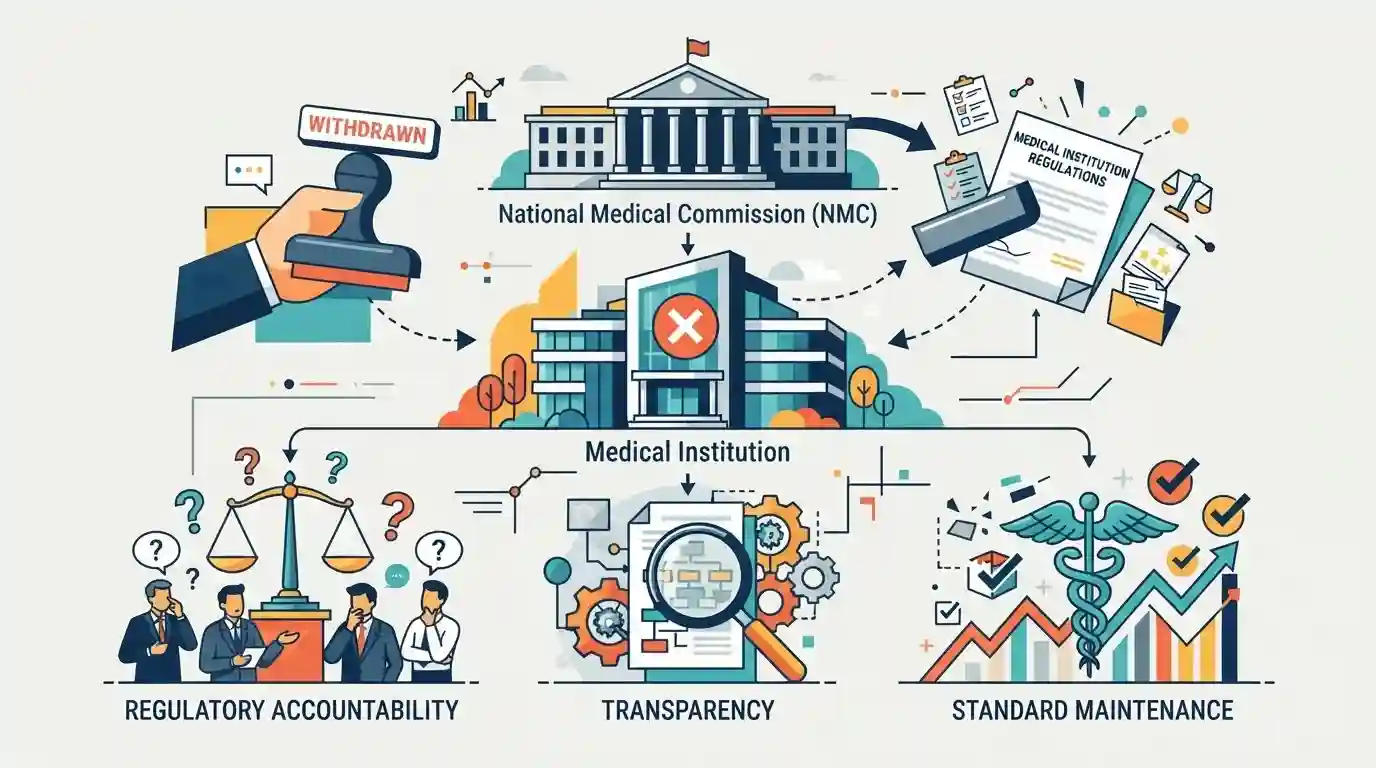
The National Medical Commission (NMC) has withdrawn the 'Establishment of Medical Institutions, Assessment and Rating Regulations, 2023', triggering fresh debates regarding regulatory accountability, transparency, and standard maintenance in India's medical education framework.
Key Points
- The National Medical Commission (NMC) has withdrawn its contentious 2023 rules on medical education standards (Establishment of Medical Institutions, Assessment and Rating Regulations, 2023).
- The withdrawal has raised serious accountability, transparency, and regulatory oversight concerns among medical professionals and public health advocates.
- The 2023 regulations were intended to streamline the setting up of new medical colleges and fix standards for medical education, but faced intense scrutiny over diluted benchmarks.
- The sudden repeal highlights systemic challenges in institutional regulation and policy flip-flops in India's medical education sector.
Important Terms
National Medical Commission (NMC)

Statutory regulatory body established under the NMC Act, 2019 to replace the Medical Council of India, tasked with determining standards of medical education, licensing, and professional conduct in India.
UPSC context
UPSC GS Paper II (Health, Governance, Statutory Bodies). Tests regulatory framework, institutional accountability, and governance in the medical education sector.
National Medical Commission Act, 2019
Landmark legislation enacted in 2019 that abolished the corruption-plagued Medical Council of India (MCI) and established the NMC along with four autonomous boards for reforming medical education and practice.
UPSC context
UPSC GS Paper II (Polity & Governance / Health Policies). Evaluates legislative reforms in healthcare administration and statutory powers of regulatory bodies.
Establishment of Medical Institutions, Assessment and Rating Regulations, 2023
Regulations notified by the NMC to govern standards, assessment, rating, and penalties for medical colleges, recently withdrawn to eliminate regulatory duplication and streamline oversight.
UPSC context
UPSC GS Paper II (Government Policies & Interventions). Tests issues concerning regulatory transparency, policy rollbacks, and standard maintenance in higher education.
Ministry of Health and Family Welfare
The central government ministry responsible for formulating health policies, overseeing public health administration, and regulating medical education standards through statutory bodies like the NMC.
UPSC context
UPSC GS Paper II (Governance / Social Sector Schemes). Important for understanding executive control, policy implementation, and ministerial oversight in Indian healthcare.
Static Concepts Connected
How is the National Medical Commission (NMC) structured and what are its core autonomous boards?
- NMC Act 2019: Apex Regulator: Replaced the Medical Council of India (MCI) via the NMC Act, 2019 to reform medical education governance.
- Autonomous Boards: UG/PG Boards: Operates through autonomous boards including UGMEB, PGMEB, MARB, and the Ethics and Medical Registration Board.
- Rating Board: MARB Mandate: Responsible for assessing medical institutions, granting permissions, and verifying infrastructure and faculty disclosures.
Cross-Topic Patterns
NMC Act & Statutory Body Reforms
The shift from MCI to NMC mirrors broader governance reforms replacing old corrupt inspector-raj bodies with autonomous expert commissions across education, environment, and competition law.

Expect a statement-based question comparing the statutory powers of the NMC Act 2019 versus the erstwhile Medical Council of India (MCI).
Linked PYQs · 2
Linked PYQs · 2
- 2024MainsGS2
In a crucial domain like the public healthcare system the Indian State should play a vital role to contain the adverse impact of marketisation of the system. Suggest some measures through which the State can enhance the reach of public healthcare at the grassroots level.
- 2023PrelimsGS1
Consider the following statements: Statement-I: India's public sector health care system largely focuses on curative care with limited preventive, promotive and rehabilitative care. Statement-II: Under India's decentralized approach to health care delivery, the States are primarily responsible for organizing health services. Which one of the following is correct in respect of the above statements?
