Minority welfare and political representation in Bihar elections
Source:The Hindu ↗
Why It Matters
The article provides real-world examples of how political representation, minority welfare schemes, and communalism intersect during elections. This is highly relevant for GS-2 (Polity and Social Justice) when discussing the effectiveness of minority welfare, secularism, and the marginalization of vulnerable groups in electoral democracy, as well as for GS-1 (Indian Society) concerning communal violence and social cohesion.
Summary
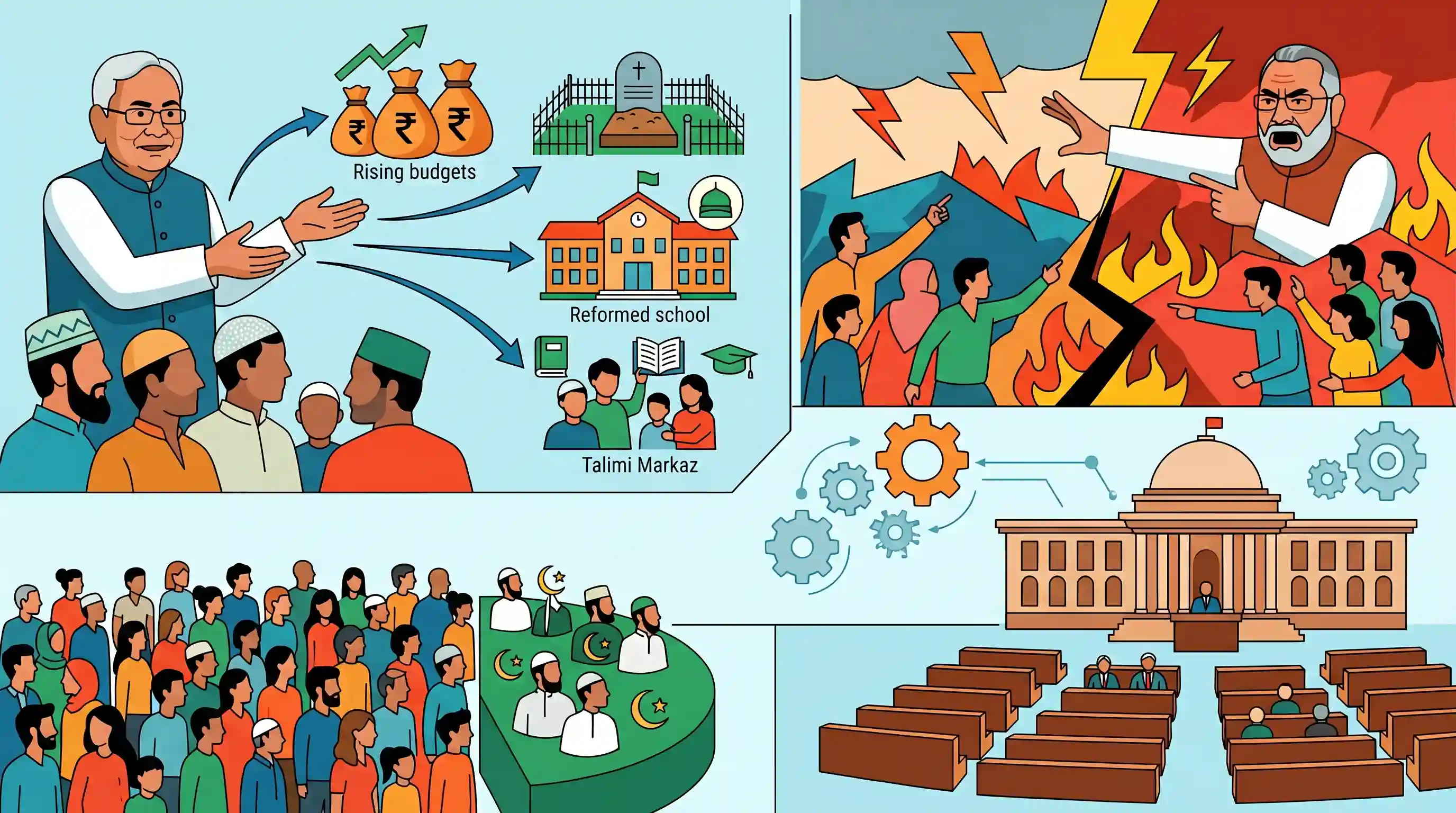
Amidst the Bihar Assembly elections, Chief Minister Nitish Kumar appealed to Muslim voters by citing his government's welfare initiatives—such as increased minority budgets, graveyard fencing, madrasa reforms, and the 'Talimi Markaz' scheme—to counter polarizing remarks by BJP leader Giriraj Singh. However, despite Muslims constituting 17.7% of the state's population, the ruling NDA alliance fielded only five Muslim candidates out of 243 seats. This highlights a persistent gap in Indian politics between welfare-based appeasement, communal rhetoric, and genuine political representation for minorities.
Key Points
- Bihar Chief Minister Nitish Kumar highlighted his government's welfare initiatives for Muslims, including a massive hike in the Minority Welfare Department budget, madrasa teacher parity, and the 'Talimi Markaz' and 'Hunar' schemes.
- The state government cited proactive measures against communalism, such as fencing over 8,000 sensitive graveyards and providing justice and pensions to victims of the 1989 Bhagalpur riots.
- Despite welfare measures and comprising 17.7% of Bihar's population, Muslims remain severely under-represented politically, with the ruling NDA fielding only 5 Muslim candidates out of 243 assembly seats.
- The electoral discourse underscores the ongoing tension in Indian democracy between polarizing rhetoric, vote bank politics, and the substantive political empowerment of minority communities.
Important Terms
Talimi Markaz

A Bihar government initiative providing non-formal education and mainstreaming support for out-of-school children from Maha-Dalit, Dalit, and Minority communities.
UPSC context
GS-II: Welfare schemes for vulnerable sections; tests targeted educational interventions for social justice.
Hunar
A skill development scheme in Bihar launched to empower girls from minority (Muslim), SC/ST, and EBC communities through vocational training and self-employment.
UPSC context
GS-II: Social Justice; relevant for women's empowerment and minority upliftment.
Minority Welfare Department
A state-level administrative body responsible for formulating and implementing policies, scholarships, and infrastructure programs for religious and linguistic minorities.
UPSC context
GS-II: Governance; tests knowledge of institutional mechanisms for protecting minority interests.
National Democratic Alliance (NDA)
A center-right political coalition in India led by the BJP, exemplifying the dynamics of coalition governance and federalism in a multi-party system.
UPSC context
GS-II: Indian Polity; relevant for coalition politics and executive-legislature relations.
Janata Dal-United (JD-U)
A Bihar-based political party known for 'Social Justice with Development,' targeting Extremely Backward Classes (EBCs), Pasmanda Muslims, and women.
UPSC context
GS-II: Indian Constitution & Polity; illustrates regional party influence and social engineering.
Prelims Trap
Talimi Markaz and Hunar are Centrally Sponsored Schemes for minority education.
These are state-level welfare initiatives implemented by the Bihar government. Aspirants often confuse 'Hunar' with the Centre's 'Hunar Haat' under the USTTAD scheme.
Static Concepts Connected
What is the difference between Descriptive and Substantive political representation?
- Descriptive Representation: Elected representatives directly mirror the demographic characteristics (religion, gender, caste) of the population they represent.
- Substantive Representation: Representatives actively advocate for and enact policies benefiting marginalized groups, irrespective of their own personal identity or background.
Which constitutional articles specifically safeguard religious and linguistic minority rights?
- Article 29: Secures the fundamental right of distinct cultural, linguistic, or religious groups to conserve their unique heritage.
- Article 30: Grants minorities the fundamental right to establish and administer educational institutions of their choice.
- Article 350B: Mandates the appointment of a Special Officer for Linguistic Minorities to investigate constitutional safeguards.
Cross-Topic Patterns
Paternalistic welfare vs. Political agency
The substitution of genuine descriptive representation in legislatures with targeted state welfare schemes reflects an ongoing shift in Indian minority politics post-Sachar Committee.
Indian Secularism's operational dilemmas
Countering polarizing rhetoric through selective, religion-specific state interventions (like graveyard fencing) frequently sparks debate around the 'principled distance' model of Indian secularism.

Expect a GS-2 Mains question analyzing whether state-led welfare interventions compensate for declining minority political representation.
Linked PYQs · 3
Linked PYQs · 3
- 2024MainsGS2
Discuss India as a secular state and compare with the secular principles of the US constitution.
- 2023MainsGS2
“Development and welfare schemes for the vulnerable, by its nature, are discriminatory in approach.” Do you agree? Give reasons for your answer.
- 2018MainsGS1
Communalism arises either due to power struggle or relative deprivation.' Argue by giving suitable illustrations.
