Coalition Politics and Regional Leadership in Bihar
Source:Indian Express ↗
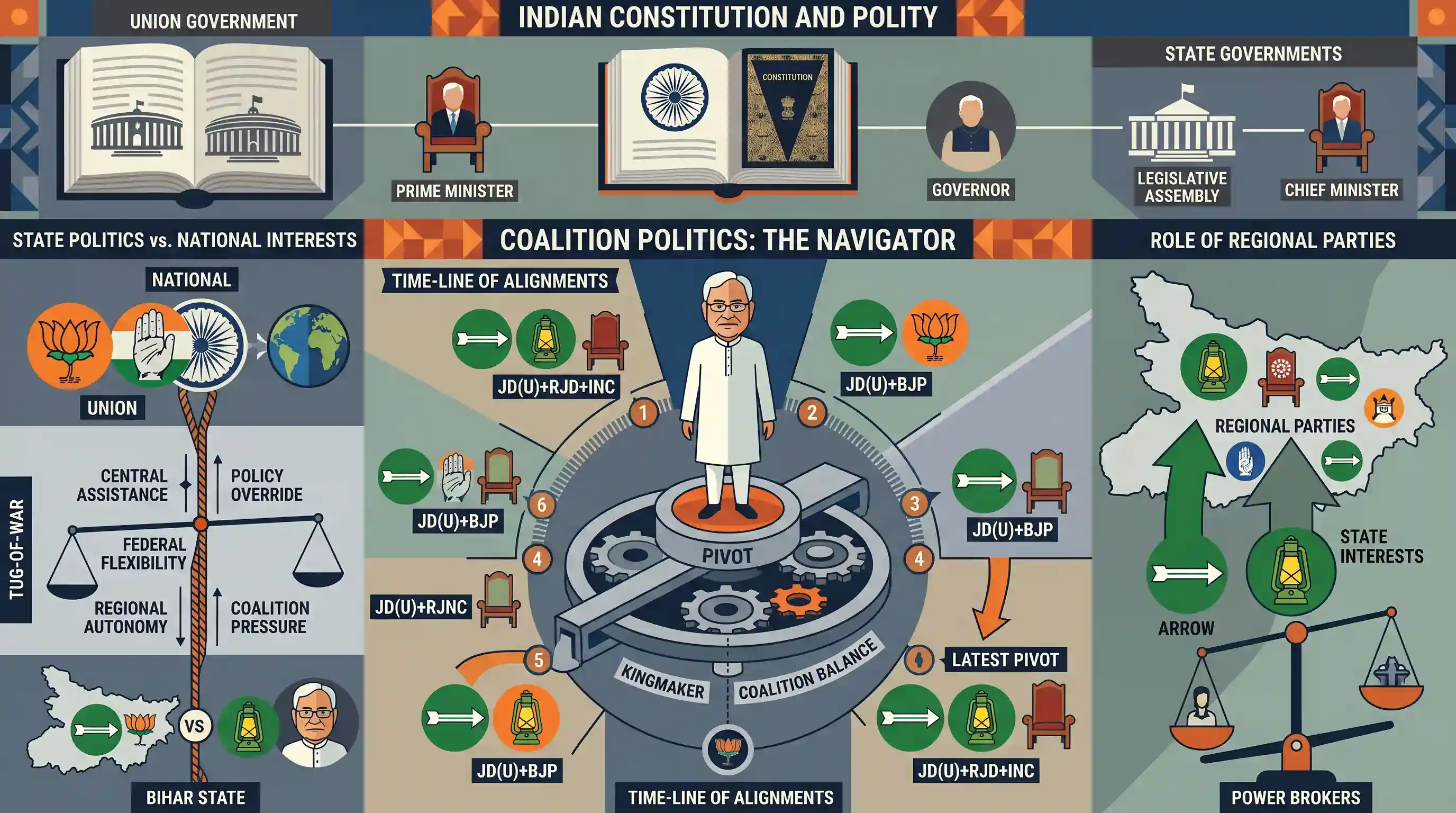
Why It Matters
Understanding the dynamics of coalition politics and the role of regional parties is crucial for analyzing India's federal structure, state governance, and the practical functioning of democracy at the regional level.
Summary
The article discusses the political longevity and strategic maneuvering of Bihar Chief Minister Nitish Kumar, who has repeatedly demonstrated his ability to retain power by navigating complex coalition dynamics. His latest political pivot highlights the fluid nature of state politics, the outsized influence of regional leaders, and the ongoing tug-of-war between national and regional political interests in India's federal structure.
Key Points
- Nitish Kumar continues to be a central figure in Bihar politics, demonstrating remarkable political adaptability and survival skills.
- His repeated ability to pivot between alliances underscores the fluid nature of coalition politics at the state level.
- The political maneuvers reflect the crucial role of regional parties in balancing power dynamics against national parties.
- Such state-level realignments have significant implications for both state governance and national political coalitions.
Important Terms
Janata Dal (United) (JD(U))

A center-left regional party primarily active in Bihar, advocating social justice and socialism. Led by Nitish Kumar, it is a key player in shifting state coalition dynamics.
UPSC context
GS-II/Polity: Tests understanding of regional parties' roles in state governance and their impact on national coalition-building and federal stability.
Bharatiya Janata Party (BJP)
A major national party with a right-wing ideology focused on Hindutva (Hindu nationalism). It leads the National Democratic Alliance (NDA) and is currently the dominant force in national politics.
UPSC context
GS-II/Polity: Tests knowledge of national party systems, political ideologies, and the evolution of one-party dominance versus coalition eras in democracy.
Rashtriya Janata Dal (RJD)
A socialist regional party in Bihar, founded by Lalu Prasad Yadav. It focuses on social justice for backward classes and Muslims, often leading the Mahagathbandhan (Grand Alliance) opposition.
UPSC context
GS-II/Polity: Tests the intersection of caste identity, social justice, and regionalism in Indian elections and the functioning of state-level opposition.
Coalition Politics
A governance system where multiple parties collaborate to form a government when no single party secures a majority, often relying on a negotiated 'Common Minimum Programme.'
UPSC context
GS-II/Polity: Essential for analyzing parliamentary democracy, cabinet responsibility, and the historical shift from single-party dominance to multiparty alliances.
Regional Parties
Political organizations operating within specific states, championing local issues, identity, or language. They act as "kingmakers" in national politics and represent sub-national interests within the federal system.
UPSC context
GS-II/Polity: Critical for discussing "unity in diversity," decentralization of power, and the impact of local aspirations on national policy-making.
Federal Structure
The constitutional division of power between India's Union and state governments. Termed 'quasi-federal,' it balances central authority with state autonomy as a 'Union of States' (Article 1).
UPSC context
GS-II/Polity: Core concept regarding the 'Basic Structure' doctrine, Centre-State relations, and the evolving nature of cooperative and competitive federalism.
Prelims Trap
The Tenth Schedule restricts a recognized political party from exiting a pre-poll alliance to form a new government.
The Anti-Defection Law (Tenth Schedule) only penalizes individual legislators who defect or defy party whips. It does not regulate a political party shifting coalition alliances.
Static Concepts Connected
What is the Sarkaria Commission's preference order for government formation in a hung assembly?
- Pre-poll alliance: An alliance of parties formed explicitly before the elections.
- Single largest party: The party with the highest number of seats, staking a claim with outside support.
- Post-poll coalition: A coalition of parties formed after the elections to secure a functional legislative majority.
How does Article 164(1) govern the resignation of a Chief Minister?
- Automatic dissolution: The resignation of the Chief Minister automatically and immediately dissolves the entire Council of Ministers.
- Strategic alliance pivot: This mechanism allows a CM to legally exit a coalition and stake a fresh claim with new partners without triggering fresh state elections.
Cross-Topic Patterns
Governor's discretion + Floor tests
State coalition shifts trigger the Governor's situational discretion, frequently testing the S.R. Bommai mandate that majorities must be proven on the assembly floor, not in the Raj Bhavan.
Bargaining Federalism + Resource allocation
W.H. Morris-Jones's concept of 'bargaining federalism' plays out here, where regional parties leverage coalition math in hung assemblies to extract special state financial packages from national parties.

Expect a 2026 prelims question merging the Anti-Defection Law's limitations with the constitutional effects of a Chief Minister's resignation.
Linked PYQs · 1
Linked PYQs · 1
- 2022MainsGS2
“While the national political parties in India favour centralisation, the regional parties are in favour of State autonomy.” Comment.
