Namesake Candidates Lose Security Deposits in Bankipur Bypoll
Source:the-print ↗
Why It Matters
Provides practical context to the Representation of the People Act and Election Commission regulations regarding the forfeiture of security deposits, while also tracking emerging political dynamics and party formations in Bihar state elections.
Summary
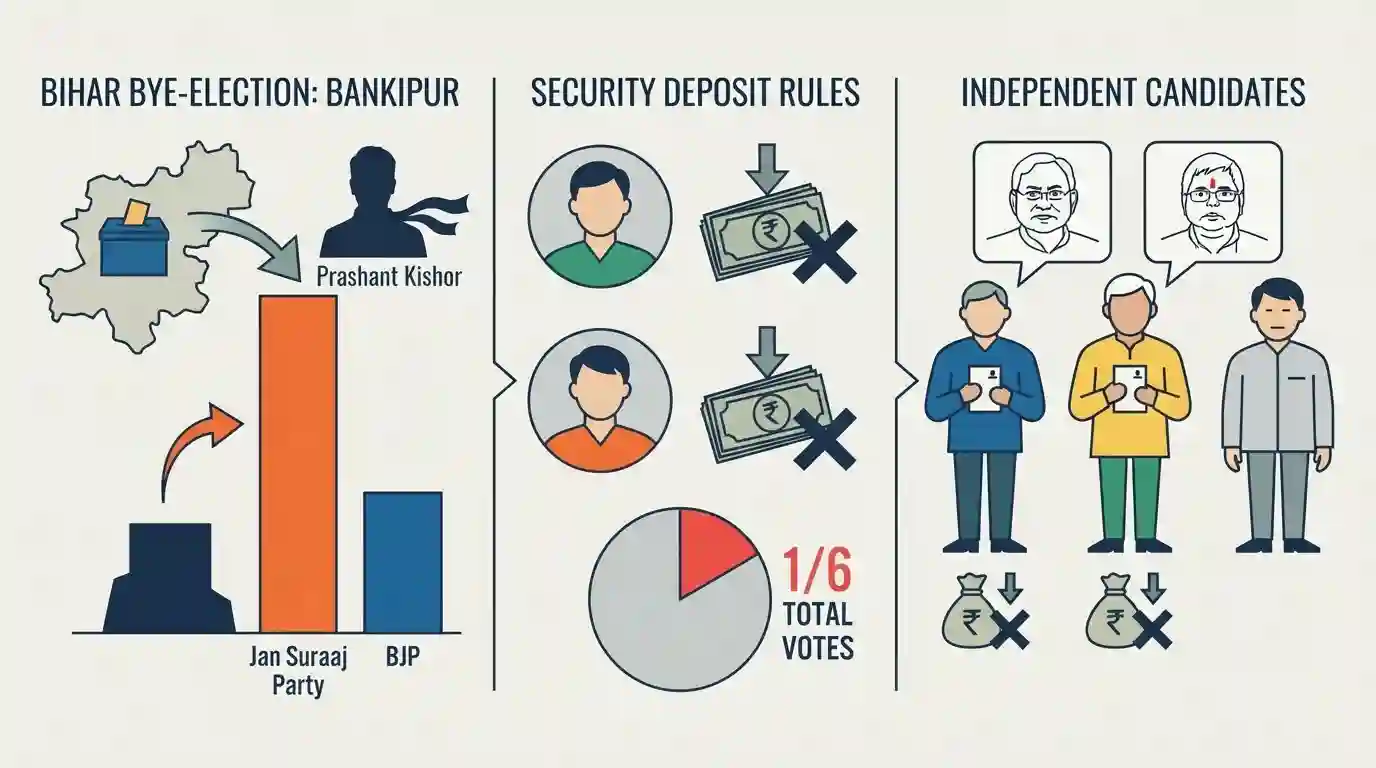
In the recent Bankipur assembly bypoll in Bihar, Prashant Kishor's newly formed Jan Suraaj Party made significant inroads by defeating the BJP candidate. Notably, independent candidates bearing the names of prominent political figures—Nitish Kumar and Lalu Prasad Yadav—failed to make an impact and lost their security deposits. This occurs under Election Commission rules when a candidate fails to secure one-sixth of the total valid votes.
Key Points
- The Jan Suraaj Party, founded by Prashant Kishor, successfully won the Bankipur assembly bypoll in Bihar, breaching a known BJP bastion.
- Independent candidates named Nitish Kumar and Lalu Prasad Yadav failed to garner sufficient votes and consequently lost their security deposits.
- Under Election Commission regulations, candidates must secure at least one-sixth of the total valid votes polled to retain their security deposits.
- The bypoll was triggered by the elevation of BJP leader Nitin Nabin to the Rajya Sabha.
Important Terms
Jan Suraaj Party

A regional political party in Bihar founded by Prashant Kishor on October 2, 2024, focusing on grassroots development, decentralised governance, and alternative leadership.
UPSC context
GS Paper II: Polity — Role of regional parties and electoral dynamics in state legislatures.
Election Commission of India
An autonomous constitutional authority established under Article 324 of the Constitution to administer Union and State election processes in India.
UPSC context
GS Paper II: Polity — Functions, powers, and responsibilities of constitutional bodies.
Election Security Deposit
A monetary sum required from candidates contesting elections, which is forfeited under Section 34 of the RPA 1951 if they fail to secure one-sixth of valid votes.
UPSC context
GS Paper II: Polity — Electoral reform measures and RPA 1951 requirements.
Bye-election
A special election held to fill a legislative vacancy arising between general elections due to an incumbent's death, resignation, or disqualification.
UPSC context
GS Paper II: Polity — Legislative representation and Section 151A of RPA, 1951.
Representation of the People Act, 1951
A parliamentary act regulating the conduct of elections, member qualifications, disqualifications, corrupt practices, and disputes for Union and State legislatures.
UPSC context
GS Paper II: Polity — Salient features of the Representation of the People Act.
Prelims Trap
A candidate forfeits their security deposit if they fail to secure at least one-sixth of the total registered voters in a constituency.
The RPA 1951 specifies one-sixth of the 'total valid votes polled' in the election, not the total number of registered voters/electors.
Static Concepts Connected
What are the rules governing candidate security deposits and by-elections under RPA, 1951?
- Security Deposit Rules: Candidates pay ₹25,000 for LS and ₹10,000 for Assembly; SC/ST candidates get a 50% concession.
- Forfeiture Threshold: Deposit is forfeited under Section 158 if a candidate fails to secure at least 1/6th of total valid votes polled.
- By-Election Mandate: Section 151A mandates filling vacancies within 6 months, unless the remaining term of the seat is less than one year.
Can the Election Commission of India (ECI) de-register a political party?
- No Explicit Power: Under the RPA 1951, the ECI has the power to register political parties but lacks explicit statutory power to de-register them.
- Judicial Precedent: In the 2002 INC vs. Institute of Social Welfare case, the SC ruled ECI can only de-register in exceptional cases like fraud.
- Administrative Workaround: ECI can only 'delist' inactive, unrecognized parties to clean up electoral rolls, but cannot outright de-register them.
Cross-Topic Patterns
EVM Evolution and Voter Information
Linking the 2015 photo-ballot reform to broader electoral integrity measures like VVPATs, addressing voter confusion created by proxy or namesake candidates.
Inner-Party Democracy vs ECI Authority
Highlights the gap between ECI's mandate to ensure fair elections and its inability to enforce internal party democracy or penalize inactive parties.

RPA 1951 provisions on by-election exemptions and the strict legal limits of ECI's party de-registration powers will likely feature in 2026.
Linked PYQs · 2
Linked PYQs · 2
- 2011BPSC_PRELIMSGS1
Which party-wise performance is correct for Bihar Assembly Elections, 2010 in comparison to the elections of 2005? JDU, BJP, RJD, LJP, CONG, OTHERS:
- 2023BPSC_PRELIMSGS1
Match the following political parties listed in List-I with their years of establishment in List-II: List-I (Political Parties) List-II (Years of Establishment) a. Communist Party of India (Marxist) 1. 1964 b. Communist Party of India 2. 1998 c. Bahujan Samaj Party 3. 1925 d. All India Trinamool Congress (AITC) 4. 1984
