Nitish Kumar Visits Special Art Exhibition at Bihar Museum
Source:newsyweb ↗
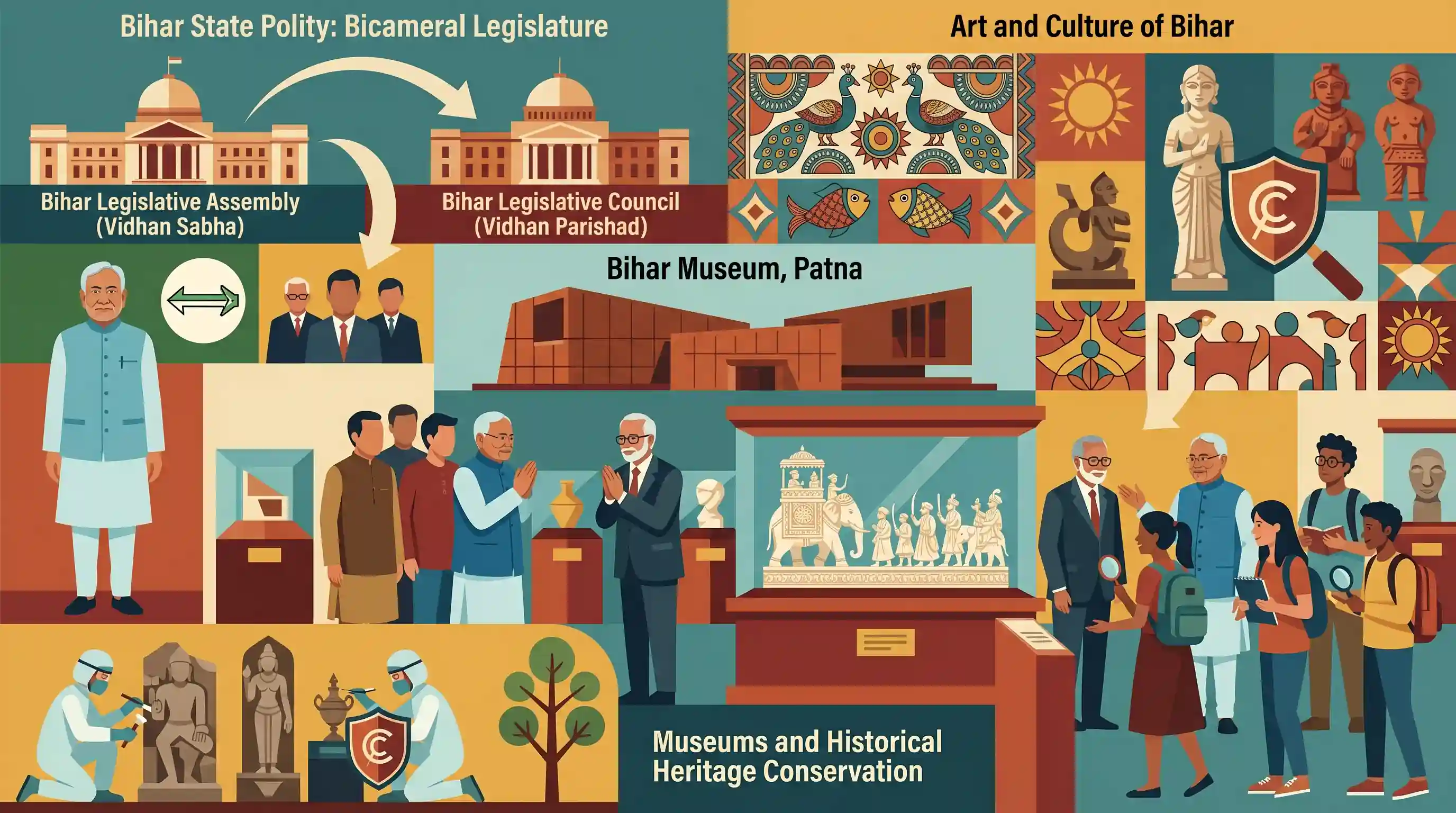
Why It Matters
The Bihar Museum is a central hub for the preservation of Bihar's ancient art, sculpture (such as Mauryan sandstone work), and traditional crafts. Understanding its layout, key exhibitions (like ivory art), and the bicameral structure of the state legislature (highlighted by the attending council members) is vital for BPSC Prelims Art & Culture and State Polity sections.
Summary
On June 30, 2026, Janata Dal (United) National President Nitish Kumar visited the Bihar Museum in Patna to view a special art exhibition featuring exquisite historical elephant ivory carvings. Accompanied by prominent members of the Bihar Legislative Council, he met with museum director Anjani Kumar Singh and interacted with students and researchers.
Key Points
- JD(U) National President and former Bihar Chief Minister Nitish Kumar visited the Bihar Museum in Patna on June 30, 2026.
- He toured a special art exhibition showcasing intricate artworks and artefacts crafted from elephant ivory, highlighting regional craftsmanship and artistic heritage.
- The visitors were hosted by the Director of the Bihar Museum, Anjani Kumar Singh (former Chief Secretary of Bihar).
- Prominent legislative figures present during the visit included Lalan Kumar Sarraf (Deputy Leader of the Ruling Party in the Bihar Legislative Council) and Chief Whip Sanjay Kumar Singh, popularly known as 'Gandhi Ji'.
- The Bihar Museum, located on Bailey Road near Patna High Court, was built to international standards (designed by Japanese firm Maki and Associates) and houses historical artefacts of Bihar up to the year 1764, including the famous 2,300-year-old Didarganj Yakshi sculpture.
Important Terms
Bihar Legislative Council

The upper house (Vidhan Parishad) of the bicameral legislature of Bihar, established in 1912, consisting of 75 members who are indirectly elected or nominated for six-year terms.
UPSC context
GS Paper II (Polity); tests the constitutional provisions of state bicameralism, legislative powers, and federal structures.
Government of India Act 1919
A landmark British colonial legislation (Montagu-Chelmsford Reforms) that introduced dyarchy in provinces, bicameralism at the central level, and paved the way for bicameral developments in Bihar.
UPSC context
GS Paper II (Constitutional Underpinnings) & GS Paper I (History); tests colonial constitutional reforms and evolution of Indian democracy.
Bihar Museum
A world-class museum inaugurated in Patna in 2015, designed to showcase Bihar's rich cultural heritage and house regional historical artifacts dating from prehistoric times up to 1764.
UPSC context
GS Paper I (Art and Culture); tests knowledge of heritage conservation initiatives, historical museums, and regional antiquity management.
Janata Dal (United)
A center-left regional political party in India, founded in 2003 through the merger of socialist factions, currently exercising significant influence and leadership in Bihar's state politics.
UPSC context
GS Paper II (Polity); tests the dynamics of regional political parties, coalition governance, and federalism in India.
Prelims Trap
The Didarganj Yakshi, representing a fly-whisk bearer, is made of Gandhara-style grey schist or basalt rock.
It is carved from a single block of Chunar sandstone and features the mirror-like 'Mauryan polish' typical of early historic court/folk art traditions.
Static Concepts Connected
What are the structural and material characteristics of Mauryan sculptural art as seen in the Didarganj Yakshi?
- Material & Polish: Carved from a single block of Chunar sandstone, it features a mirror-like 'Mauryan polish' typical of early historic sculpture.
- Stylistic Affiliation: Represents the sculptural tradition of folk art (individual statues of Yakshas/Yakshis), contrasting with the state-sponsored animal capitals of Ashokan pillars.
- Anatomical Realism: Portrays a life-size female fly-whisk (Chauri) bearer with a highly sophisticated sense of symmetry, detailed jewelry, and realistic physical form.
How are State Legislative Councils created, and what are their structural limits under the Constitution?
- Article 169 Process: Parliament can create or abolish a Council if the state's Legislative Assembly passes a resolution by a special majority.
- Composition Limits: Total membership must not exceed one-third of the Legislative Assembly's strength, and cannot fall below a minimum of 40 members.
- Historical Origin: Bicameralism at the provincial level was first introduced under the Government of India Act 1919, later expanded in 1935.
Cross-Topic Patterns
1764 as a Museological Pivot
The Battle of Buxar (1764) serves as a physical boundary dividing Bihar's ancient-medieval antiquities in the modern Bihar Museum from colonial-modern collections in the Patna Museum.
Folk Craft and GI Protection
Traditional crafts like Bihar's Sujini embroidery combine cultural preservation with intellectual property rights, safeguarding rural women's livelihood through GI tag recognition.

Didarganj Yakshi's style, material, and Mauryan polish likely to feature in a comparative statement-based art & architecture question.
Linked PYQs · 2
Linked PYQs · 2
- 2024-IBPSC_PRELIMSGS1
Which of the following Acts converted Unicameral Legislature of Bihar into Bicameral : Bihar Legislative Assembly and Bihar Legislative Council?
- 2023BPSC_PRELIMSGS1
In the context of Indian handicrafts, what is ‘Sujini’ in Bihar?
