Bihar Legislative Council Elections and Ministerial Representation
Source:republic-world ↗
Why It Matters
This political development serves as a perfect real-world application of Indian constitutional principles. Specifically, it illustrates the working of Article 164(4) regarding the requirement for non-legislator ministers to get elected to either house within six months. Furthermore, the history of Bihar's bicameralism (originating from the Government of India Act 1919) and the composition of the Bihar Legislative Council are recurrent, high-yielding topics in the BPSC Prelims exam.
Summary
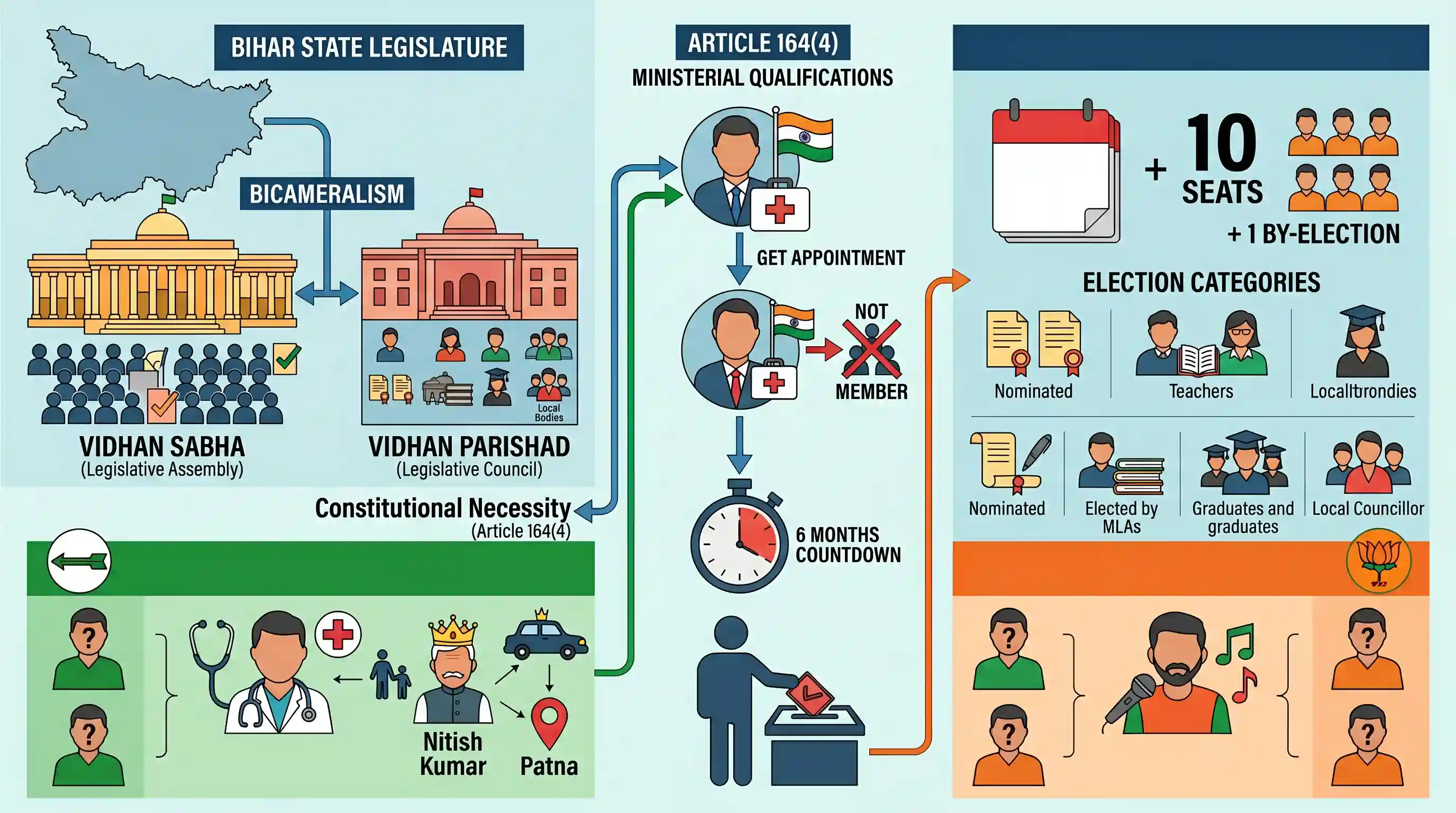
The Janata Dal (United) and BJP have announced candidates for the upcoming 10 Bihar Legislative Council (MLC) seats (including one by-election) scheduled for June 18, 2026. JD(U) has fielded Nishant Kumar, Bihar's Health Minister and son of former CM Nitish Kumar, from Patna. This election is a constitutional necessity for Nishant Kumar under Article 164(4), as he was appointed minister in March 2026 without holding a seat in either house of the Bihar Legislature. The BJP has also named its candidates, including Bhojpuri singer Pawan Singh.
Key Points
- Janata Dal (United) announced its candidates for the June 18, 2026 Bihar Legislative Council (MLC) elections and by-elections.
- Nishant Kumar, Bihar's Health Minister and son of former CM Nitish Kumar, was given a ticket from Patna. He had recently entered politics in March 2026.
- Other JD(U) candidates include Bharti Mehta (Madhubani), Shivani Devi Prajapati (West Champaran) for the main MLC elections, and Lalan Prasad (Sheikhpura) for the MLC by-election.
- The BJP also fielded candidates including Bhojpuri singer Pawan Singh (who rejoined BJP in Oct 2025), Dr. Sanjay Mayukh, Anil Kumar Thakur, and Sheela Pandit.
- Under Article 164(4) of the Indian Constitution, a Minister who is not a member of the state legislature must become one within six consecutive months. Nishant Kumar, appointed Health Minister in March 2026, is contesting this election to fulfill this constitutional requirement.
- Bihar's bicameral state legislature was originally established via the Government of India Act 1919 (Montagu-Chelmsford Reforms). The Bihar Legislative Council currently has 75 seats.
Important Terms
91st Constitutional Amendment Act

Enacted in 2003, this amendment limits the size of Union and State Councils of Ministers to 15% of the lower house strength and strengthens anti-defection provisions in the Tenth Schedule.
UPSC context
GS Paper II: Indian Polity. Tests understanding of executive size limitations, political stability, and anti-defection laws.
Bihar Legislative Council
The upper chamber of Bihar's bicameral state legislature, composed of 75 members who are indirectly elected or nominated to act as a permanent, non-dissoluble revisory body.
UPSC context
GS Paper II: State Legislature. Tests understanding of state bicameralism, council elections, and legislative powers.
Government of India Act 1919
A landmark British legislative act that introduced the system of dyarchy in the provinces and established a bicameral central legislature for the first time.
UPSC context
GS Paper I & II: Modern History & Polity. Tests knowledge of historical milestones in India's constitutional development.
Constitution of India
The supreme lawbook of India that outlines the framework for governance, details fundamental rights, and lists powers and duties of state and federal organs.
UPSC context
GS Paper II: Indian Polity. Foundational topic testing basic constitutionalism, executive-legislative relations, and fundamental laws.
Prelims Trap
The President's nominations to Rajya Sabha and the Governor's nominations to Legislative Councils are drawn from the exact same five fields.
Article 171(5) includes 'cooperative movement' as a qualifying field for Legislative Councils, whereas Article 80(3) for Rajya Sabha completely omits this category.
Static Concepts Connected
What are the composition limits and electorates of a State Legislative Council under Article 171?
- Strength Limits: Capped at one-third of the Legislative Assembly's total strength, with a strict statutory minimum of 40 members.
- Electoral College: 1/3 elected by local bodies, 1/12 by graduates, 1/12 by teachers, 1/3 by MLAs, and 1/6 nominated by the Governor.
- Unique Nomination Field: Governor nominations include 'cooperative movement', which is entirely absent from Rajya Sabha nomination categories under Article 80.
What are the rules regarding appointing non-legislators as Ministers under Article 164?
- Six-Month Rule: Under Article 164(4), a non-legislator minister must be elected to either house within six consecutive months or vacate office.
- S.R. Chaudhuri Case: The Supreme Court (2001) ruled that reappointing a non-legislator as minister without interim election bypasses the six-month cap and is unconstitutional.
Cross-Topic Patterns
Article 169 and asymmetric federalism
The power of Parliament to create or abolish Legislative Councils only upon State Assembly resolutions represents a delicate balance of asymmetric federalism.
Colonial devolution under 1919 Act
Bicameralism in states like Bihar dates back to the Government of India Act 1919, showing how modern legislative structures remain rooted in colonial constitutional evolution.

Expect a 2026 MCQ testing the 'cooperative movement' nomination anomaly in Article 171 alongside the Article 164(4) six-month rule.
Linked PYQs · 4
Linked PYQs · 4
- 2024-IBPSC_PRELIMSGS1
Which of the following Acts converted Unicameral Legislature of Bihar into Bicameral : Bihar Legislative Assembly and Bihar Legislative Council?
- 2024-IBPSC_PRELIMSGS1
Which of the following Constitutional Amendment in India has decided the maximum strength of the Council of Minister with Chief Minister in a State?
- 2024-EBPSC_PRELIMSGS1
Size of Council of Ministers has been restricted to 15 percent of membership of Lok Sabha by which Constitutional Amendment?
- 2022BPSC_PRELIMSGS1
How many seats are reserved for the SC candidates in the Bihar Legislative Assembly?
