Rajya Sabha elections and anti-defection law provisions in India
Source:Indian Express ↗
Why It Matters
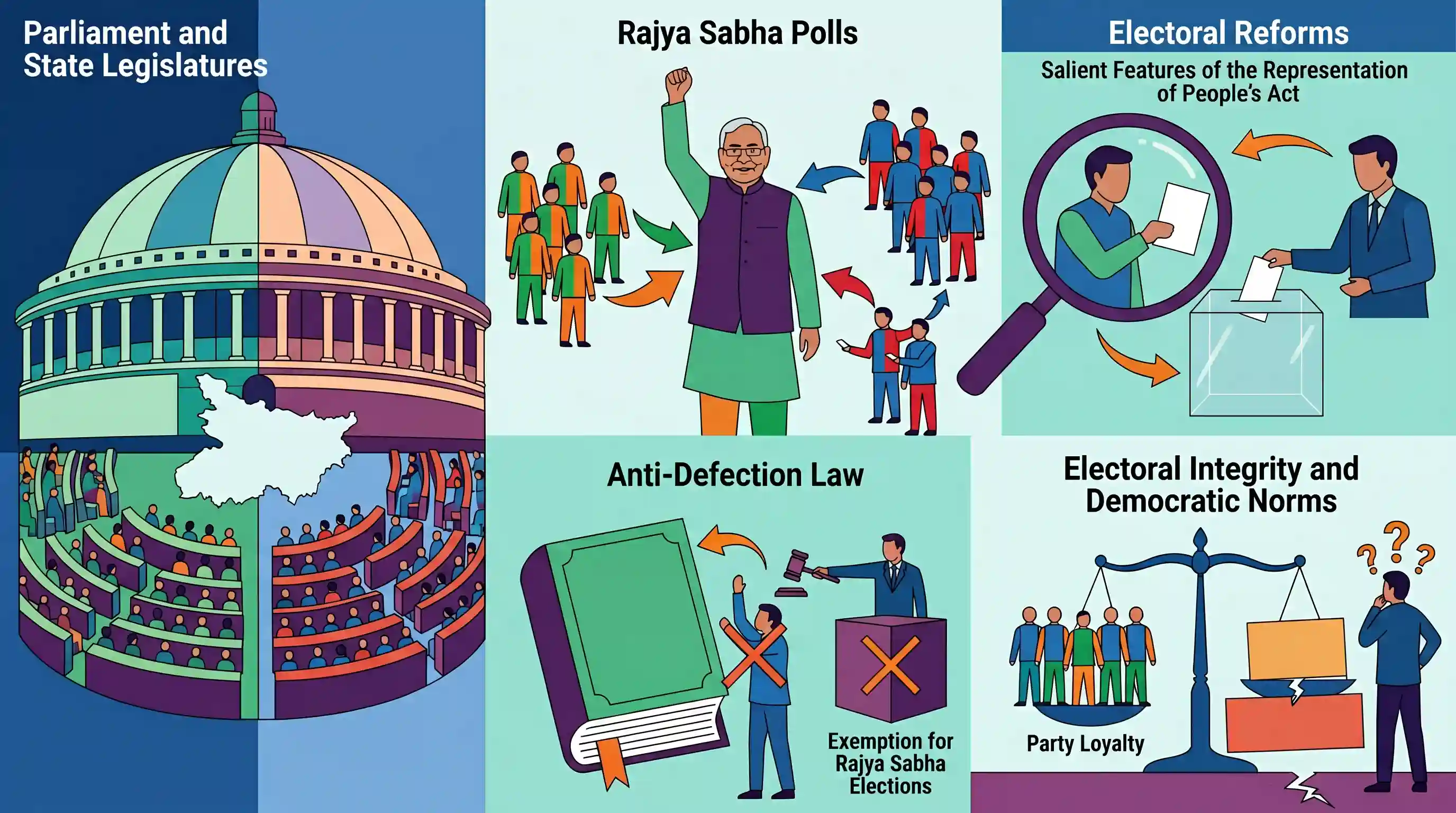
Incidents of cross-voting in Rajya Sabha elections routinely test the boundaries of the Anti-Defection Law and the Representation of the People Act. Understanding the legal distinctions—such as why cross-voting in Rajya Sabha polls does not result in disqualification despite the open ballot requirement—is critical for analyzing India's parliamentary framework and suggesting meaningful electoral reforms.
Summary
The Nitish Kumar-led NDA achieved a sweeping victory in the Bihar Rajya Sabha polls, bolstered by cross-voting from opposition MLAs. This 'betrayal' brings renewed attention to the intricacies of India's indirect electoral processes, notably the open ballot system designed to curb cross-voting in Rajya Sabha elections. Crucially, while MLAs are expected to follow party directives, defying the party whip in these specific elections does not trigger disqualification under the Tenth Schedule. The event raises substantive questions regarding party loyalty, electoral integrity, and the efficacy of current anti-defection provisions in maintaining democratic norms.
Key Points
- The NDA, under the leadership of Nitish Kumar, swept the Bihar Rajya Sabha polls following cross-voting by opposition MLAs.
- Members of the Rajya Sabha are indirectly elected by the elected members of the State Legislative Assemblies via a single transferable vote system.
- The 'open ballot' system mandates MLAs to show their ballot to an authorized party agent before casting, aiming to deter cross-voting.
- However, voting against the party whip in Rajya Sabha elections does not automatically attract disqualification under the Tenth Schedule (Anti-Defection Law), creating loopholes for political defection.
- The incident highlights persistent issues regarding party discipline, electoral ethics, and the need for reforms in India's indirect election mechanisms.
Important Terms
Tenth Schedule (Anti-Defection Law)

Provisions added by the 52nd Amendment (1985) to disqualify legislators for defection. In Rajya Sabha elections, however, the Supreme Court ruled that cross-voting does not trigger disqualification under this Schedule.
UPSC context
GS Paper II (Polity); essential for understanding legislative stability and the legal boundaries of party discipline.
Representation of the People Act, 1951
The principal legislation governing the conduct of elections to Parliament and State Legislatures, including candidate qualifications, disqualifications, electoral offenses, and the resolution of election disputes.
UPSC context
GS Paper II (Polity); a core syllabus topic (Salient features of RPA) governing Indian electoral machinery.
Rajya Sabha (Council of States)
The Upper House of Parliament representing States and UTs. Members are elected indirectly by State Legislative Assemblies for six-year terms, with one-third retiring every two years.
UPSC context
GS Paper II (Parliament); central to Indian federalism and the permanent structure of the bicameral legislature.
Open Ballot System
A mechanism used in Rajya Sabha polls (since 2003) where party MLAs show their marked ballots to an authorized party agent before casting to prevent corruption and cross-voting.
UPSC context
GS Paper II (Electoral Reforms); tests knowledge of measures taken to curb horse-trading in indirect elections.
Single Transferable Vote (STV)
An electoral system where voters rank candidates by preference. A candidate must secure a specific 'quota' of votes to be elected; used for Rajya Sabha and Presidential elections.
UPSC context
GS Paper II (Election Processes); tests technical understanding of indirect representation and mathematical quota systems.
Cross-voting
When a legislator votes for a candidate from a rival party, defying their own party's unofficial preference or directive, often observed in indirect elections.
UPSC context
GS Paper II (Political Ethics/Integrity); relevant for analyzing the efficacy of anti-defection provisions in maintaining democratic norms.
Prelims Trap
Cross-voting by an MLA in a Rajya Sabha election leads to automatic disqualification under the Tenth Schedule.
False. Defying a party candidate in RS elections does not trigger the Anti-Defection Law. The Election Commission explicitly bars parties from issuing mandatory whips for this.
Static Concepts Connected
How does the Open Ballot system work in Rajya Sabha elections?
- Legal Backing: Introduced via a 2003 amendment to the Representation of the People Act, 1951, to curb corruption by replacing the secret ballot.
- Mandatory Verification: MLAs of political parties must show their marked ballot to their party's authorized agent before casting it into the ballot box.
- Independent MLAs: Independent MLAs are strictly barred from showing their ballot to anyone; doing so invalidates their vote.
Why doesn't cross-voting in Rajya Sabha trigger the Anti-Defection Law?
- Not House Proceedings: The voting is considered part of the electoral process, not a proceeding or vote within the State Legislative Assembly itself.
- No Mandatory Whip: Parties cannot issue mandatory whips dictating how MLAs must vote in these elections, meaning defiance is only a disciplinary issue, not a defection.
- Supreme Court Ruling: In Kuldip Nayar v. UoI (2006), the Supreme Court upheld the open ballot but affirmed it does not attract Tenth Schedule disqualification.
Cross-Topic Patterns
Interplay of RPA and Tenth Schedule
UPSC frequently tests the grey areas where the Representation of the People Act (RPA) interfaces with Constitutional disqualification criteria, specifically regarding whips, party tickets, and the voting rights of independent MLAs.
Electoral Ethics vs Legal Loopholes
The phenomenon of cross-voting without legislative disqualification serves as a prime GS-4 case study distinguishing between strict legal compliance and the broader ethical mandate of political representation and party loyalty.

Expect a 2026 Prelims statement contrasting vote invalidation under the RPA with MLA disqualification under the 10th Schedule in RS polls.
Linked PYQs · 4
Linked PYQs · 4
- 2020PrelimsGS1
Rajya Sabha has equal powers with Lok Sabha in
- 2014PrelimsGS1
Which one of the following Schedules of the Constitution of India contains provisions regarding anti-defection?
- 2020MainsGS2
There is a need for simplification of procedure for disqualification of persons found guilty of corrupt practices under the Representation of Peoples Act". Comment.
- 2022MainsGS2
Discuss the procedures to decide the disputes arising out of the election of a Member of the Parliament or State Legislature under The Representation of the People Act, 1951. What are the grounds on which the election of any returned candidate may be declared void ? What remedy is available to the aggrieved party against the decision ? Refer to the case laws.
