Bihar Assembly Elections and Double Engine Governance Record
Source:The Hindu ↗
Why It Matters
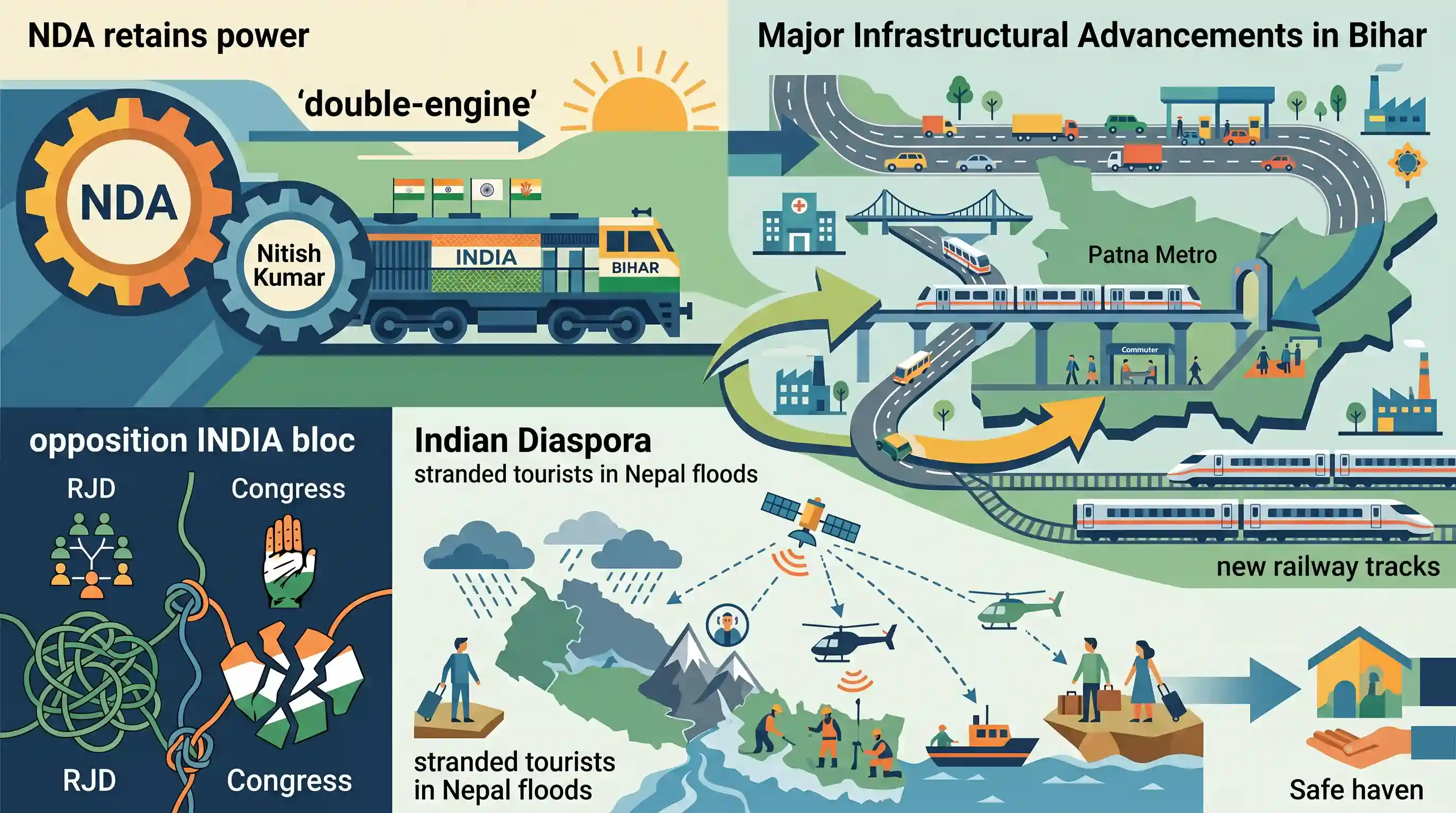
The article provides insights into the prevailing political narratives in state elections, focusing on the dichotomy of development politics versus dynastic politics. It highlights state-level infrastructural milestones which serve as examples for regional growth under cooperative federalism, and notes the government's swift response in disaster management for citizens stranded in neighboring countries.
Summary
Union Minister Piyush Goyal expressed strong confidence in the NDA retaining power in the upcoming Bihar Assembly elections under the leadership of Nitish Kumar. Highlighting the 'double-engine' government's developmental push, Goyal cited major infrastructural advancements in Bihar, including new highways, railway tracks, and the Patna Metro. He contrasted this with the opposition INDIA bloc, accusing parties like the RJD and Congress of engaging in dynastic politics. Additionally, he noted that the central government is closely coordinating efforts to ensure the safety of Indian tourists stranded in flood-hit Nepal.
Key Points
- Union Minister Piyush Goyal stated that the NDA government, led by Nitish Kumar, will return to power in Bihar based on its governance and development record.
- Significant infrastructure projects were highlighted as achievements, including the Mokama Munger four-lane highway, the Bhagalpur-Dumka-Rampurhat railway track, and the Patna Metro.
- The opposition INDIA bloc (RJD and Congress) was criticized for allegedly practicing dynastic politics and prioritizing self-interest over the state's development.
- The Union government is actively monitoring the situation of Indian citizens stranded in Nepal due to heavy rains and landslides, ensuring their safety and swift return.
Important Terms
NDA (National Democratic Alliance)

A center-right political alliance in India led by the Bharatiya Janata Party (BJP), founded in 1998 to form a non-Congress coalition.
UPSC context
GS Paper II (Polity); essential for understanding coalition dynamics, federalism, and the evolution of the party system in India.
INDIA bloc
A big-tent political alliance of approximately 28 opposition parties formed in 2023 to challenge the NDA in the 2024 general elections.
UPSC context
GS Paper II (Polity); highlights the role of opposition and the formation of pre-poll alliances in a multi-party democracy.
Double Engine Government
A political slogan describing a scenario where the same party or coalition governs at both the Central and State levels to ensure coordinated development.
UPSC context
GS Paper II (Federalism); relevant for analyzing Centre-State relations and the impact of political alignment on governance.
Rashtriya Janata Dal (RJD)
A socialist political party in Bihar founded by Lalu Prasad Yadav in 1997, focusing on social justice, secularism, and backward-class empowerment.
UPSC context
GS Paper II (Polity); significant for studying the role of regional parties and identity-based politics in Indian states.
Coalition Government
A government formed by an alliance of multiple political parties, usually when no single party secures an absolute majority.
UPSC context
GS Paper II (Polity/Governance); critical for understanding political stability, decision-making, and constitutional conventions in India.
Dynastic Politics
A political system where power or leadership within a party is concentrated within a single family across generations.
UPSC context
GS Paper II (Polity); tests critical analysis of internal party democracy and its impact on representative governance.
Prelims Trap
The Election Commission can de-register a political party if it fails to conduct internal democratic elections.
The ECI registers parties under Section 29A of the RPA 1951, but the Supreme Court has ruled it lacks explicit statutory power to de-register them simply for lacking internal democracy.
Static Concepts Connected
Why is North Bihar highly vulnerable to transboundary flooding?
- Topographic drop: Rivers like Kosi, Gandak, and Bagmati descend steeply from Nepal into the flat Bihar plains, rapidly losing velocity and spreading out.
- Heavy siltation: The reduced velocity causes massive sediment deposition, raising river beds and forcing rivers to breach embankments or change course (e.g., Kosi).
- Bilateral dependence: Infrastructure like barrages and embankments are governed by older agreements (like the 1954 Kosi Treaty) requiring continuous joint India-Nepal coordination.
Does the RPA 1951 mandate intra-party democracy in India?
- Section 29A: It requires parties to pledge allegiance to the Constitution for registration, but lacks strict enforcement mechanisms to ensure regular internal democratic elections.
- No de-registration power: The Election Commission cannot de-register a party for failing to hold internal elections (established in the INC v. Institute of Social Welfare case).
- Law Commission recommendations: The 170th report recommended enacting a comprehensive law to regulate internal party democracy and candidate selection, which remains unimplemented.
Cross-Topic Patterns
Transboundary floods and hydro-diplomacy
Floods in Nepal immediately impact North Bihar. This connects GS3 Disaster Management with GS2 India-Neighborhood relations, highlighting the urgent need for joint hydro-meteorological data sharing and revised water treaties.
Diaspora rescue and MEA mandates
Rapid evacuation of Indians stranded in Nepal aligns with recent operations (Ganga, Kaveri), reflecting India’s elevated institutional focus on diaspora security and rapid response capabilities abroad.

Expect a GS2 or GS3 Mains question linking Nepal-India transboundary hydro-diplomacy to the chronic, recurrent flood disasters in Bihar.
Linked PYQs · 3
Linked PYQs · 3
- 2022MainsGS2
“While the national political parties in India favour centralisation, the regional parties are in favour of State autonomy.” Comment.
- 2021MainsGS3
“Investment in infrastructure is essential for more rapid and inclusive economic growth.” Discuss in the light of India's experience.
- 2022MainsGS3
Why is Public Private Partnership (PPP) required in infrastructural projects ? Examine the role of PPP model in the redevelopment of Railway Stations in India.
