Bihar cabinet expansion and constitutional limit on ministers
Source:Indian Express ↗
Why It Matters
The development serves as a practical example of the functioning of the State Executive and the enforcement of the 91st Constitutional Amendment Act, which caps the size of the Council of Ministers, making it a highly relevant topic for the Polity section in Prelims.
Summary
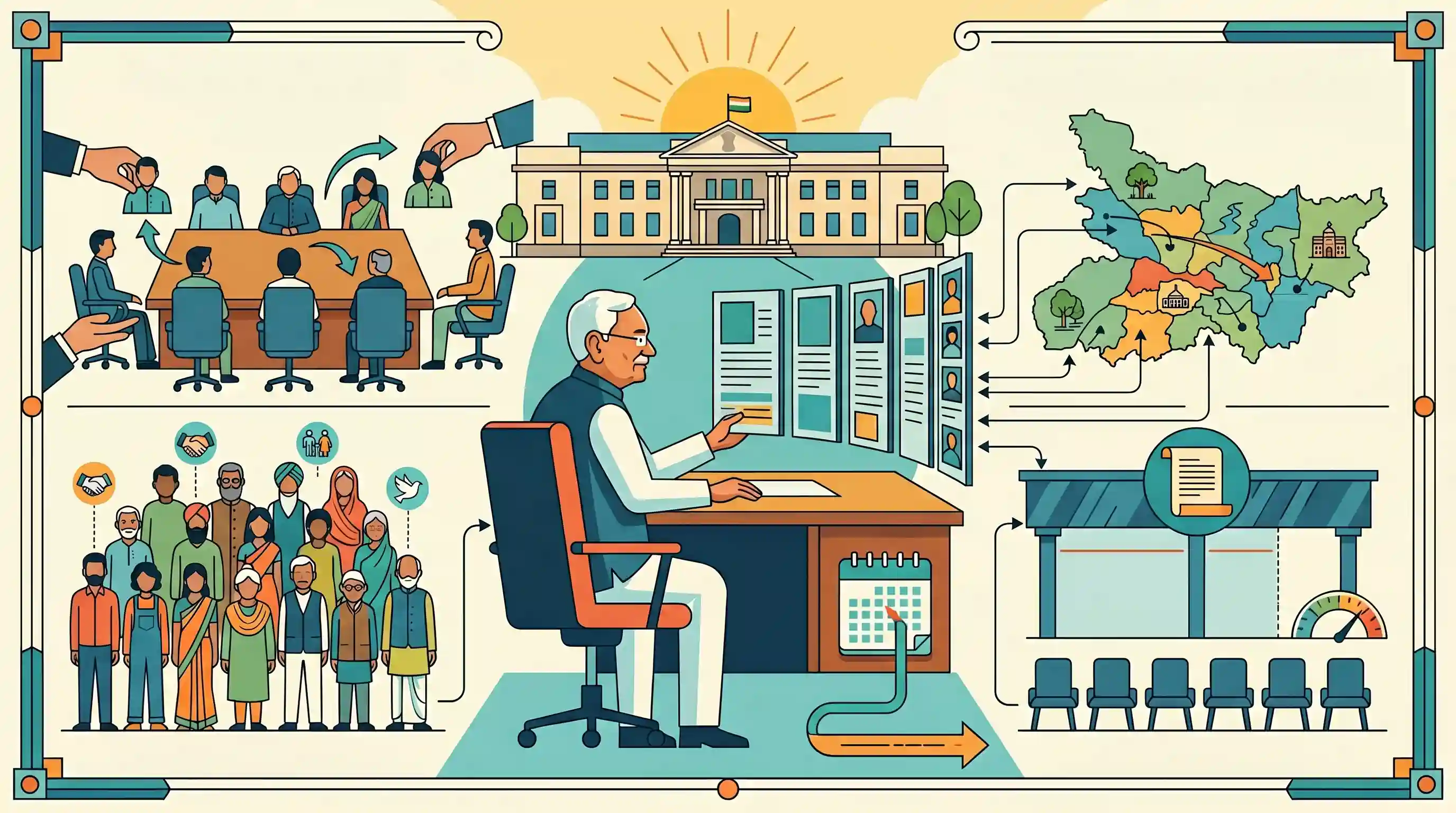
Bihar Chief Minister Nitish Kumar is anticipated to undertake a Cabinet reshuffle and expansion after January 15, aiming to fine-tune the government's social and regional representation. The expansion will adhere to the constitutional limits on the size of the Council of Ministers.
Key Points
- Bihar Chief Minister Nitish Kumar is expected to reshuffle and potentially expand his state Cabinet after January 15 to maintain caste and regional balances.
- Under Article 164(1A) of the Constitution, introduced by the 91st Constitutional Amendment Act (2003), the total number of Ministers, including the Chief Minister, cannot exceed 15% of the total members of the State Legislative Assembly.
- The Bihar Legislative Assembly has 243 members, legally restricting the maximum size of the state's Council of Ministers to 36.
- The Cabinet reshuffle underscores the dynamics of coalition governments where accommodating diverse social equations (such as caste and regional representation) is essential for political stability.
Important Terms
91st Constitutional Amendment Act, 2003

A 2003 amendment that limited the size of the Council of Ministers to 15% of the House's total strength and strengthened the Anti-Defection Law.
UPSC context
GS Paper-II (Polity); essential for understanding executive limits and political stability through the 15% rule.
Article 164 of the Constitution
The constitutional provision governing the appointment of the Chief Minister by the Governor, ministerial appointments, and their collective responsibility to the Legislative Assembly.
UPSC context
GS Paper-II (State Executive); core article for questions on ministerial accountability and Governor-CM relations.
Bihar Legislative Assembly
The lower house of Bihar's bicameral legislature, consisting of 243 directly elected members to whom the state government is collectively responsible.
UPSC context
GS Paper-II (State Legislature); significant for calculating ministerial caps and understanding state-level parliamentary democracy.
Council of Ministers
The constitutional body headed by the Chief Minister to aid and advise the Governor, including Cabinet Ministers, Ministers of State, and Deputy Ministers.
UPSC context
GS Paper-II (Executive); fundamental for understanding the structure of governance and collective responsibility.
State Cabinet
A smaller, elite body within the Council of Ministers comprising senior ministers who serve as the primary decision-making wing of the state government.
UPSC context
GS Paper-II (Governance); tests the distinction between the broad executive body and the inner decision-making core.
Prelims Trap
The state Council of Ministers cannot exceed 15% of the State Legislature, subject to a minimum of 12%.
The 15% cap applies exclusively to the Legislative Assembly (Vidhan Sabha), not the entire Legislature. Furthermore, the minimum limit is 12 ministers, not 12%.
Static Concepts Connected
What restrictions did the 91st CAA, 2003 place on the Council of Ministers?
- Maximum ceiling: Capped the total number of Ministers, including PM/CM, at 15% of the total strength of the Lok Sabha or State Legislative Assembly.
- Minimum threshold: Stipulated that a State Council of Ministers must have at least 12 ministers, regardless of the Assembly's total size.
- Defector disqualification: Barred any legislator disqualified under the Tenth Schedule (Anti-Defection Law) from being appointed as a minister.
How is Ministerial responsibility structured under Article 164 of the Constitution?
- Collective responsibility: Under Art 164(2), the entire Council of Ministers is collectively responsible solely to the State Legislative Assembly, not the Legislative Council.
- Individual responsibility: Under Art 164(1), ministers hold office during the Governor's pleasure. In practice, the Governor can dismiss a minister only on the Chief Minister's advice.
Cross-Topic Patterns
Cabinet sizing & Anti-Defection Law
The 91st CAA capped cabinet size to end jumbo ministries, while simultaneously tightening the 10th Schedule by deleting the exemption for a 'split' (one-third members) in a political party.
Caste census & social engineering
Cabinet reshuffles for 'social balance' in Bihar are closely tied to its recent caste survey, illustrating how sub-categorized demographic data directly dictates coalition power-sharing.

Expect a Prelims question testing nuances of the 91st CAA, specifically distinguishing the 12-minister minimum vs the 15% cap.
Linked PYQs · 4
Linked PYQs · 4
- 2024-EBPSC_PRELIMSGS1
Size of Council of Ministers has been restricted to 15 percent of membership of Lok Sabha by which Constitutional Amendment?
- 2024-IBPSC_PRELIMSGS1
Which of the following Constitutional Amendment in India has decided the maximum strength of the Council of Minister with Chief Minister in a State?
- 2023BPSC_PRELIMSGS1
The Council of Ministers in a State is collectively responsible to
- 2022BPSC_PRELIMSGS1
How many seats are reserved for the SC candidates in the Bihar Legislative Assembly?
