Delhi Mumbai Expressway Safety Inspection and Patrolling
Source:ommcomnews ↗
Why It Matters
The Delhi–Mumbai Expressway is a key infrastructural corridor. For RPSC RAS and other examinations, tracking the alignment of major expressways through Rajasthan (including key districts like Alwar, Bundi, and Kota) and understanding highway financing and management (like NHAI projects) is vital for physical geography and state economy sections.
Summary
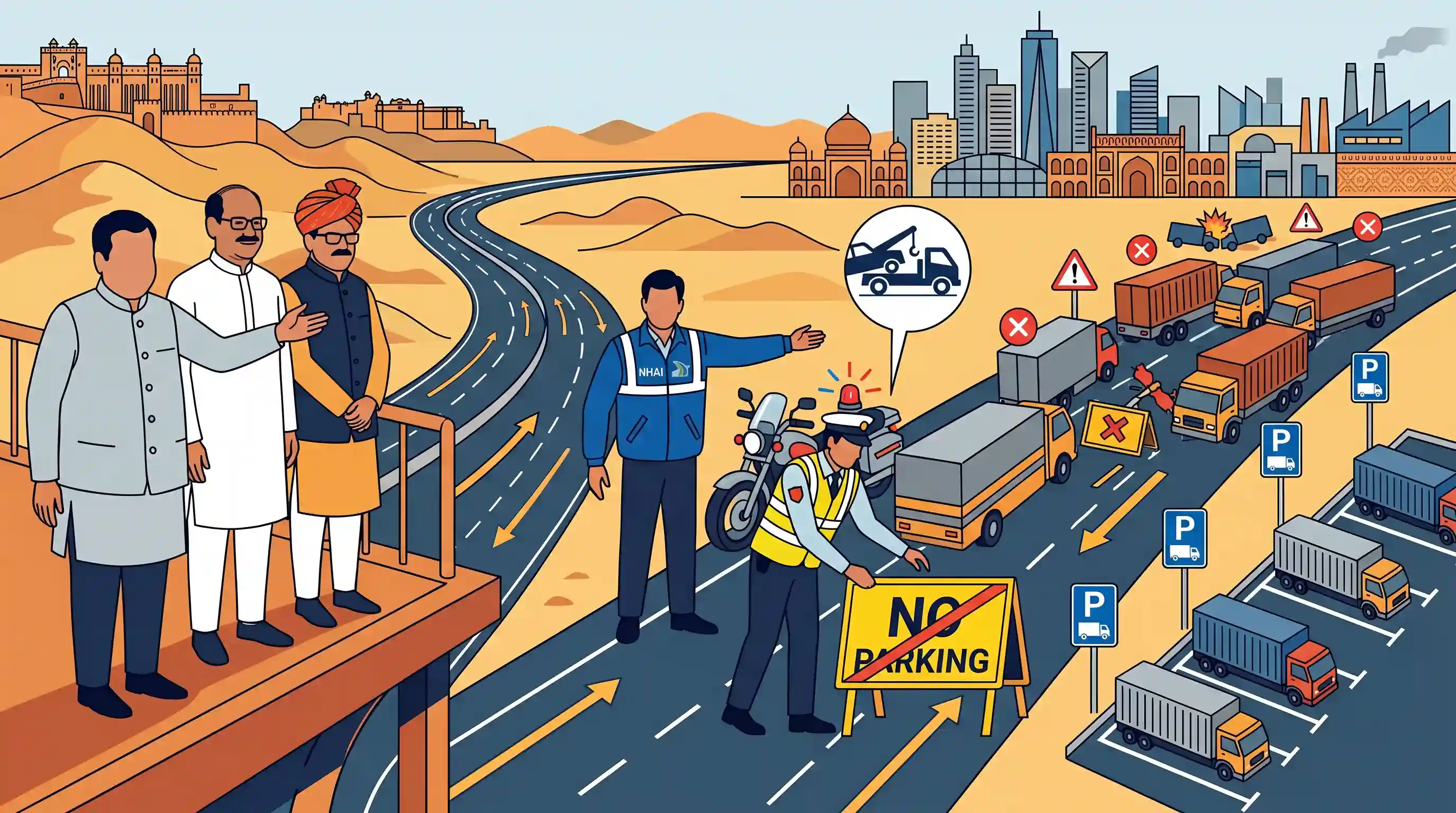
Union Minister Nitin Gadkari, accompanied by Lok Sabha Speaker Om Birla and Rajasthan CM Bhajan Lal Sharma, inspected the Delhi-Mumbai Expressway corridor in Rajasthan. Gadkari instructed the NHAI and police authorities to reinforce patrolling and strictly enforce parking regulations, especially targeting indiscriminate truck parking, to enhance safety and prevent accidents along the expressway.
Key Points
- Union Minister Nitin Gadkari inspected the Delhi–Mumbai Expressway stretch in Rajasthan, reviewing safety measures and infrastructure progress.
- During a review meeting at the Pinan rest area in Alwar district, Gadkari directed NHAI and police officials to strengthen patrolling and speed up emergency response systems.
- To curb road accidents, the Minister ordered strict enforcement of parking rules, ensuring trucks are not parked indiscriminately along the expressway corridor.
- The inspection route covered critical stretches from Labana Interchange in Bundi district to the Dara Tunnel in Kota, focusing primarily on the Delhi-to-Kota carriageway.
- Rajasthan Deputy CM Diya Kumari emphasized that the expressway has significantly reduced travel times between major cities, boosting regional trade, tourism, and overall connectivity.
Important Terms
Delhi–Mumbai Expressway

An 8-lane (expandable to 12), 1,386 km access-controlled greenfield expressway connecting Delhi and Mumbai, designed to reduce travel time from 24 to 12 hours.
UPSC context
GS Paper III (Infrastructure); tests economic impact of mega-corridors, wildlife mitigation features, and public-private investment models.
Bharatmala Pariyojana
A flagship corridor-based national highway development programme launched in 2017 to optimize freight efficiency, bridge infrastructure gaps, and reduce logistics costs across India.
UPSC context
GS Paper III (Infrastructure/Economy); tests connectivity corridors, logistic efficiency, and challenges in mega-infrastructure project implementation.
National Highways Authority of India (NHAI)
An autonomous statutory body under the Ministry of Road Transport and Highways responsible for the development, maintenance, and management of national highways in India.
UPSC context
GS Papers II & III; tests statutory bodies, highway management, toll mechanisms like FASTag, and infrastructure financing models.
Ministry of Road Transport and Highways (MoRTH)
The apex central ministry responsible for formulating road transport policies, administering motor vehicle legislation, and managing the country's national highway infrastructure.
UPSC context
GS Paper II (Governance); tests policy initiatives on road safety, motor vehicle legislation, and national infrastructure planning.
Prelims Trap
The right to safe commuting on national highways is a purely statutory right governed under the Motor Vehicles Act.
The Supreme Court in April 2026 ruled that 'safe passage and commuting' is a fundamental right under Article 21 (Right to Life).
Static Concepts Connected
What is the 'forgiving highways' principle in infrastructure design?
- Core Goal: Minimizes the severity of traffic accidents by absorbing human errors through structural and spatial design adjustments.
- Key Elements: Features wide clear zones, crash-attenuating barriers, and wide medians allowing inward expansion without outer ecological disruption.
What is a Step-Up Loan (SuL) in multilateral development finance?
- Debt Structuring: A loan structure where debt service obligations are low initially and scale upward as project revenues or fiscal capacities grow.
- Fiscal Utility: Minimizes the immediate fiscal strain on sub-national governments during capital-intensive initial construction phases.
Cross-Topic Patterns
Article 21 expansion & public assets
Judicial expansion of Right to Life to encompass safe highway commuting marks a major shift from negative liberties to positive state obligations.
Green corridors vs. Wildlife conservation
Using eco-sensitive bypasses like the Mukundra Hills tunnel shows how linear infrastructure must reconcile with the Wildlife Protection Act.

SC's 2026 linkage of 'safe commuting' to Article 21 will likely trigger conceptual questions on the expanding horizon of the Right to Life.
Linked PYQs · 1
Linked PYQs · 1
- 2023RPSC_PRELIMSGS1
The Rajasthan State Highway Development Program-II project, which includes the upgrading of 11 highways with a length of 801 km, is financed by which agency?
