NITI Aayog council debates fiscal federalism and development goals
Source:The Hindu ↗
Why It Matters
The NITI Aayog Governing Council meeting serves as a microcosm of India's federal dynamics. It exposes the diverse socio-economic and security challenges facing different states—ranging from fiscal devolution and river disputes to border security and demographic shifts—which are central to GS2 and GS3 syllabus areas.
Summary
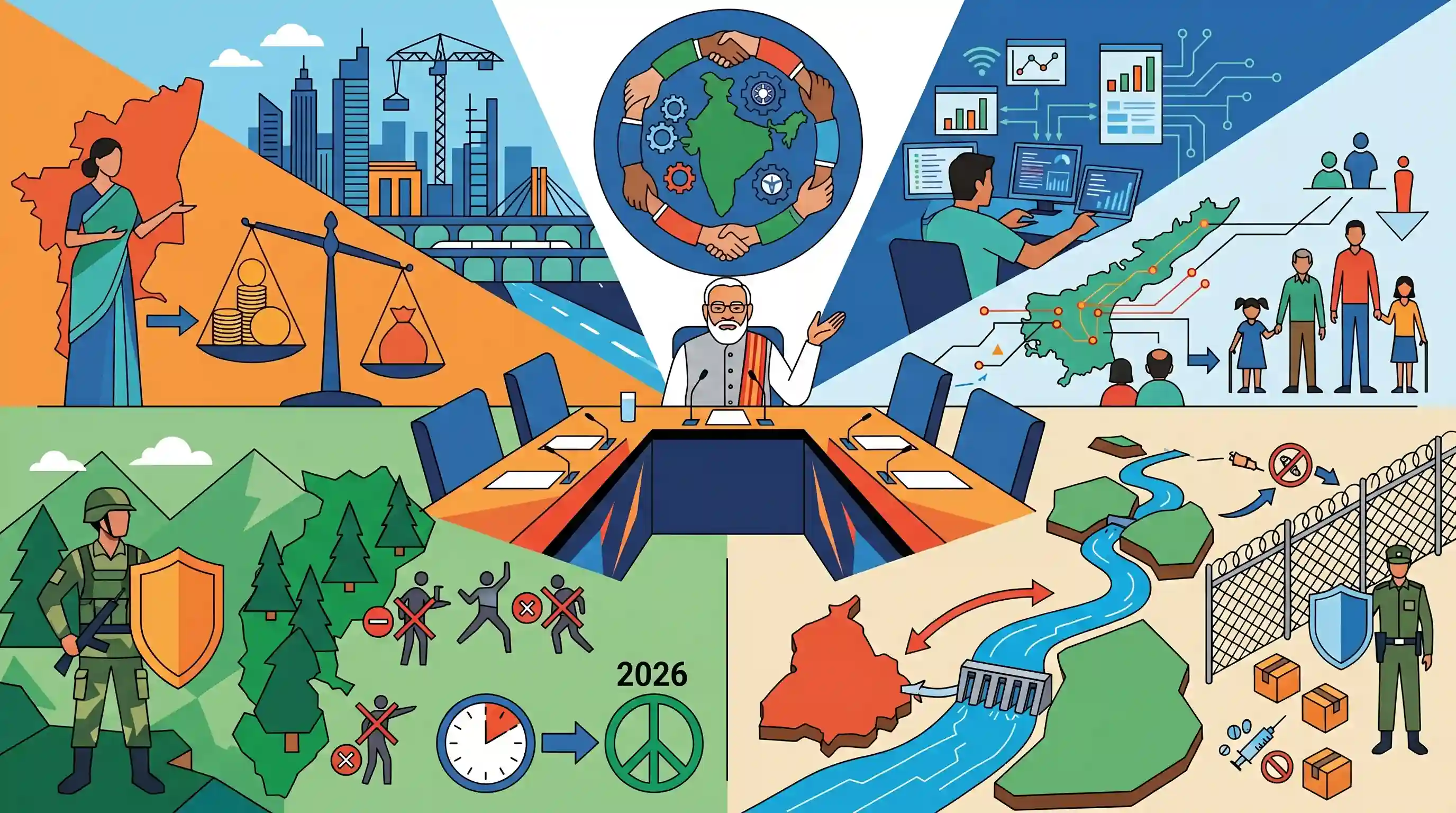
The 10th NITI Aayog Governing Council meeting, chaired by PM Modi under the theme 'Viksit Rajya for Viksit Bharat@2047', highlighted a wide spectrum of federal priorities and friction points. While the Prime Minister emphasized cooperative federalism, participating states raised critical, localized demands. Tamil Nadu pushed for 50% devolution of central taxes and urban infrastructure support. Andhra Pradesh focused on demographic shifts and technology-driven governance. Chhattisgarh underscored internal security by committing to eradicate Naxalism by 2026, and Punjab flagged ongoing inter-state river water disputes alongside the need for border management funds to curb drug smuggling.
Key Points
- PM Modi emphasized cooperative federalism ('Team India') at the 10th NITI Aayog Governing Council meeting, urging states to focus on global tourism hubs and increasing women's workforce participation.
- Tamil Nadu CM M.K. Stalin demanded a 50% share for States in central taxes (up from the current 33.16%) and a dedicated river cleaning project for the Cauvery, Vaigai, and Thamirabarani.
- Andhra Pradesh CM N. Chandrababu Naidu proposed working groups to address GDP growth, AI-driven governance, and population management to balance the demographic dividend with an aging population.
- Chhattisgarh CM Vishnu Deo Sai pledged to make the state Naxal-free by March 2026, while pushing for a 3T governance model (Technology, Transparency, Transformation).
- Punjab CM Bhagwant Mann raised inter-state water disputes concerning the Yamuna, Ravi, and Beas rivers, and sought funds beyond the Vibrant Villages programme to combat drug trafficking in border areas.
Important Terms
NITI Aayog

The premier policy 'Think Tank' of India that provides directional and strategic inputs, replacing the Planning Commission to promote a bottom-up approach and involve states in policymaking.
UPSC context
GS Paper II: Governance; tests knowledge of extra-constitutional bodies and the shift from centralized to collaborative planning.
Finance Commission
A constitutional body established under Article 280 to recommend the distribution of tax proceeds between the Centre and States (vertical) and among individual States (horizontal).
UPSC context
GS Paper II (Federal Structure) & GS Paper III (Economy); tests fiscal federalism and resource allocation mechanisms.
Cooperative Federalism
A governance framework where the Union and States work as partners to achieve national goals, characterized by 'Team India' collaboration rather than a top-down command relationship.
UPSC context
GS Paper II: Functions and responsibilities of the Union and States; essential for understanding center-state friction and harmony.
Vibrant Villages Programme
A centrally sponsored scheme targeting the comprehensive development of border villages to improve infrastructure, provide livelihoods, and curb out-migration for enhanced national security.
UPSC context
GS Paper III: Internal Security/Border Management; tests strategies for border stability through socio-economic development.
AMRUT 2.0
An urban transformation mission focusing on universal water supply in statutory towns and 100% sewerage coverage in 500 cities to promote a 'circular economy of water.'
UPSC context
GS Paper III: Infrastructure/Urbanization; tests government initiatives for basic service delivery and sustainable urban development.
Prelims Trap
"The NITI Aayog Governing Council determines the formula and percentage for devolution of central taxes."
Aspirants often confuse NITI Aayog's advisory platform for cooperative federalism with the Finance Commission's constitutional mandate to determine tax sharing under Article 280.
Static Concepts Connected
How does NITI Aayog Governing Council differ from the Inter-State Council?
- Constitutional Status: NITI Aayog was created by an executive resolution (2015), whereas the Inter-State Council (ISC) is a constitutional body established under Article 263.
- Mandate: NITI Aayog focuses on socio-economic planning and cooperative federalism. The ISC specifically investigates and advises on inter-state disputes and policy coordination.
- Shared Leadership: Both bodies are chaired by the Prime Minister and include Chief Ministers, making them key platforms for federal dialogue.
What constitutes 'Vertical Fiscal Imbalance' in India's federal structure?
- Definition: The structural disparity between the high revenue-raising capacity of the Centre and the extensive welfare expenditure responsibilities of the States.
- Correction Mechanism: Article 280 mandates the Finance Commission to recommend vertical tax devolution to bridge this gap.
- The Cess Issue: The Centre's increasing reliance on cesses and surcharges (which are not part of the divisible pool) reduces the 'effective' devolution to States.
Cross-Topic Patterns
Naxalism eradication & Tech governance
Left-Wing Extremism (LWE) management now explicitly links to '3T' governance models (Technology, Transparency, Transformation), shifting focus from purely kinetic military operations to inclusive, tech-driven administration.
Population transition & Federal representation
Southern states managing aging populations fear political and fiscal marginalization ahead of the upcoming delimitation, driving proactive demands for alternative governance and economic models.
Drug cartels & Border infrastructure
The Vibrant Villages scheme is increasingly merged with narco-terror defense; border infrastructure development is now positioned as a primary denial strategy against cross-border smuggling networks.

Expect a 2026 GS2 Mains question evaluating NITI Aayog vs Inter-State Council in managing rising center-state fiscal and water disputes.
Linked PYQs · 5
Linked PYQs · 5
- 2025MainsGS2
Examine the evolving pattern of Centre-State financial relations in the context of planned development in India. How far have the recent reforms impacted the fiscal federalism in India?
- 2020MainsGS2
How far do you think cooperation, competition and confrontation have shaped the nature of federation in India? Cite some recent examples to validate your answer.
- 2022MainsGS3
Naxalism is a social, economic and developmental issue manifesting as a violent internal security threat. In this context, discuss the emerging issues and suggest a multilayered strategy to tackle the menace of Naxalism.
- 2024MainsGS1
What is the concept of a 'demographic winter'? Is the world moving towards such a situation? Elaborate.
- 2020MainsGS3
For effective border area management, discuss the steps required to be taken to deny local support to militants and also suggest ways to manage favourable perception among locals.
