Nithari Acquittal and Evidentiary Standards in Criminal Justice
Source:The Hindu ↗
Why It Matters
This case serves as a crucial case study for UPSC aspirants on the operational flaws of investigating agencies and the high evidentiary standards maintained by the judiciary to prevent miscarriages of justice. It also touches upon the constitutional debate regarding delays in deciding mercy petitions (Article 72/161) and the shift from punitive to evidence-based justice.
Summary
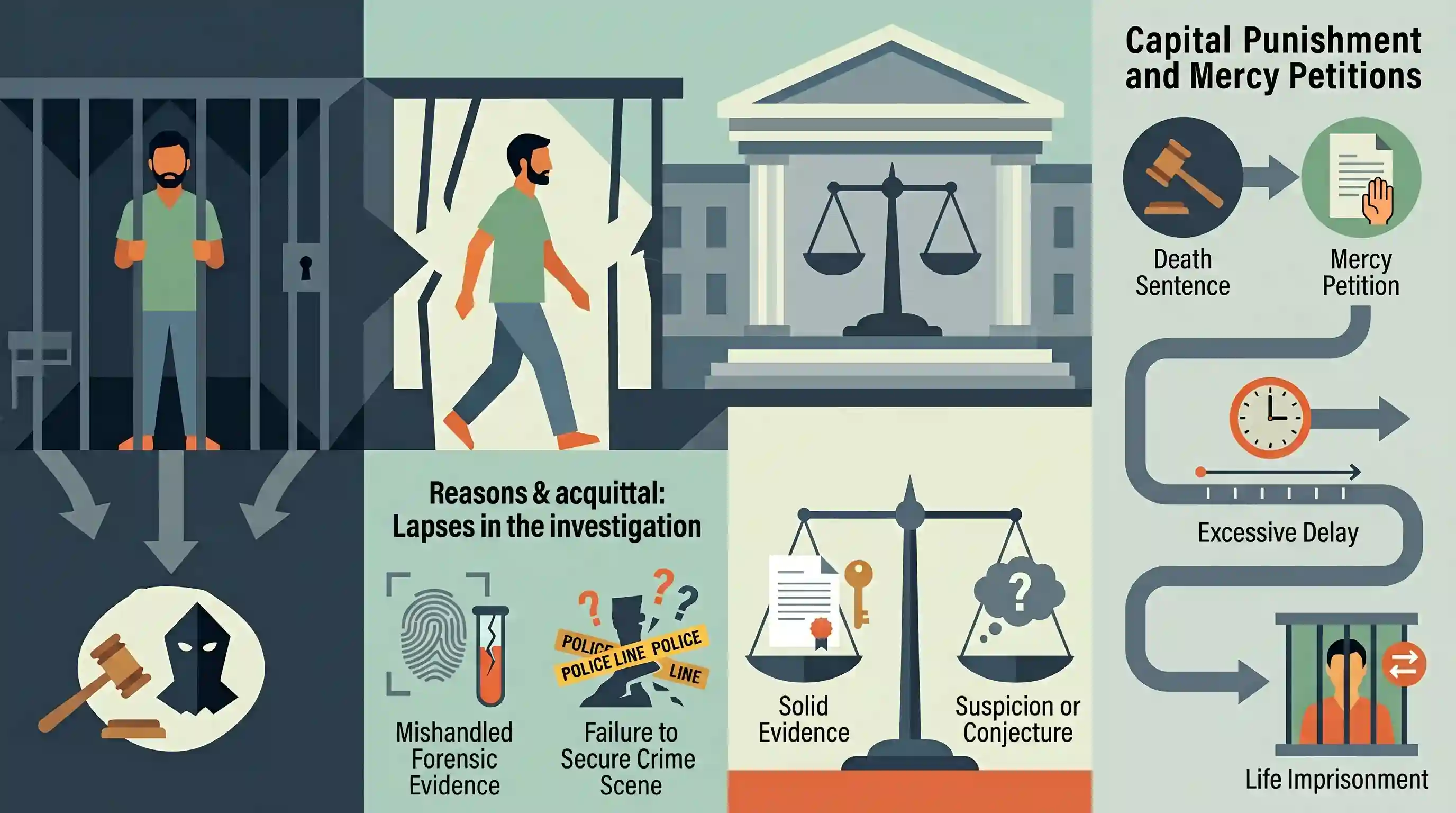
Surinder Koli, a prime accused in the Nithari serial killings, was released from Dasna jail after being acquitted by the Supreme Court. The apex court overturned his conviction, citing severe lapses by investigating agencies, including the mishandling of forensic evidence and failure to secure the crime scene. Emphasizing the rule of law, the Court noted that a conviction cannot rely on suspicion or conjecture, regardless of how grave the accusations are. Furthermore, Koli's death sentence had previously been commuted to life imprisonment by the Allahabad High Court due to excessive delays in processing his mercy plea, casting a spotlight on the systemic flaws in both criminal investigations and the handling of capital punishment cases.
Key Points
- Surinder Koli was released from Dasna jail following his acquittal by the Supreme Court in the infamous Nithari serial killings case.
- The Supreme Court reaffirmed the foundational legal principle that criminal convictions must be based on solid evidence, stating that 'suspicion, however grave, cannot replace proof.'
- The judgment heavily criticized investigating agencies for gross negligence, pointing out failures such as not securing the crime scene, mishandling forensic material, and delayed recording of disclosures.
- The case also highlights issues related to capital punishment; Koli's death sentence was previously commuted to life imprisonment by the Allahabad High Court due to an inordinate delay in deciding his mercy petition.
Important Terms
Rule of Law

The constitutional principle that law is supreme and all individuals/institutions are equally accountable to it. In India, it is a 'basic structure' feature rooted in Article 14.
UPSC context
GS II: Indian Constitution. Tests understanding of democratic foundations, Article 14, and safeguards against arbitrary executive or investigative actions.
Mercy Petition
The final constitutional remedy available under Articles 72 (President) or 161 (Governor) after exhausting all judicial appeals. It serves as a safeguard against miscarriage of justice.
UPSC context
GS II: Executive & Judiciary. Tests knowledge of pardoning powers and the judicial review of 'inordinate delays' in executive decisions.
Commutation
A form of executive clemency that substitutes a harsher punishment for a lighter one, such as replacing a death sentence with life imprisonment.
UPSC context
GS II: Pardoning Powers. Relevant for understanding Article 72 and the procedural shifts under the new Bharatiya Nagarik Suraksha Sanhita (BNSS).
Curative Petition
The final judicial remedy in the Supreme Court, invoked after a review petition is dismissed, to prevent gross miscarriage of justice or violation of natural justice.
UPSC context
GS II: Judiciary. Tests knowledge of the Supreme Court's inherent powers (Rupa Hurra case) and extraordinary measures for ensuring justice.
Criminal Justice System
The institutional framework comprising the police, judiciary, and prisons. Recent reforms aim to address investigative lapses, forensic mishandling, and excessive delays in justice delivery.
UPSC context
GS II/III: Governance and Security. Focuses on institutional reforms (Malimath Committee) and the impact of investigative failures on human rights.
Supreme Court
The highest court of appeal and the 'guardian of the Constitution.' It possesses original, appellate, and advisory jurisdictions to protect fundamental rights and resolve inter-state disputes.
UPSC context
GS II: Judiciary. Tests powers under Articles 124-147, judicial activism, and its role in reviewing death penalty cases.
Allahabad High Court
The highest judicial authority in Uttar Pradesh. It possesses the power of judicial review and superintendence over all subordinate courts within its territorial jurisdiction.
UPSC context
GS II: State Judiciary. Relevant for understanding the hierarchy of courts and the process of reviewing high-profile criminal convictions.
Prelims Trap
The Constitution of India prescribes a strict time limit for the President to dispose of mercy petitions.
The Constitution does not specify any time limit. However, the Supreme Court has ruled that unexplained, inordinate delays violate Article 21, allowing for commutation of the death sentence.
Static Concepts Connected
How do the pardoning powers of the President (Art 72) and Governor (Art 161) differ?
- Court Martial: The President can pardon sentences inflicted by military courts (Court Martial), whereas the Governor holds no such power.
- Death Sentences: Only the President can fully pardon a death sentence. A Governor can suspend, remit, or commute a death sentence, but cannot issue a full pardon.
- Jurisdiction Limit: The President's power extends to offenses against Union laws, while the Governor's power applies strictly to state laws.
What are the core legal standards for convictions based on circumstantial evidence?
- Complete Chain: The chain of evidence must be entirely complete, leaving no reasonable ground for a conclusion consistent with the innocence of the accused.
- Beyond Reasonable Doubt: Suspicion, however grave, cannot replace definitive proof. The evidence must unequivocally point to the guilt of the accused beyond a reasonable doubt.
Cross-Topic Patterns
Article 72 meets Article 21 Right to Life
The intersection of executive clemency and fundamental rights, where systemic delays in mercy petitions amount to mental torture, effectively violating the Right to Life under Article 21.
Police Reforms & the New Evidence Act
Highlights the urgency of the Prakash Singh directives (separating investigation from law and order) paired with the new Bharatiya Sakshya Adhiniyam's strict mandates for forensic evidence collection.

Judicial review of Article 72 and mercy petition delays under Article 21 is a high-probability multi-statement question for Prelims 2026.
Linked PYQs · 2
Linked PYQs · 2
- 2014MainsGS2
Instances of President's delay in commuting death sentences has come under public debate as denial of justice. Should there be a time limit specified for the President to accept/reject such petitions ? Analyse.
- 2024MainsGS4
The new law, Bharatiya Nyaya Sanhita (BNS) is based on Indian culture and ethos. Discuss this in the light of major shift from a doctrine of punishment to justice in the present judicial system.
