Dry Washing Technique for Legacy Waste Recycling at Ariyamangalam
Source:The Hindu ↗
Why It Matters
Provides a practical technological solution to India's mounting legacy waste problem, demonstrating how scientific interventions can support urban local bodies in achieving sustainable solid waste management, substituting fossil fuels, and promoting a circular economy.
Summary
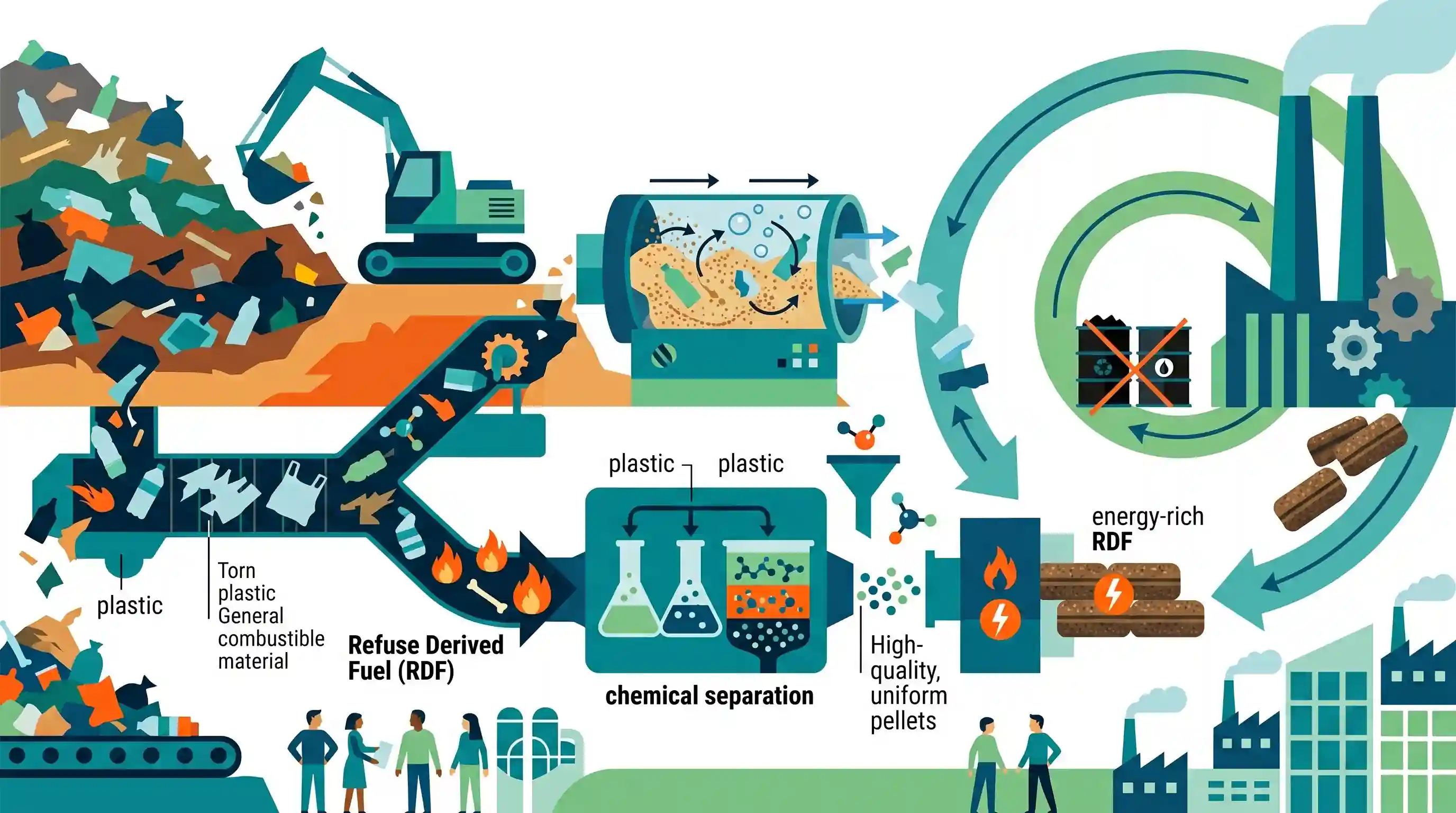
Researchers at the National Institute of Technology-Tiruchi (NIT-T) are pioneering sustainable methods to recycle combustible waste, known as Refuse Derived Fuel (RDF), excavated from the Ariyamangalam legacy dump yard. To optimize plastic recycling, the team is piloting a waterless 'dry washing' technique using fluidised sand, which efficiently removes dirt without generating liquid wastewater. Subsequently, the plastics undergo a controlled chemical separation process to extract high-quality material. The project facilitates the substitution of fossil fuels in cement factories with RDF, offering a scalable model for urban solid waste management and circular economy initiatives.
Key Points
- Around 7.6 lakh cubic metres of legacy waste have been biologically processed and mined at the Ariyamangalam dump yard in Tiruchi.
- NIT-Tiruchi researchers have developed a waterless 'dry washing' method utilizing fluidised sand to remove dirt from plastic waste without generating toxic liquid effluents.
- Cleaned plastics undergo controlled chemical separation to recover high-quality materials, advancing circular economy practices.
- The recovered combustible waste, Refuse Derived Fuel (RDF), is being supplied to industries like Dalmia Cement to serve as an alternative to fossil fuels.
Important Terms
Solid Waste Management Rules, 2016

Mandatory guidelines notified by the Environment Ministry (MoEFCC) requiring waste segregation at source (wet, dry, hazardous) and promoting waste-to-wealth via recycling, composting, and energy recovery.
UPSC context
GS Paper III (Environment/Pollution); essential for questions on urban waste governance and the 'Polluter Pays' principle.
Swachh Bharat Mission (SBM-U) 2.0
The mission’s second phase (2021-2026) aims to make Indian cities 'Garbage Free' through 100% source segregation, remediation of legacy dumpsites, and liquid waste management.
UPSC context
GS Paper II (Governance) & III (Economy/Environment); tests knowledge of urban sanitation and sustainable development goals.
Refuse Derived Fuel (RDF)
A fuel produced by shredding and dehydrating combustible components of municipal solid waste, such as non-recyclable plastics and paper, typically used in cement kilns.
UPSC context
GS Paper III (Science & Tech/Environment); relevant for waste-to-energy technologies and industrial carbon footprint reduction.
Bio-mining
The scientific process of excavating, treating, and segregating aged municipal solid waste (legacy waste) using microorganisms to stabilize organic matter and reclaim land.
UPSC context
GS Paper III (Environment); focuses on sustainable landfill restoration and technological interventions in waste management.
Circular Economy
An economic system aimed at eliminating waste through the continual use of resources—reuse, repair, and recycling—rather than the traditional 'take-make-waste' model.
UPSC context
GS Paper III (Economy/Environment); core theme for sustainable resource management and industrial efficiency.
Legacy Waste
Aged municipal solid waste accumulated over years in landfills or open dumpsites, which poses environmental risks like methane emissions and leachate contamination.
UPSC context
GS Paper III (Environment); critical for understanding the challenges of urban landfill management and bioremediation.
Waste-to-Energy (WTE)
The process of generating energy (electricity, heat, or fuel) from the primary treatment of waste, including technologies like incineration, pyrolysis, and RDF production.
UPSC context
GS Paper III (Science & Tech/Energy); explores renewable energy alternatives and technological solutions to urban waste.
Prelims Trap
"Bio-mining exclusively refers to extracting valuable metals from low-grade ores or e-waste using microorganisms."
While true in metallurgy, in municipal waste management, bio-mining refers to scientifically clearing legacy landfills by excavating, stabilizing, and segregating aged garbage to reclaim urban land.
Static Concepts Connected
What is Refuse Derived Fuel (RDF) and how is it utilized?
- Composition: It consists of the shredded, dehydrated, combustible fraction of municipal solid waste (plastics, textiles, wood) possessing a high calorific value.
- SWM Rules 2016: SWM Rules mandate that non-recyclable waste with a calorific value >1500 kcal/kg cannot be landfilled and must be used for energy generation.
- Co-processing: RDF is burned in cement kilns at ultra-high temperatures (1400–1500°C), ensuring complete combustion without generating harmful dioxin or furan emissions.
How does bio-mining remediate legacy urban landfills?
- The Process: Involves excavating aged waste, applying microbial biocultures to stabilize organic matter, and mechanically screening the material into separate fractions.
- Environmental Mitigation: It clears massive urban garbage mountains, mitigating methane emissions and preventing toxic leachate from contaminating local groundwater reserves.
- Resource Recovery: The process recovers fine bio-earth (soil enrichers), recyclables, and RDF, permanently freeing up valuable urban real estate.
Cross-Topic Patterns
Circular Economy + Swachh Bharat Urban 2.0
The remediation of legacy dumps like Ariyamangalam ties directly to Swachh Bharat Mission-Urban 2.0's mandate to make all Indian cities 'Garbage Free' by permanently clearing legacy landfills.
Zero Liquid Discharge + Plastic Waste Recycling
The 'dry washing' fluidised sand technique addresses the classic water-pollution tradeoff in plastic recycling, aligning directly with CPCB guidelines pushing industries toward Zero Liquid Discharge (ZLD).

Expect a multi-statement Prelims question linking SBM-U 2.0 legacy waste bio-mining with RDF co-processing in cement kilns.
Linked PYQs · 3
Linked PYQs · 3
- 2018MainsGS3
What are the impediments in disposing the huge quantities of discarded solid wastes which are continuously being generated? How do we remove safely the toxic wastes that have been accumulating in our habitable environment?
- 2023MainsGS3
Discuss several ways in which microorganisms can help in meeting the current fuel shortage.
- 2024PrelimsGS1
Consider the following materials : 1. Agricultural residues 2. Corn grain 3. Wastewater treatment sludge 4. Wood mill waste Which of the above can be used as feedstock for producing Sustainable Aviation Fuel?
