China Strategic Role in India Pakistan Security Dynamics
Source:Indian Express ↗
Why It Matters
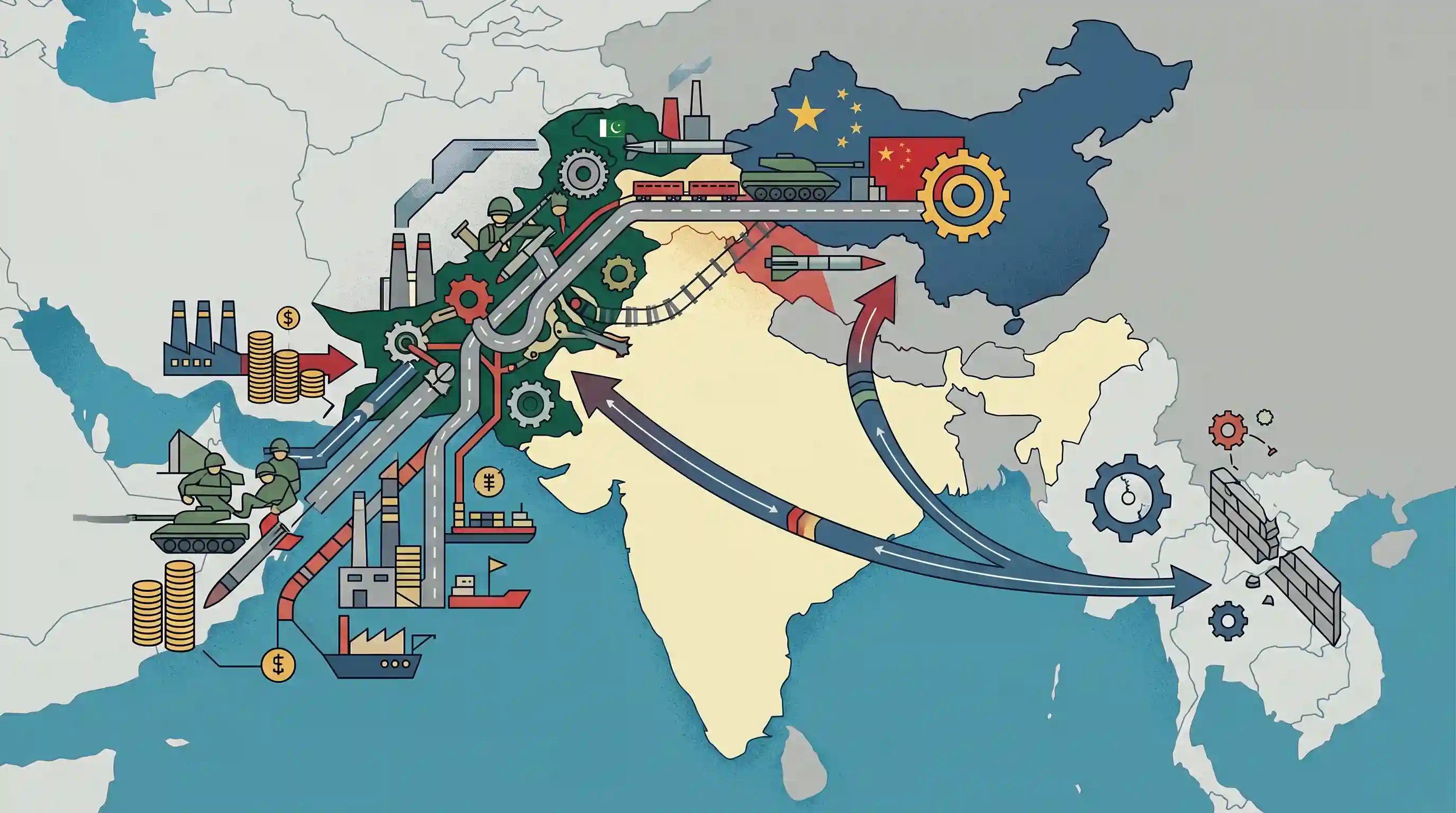
The 'iron brothers' nexus between Beijing and Islamabad is the most critical geopolitical challenge for India's strategic planners. Understanding this structural shift is vital for UPSC aspirants as it directly dictates India's foreign policy maneuvering, defense resource allocation, and border infrastructure strategies.
Summary
In her column, former Foreign Secretary Nirupama Rao highlights a fundamental shift in the structural dynamics of India-Pakistan relations: the increasingly embedded strategic, military, and economic footprint of China within Pakistan. The deepened Sino-Pak partnership—exemplified by initiatives like the China-Pakistan Economic Corridor (CPEC)—acts as a structural force multiplier for Islamabad. This transition complicates traditional bilateral peace processes and permanently alters India's security landscape into an active two-front threat. Rao suggests that India must adapt its grand strategy to manage a unified, coordinated challenge along both its western and northern frontiers, rather than treating Pakistan and China as isolated diplomatic tracks.
Key Points
- Former Foreign Secretary Nirupama Rao argues that the contemporary India-Pakistan dynamic is fundamentally altered by China\'s embedded strategic, economic, and military presence in Pakistan.
- The Sino-Pak "all-weather" partnership acts as a structural roadblock to conventional bilateral peace-building, given Beijing\'s vested interest in keeping India strategically tied down in South Asia.
- Initiatives like the China-Pakistan Economic Corridor (CPEC) and deep defense collaborations serve as a force multiplier for Islamabad, significantly emboldening its stance against India.
- This integration shifts India\'s traditional security calculations from managing separate rivalries to countering an active, coordinated "two-front" threat across both the LoC and LAC.
Important Terms
China-Pakistan Economic Corridor (CPEC)

A $60+ billion collection of infrastructure projects connecting China's Xinjiang region to Pakistan's Gwadar Port. It is a flagship component of China's Belt and Road Initiative (BRI).
UPSC context
GS Paper II (IR); critical for discussing India's sovereignty concerns over PoK and China's strategic footprint in South Asia.
Two-Front Threat
The simultaneous security challenge posed by military coordination between Pakistan on the western border and China on the northern border (LAC), stretching India's defense resources.
UPSC context
GS Paper III (Security); tests understanding of integrated defense planning and the strategic convergence of India's primary adversaries.
All-Weather Friendship
A term describing the resilient, multi-dimensional strategic alliance between China and Pakistan, characterized by deep military cooperation, diplomatic shielding, and economic interdependence.
UPSC context
GS Paper II (IR); important for analyzing the "embedded role" of China in bilateral India-Pakistan disputes.
Gwadar Port
A strategic deep-sea port in Balochistan, Pakistan. It serves as the terminal of CPEC and provides China with a direct link to the Arabian Sea, bypassing the Malacca Strait.
UPSC context
GS Paper II/III; vital for maritime security and discussing the 'String of Pearls' theory versus India's 'SAGAR' vision.
Neighborhood First Policy
India's diplomatic priority to foster stable, integrated relations with its immediate neighbors (SAARC members) to maintain regional leadership and counter extra-regional influence.
UPSC context
GS Paper II (IR); central to questions on India's regional strategy and the challenges of Chinese "checkbook diplomacy."
Pakistan-occupied Kashmir (PoK)
A territory in the erstwhile state of Jammu & Kashmir currently under Pakistani administration. India's sovereignty claim over this region is the primary reason for its opposition to CPEC.
UPSC context
GS Paper II/III; essential for explaining legal and territorial disputes and their impact on international infrastructure projects.
Prelims Trap
China officially recognizes Kashmir as a trilateral dispute and claims formal mediation rights.
Despite CPEC passing through PoK and acting as a proxy, China officially maintains Kashmir is a bilateral issue and denies formal legal mediation rights.
Static Concepts Connected
What is the Simla Agreement (1972) framework for dispute resolution?
- Strict Bilateralism: Mandates that India and Pakistan resolve their differences strictly through peaceful bilateral negotiations, explicitly excluding third-party mediation.
- Inviolability of LoC: Converted the ceasefire line into the Line of Control (LoC), with both sides agreeing to respect it irrespective of mutual differences or legal claims.
What is the 'Two-Front' threat in India's strategic doctrine?
- Simultaneous Engagement: The doctrine anticipates a simultaneous, collusive military threat from Pakistan on the Western front and China on the Northern/Eastern frontiers.
- Collusive Synergy: Involves deep interoperability, intelligence sharing, and hardware standardization (e.g., J-10C jets, frigates) between the PLA and Pakistan Armed Forces against India.
Cross-Topic Patterns
CPEC + Maritime encirclement + Quad
China's land-based CPEC infrastructure directly complements its maritime 'String of Pearls', forcing India to expand its naval projection in the Indo-Pacific and deepen Quad alignments to counter the containment.
Sino-Pak defense tech + Defense Indigenization
The supply of advanced Chinese hardware to Pakistan necessitates India's accelerated push for defense indigenization (Aatmanirbhar Bharat) to sustainably manage the closing conventional asymmetry on its western border.

Expect a GS-2 Mains question linking the obsolescence of the Simla Agreement's strict 'bilateralism' to China's physical embedding in PoK.
Linked PYQs · 4
Linked PYQs · 4
- 2015MainsGS2
Terrorist activities and mutual distrust have clouded India-Pakistan relations. To what extent the use of soft power like sports and cultural exchanges could help generate goodwill between the two countries? Discuss with suitable examples.
- 2024MainsGS3
India has a long and troubled border with China and Pakistan fraught with contentious issues. Examine the conflicting issues and security challenges along the border. Also give out the development being undertaken in these areas under the Border Area Development Programme (BADP) and Border Infrastructure and Management (BIM) Scheme.
- 2016MainsGS3
Border management is a complex task due to difficult terrain and hostile relations with some countries. Elucidate the challenges and strategies for effective border management.
- 2020MainsGS3
Analyze internal security threats and transborder crimes along Myanmar, Bangladesh and Pakistan borders including Line of Control (LoC). Also discuss the role played by various security forces in this regard.
