Taxation and Bankers Books Evidence Bills Passed in Parliament
Source:Indian Express ↗
આ શા માટે મહત્વનું છે
The Merchant Discount Rate (MDR) debate is central to the sustainability of India's UPI ecosystem, balancing the costs of payment infrastructure providers with the promotion of financial inclusion. Furthermore, updating the Bankers' Books Evidence Act is a critical governance reform to validate digital transactions in the judiciary, reflecting the widespread digitalization of the Indian economy.
સારાંશ
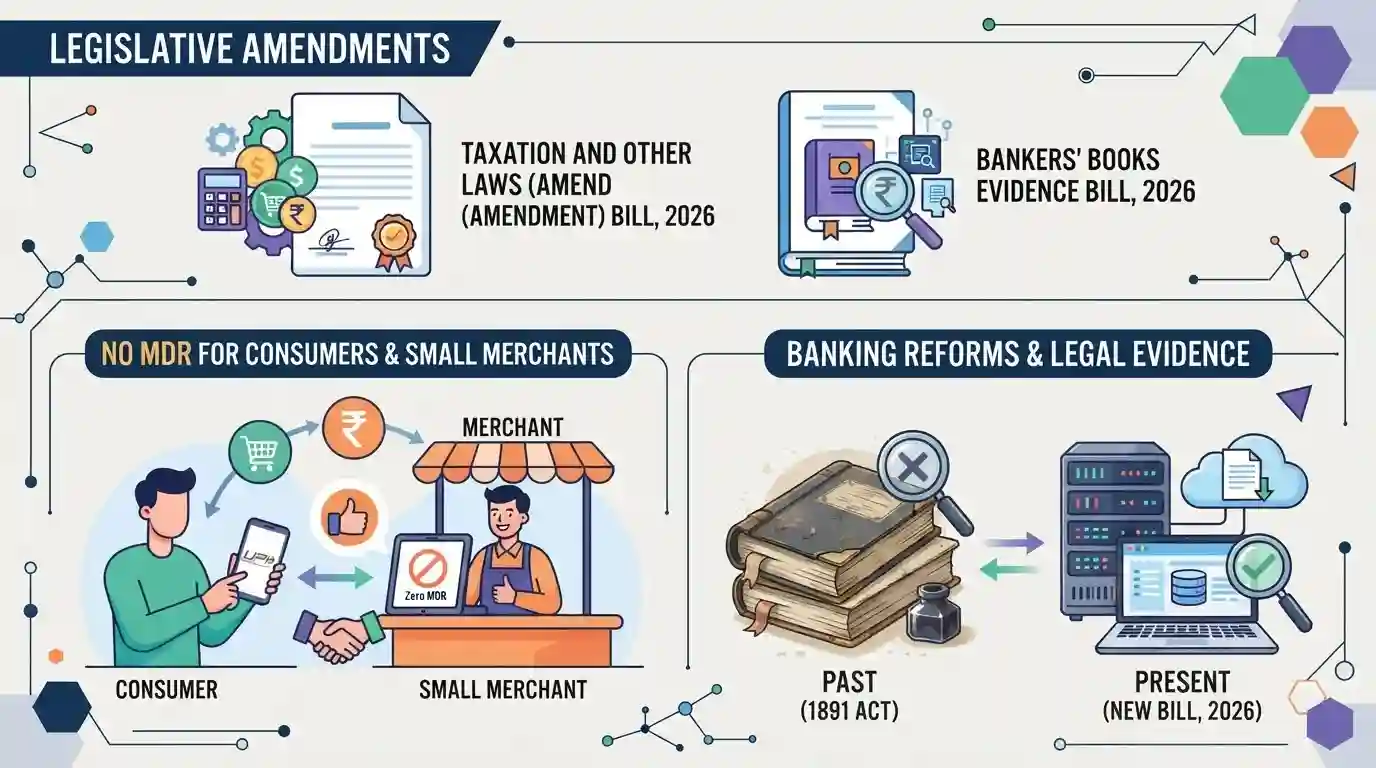
Parliament has cleared the Taxation and Other Laws (Amendment) Bill, 2026 and the Bankers' Books Evidence Bill, 2026. During the debate, Finance Minister Nirmala Sitharaman assured that consumers and small merchants will not pay for UPI transactions, stating the government's stance against imposing a Merchant Discount Rate (MDR) on the end-user. Additionally, the new Bankers' Books Evidence Bill updates the colonial-era 1891 Act to legally recognize electronic and digital banking records, aligning legal evidence standards with modern digital banking infrastructure.
મુખ્ય મુદ્દા
- Parliament passed the Taxation and Other Laws (Amendment) Bill, 2026 and the Bankers' Books Evidence Bill, 2026.
- Finance Minister Nirmala Sitharaman clarified that consumers and small merchants will not be burdened with Merchant Discount Rate (MDR) or UPI transaction charges.
- The Bankers' Books Evidence Bill, 2026 repeals the archaic 1891 Act, allowing electronic and digital banking records to be legally admissible as evidence.
- The legislative update for banking records reflects the reality of core banking systems and aims to improve the efficiency of legal proceedings involving financial data.
મહત્વપૂર્ણ શબ્દો
Taxation and Other Laws (Amendment) Bill, 2026

Legislation replacing the Income-tax (Amendment) Ordinance, 2026. It rationalizes taxes, incentivizes foreign investment in government securities and electronics manufacturing, and creates a regulatory framework for payment systems without levying UPI charges on end-users.
UPSC context
Crucial for GS Paper 3 (Economy). Tests knowledge of tax reforms, FDI incentives, and Make in India policies.
Bankers' Books Evidence Bill, 2026
A contemporary law replacing the 1891 Act to explicitly recognize electronic and digital banking records as admissible evidence in court, provided their integrity and authenticity can be verified against unauthorized alterations.
UPSC context
Relevant for GS-2 and GS-3. Highlights the modernization of India's legal infrastructure to match the digitization of banking.
Bankers' Books Evidence Act, 1891
A colonial-era statute that allowed certified copies of physical bank records to be produced as legal evidence without requiring original ledgers. It is being repealed by the 2026 Bill to accommodate digital practices.
UPSC context
Useful for GS-2 (Governance). Illustrates the ongoing legislative reform process of updating archaic British-era laws for modern realities.
Unified Payments Interface (UPI)
An instant, real-time electronic payment system. Recent debates around the 2026 tax amendments clarified that the government will not impose a Merchant Discount Rate (MDR) or transaction charges on consumers using the platform.
UPSC context
Highly relevant for GS-3 (Digital Economy). Tests understanding of digital public infrastructure and financial inclusion policies like zero-MDR.
પ્રિલિમ્સ ટ્રેપ
The Zero-MDR mandate applies to all debit cards used for UPI or merchant payments in India.
Zero-MDR strictly applies to RuPay debit cards and bank-account UPI under the PSS Act. Visa and Mastercard debit transactions still incur MDR.
સંલગ્ન સ્થિર ખ્યાલો
What is Merchant Discount Rate (MDR)?
- Definition: The transaction processing fee charged to merchants by banks for accepting digital payments like credit/debit cards.
- Fee Sharing: The fee is split between the acquiring bank, the card-issuing bank, and the payment gateway/network operator.
- Zero-MDR Scope: Legally mandated only for bank-account-based UPI and RuPay debit cards under the Payment and Settlement Systems Act.
How is digital banking evidence certified legally?
- System Integrity: Requires a certificate confirming the digital record is a true copy, with no unauthorized system alterations detected.
- Storage Coverage: Applies to virtual, cloud-stored, and disaster-recovery backup records, moving beyond physical books of accounts.
આંતર-વિષય પેટર્ન
Zero-MDR vs Financial Infrastructure Sustainability
Zero-MDR accelerates digital adoption but strains payment service providers. This balances consumer welfare against the commercial viability of backing India's digital public infrastructure.
Decolonizing Laws & Digital Public Infrastructure
Replacing the 1891 Act aligns evidence standards with modern digital public infrastructure (DPI), ensuring judicial processes match India's massive scale of paperless, cloud-based transactions.

Prelims 2026 is highly likely to test the legal boundary of zero-MDR (PSS Act) alongside conditions for admitting digital banking evidence.
સંલગ્ન PYQ · 3
સંલગ્ન PYQ · 3
- 2018PrelimsGS1
Which one of the following best describes the term "Merchant Discount Rate" sometimes seen in news?
- 2026PrelimsGS1
Which one of the following statements about Unified Payments Interface (UPI) and Central Bank Digital Currency (Digital Rupee) is not correct ?
- 2023MainsGS3
What is the status of digitalization in the Indian economy? Examine the problems faced in this regard and suggest improvements.
