India China Trade Imbalance and Non-Tariff Barriers Challenge
Source:Indian Express ↗
Why It Matters
Bilateral trade imbalances and non-tariff barriers are key concerns for India's external sector, manufacturing competitiveness, and supply chain resilience under GS3.
Summary
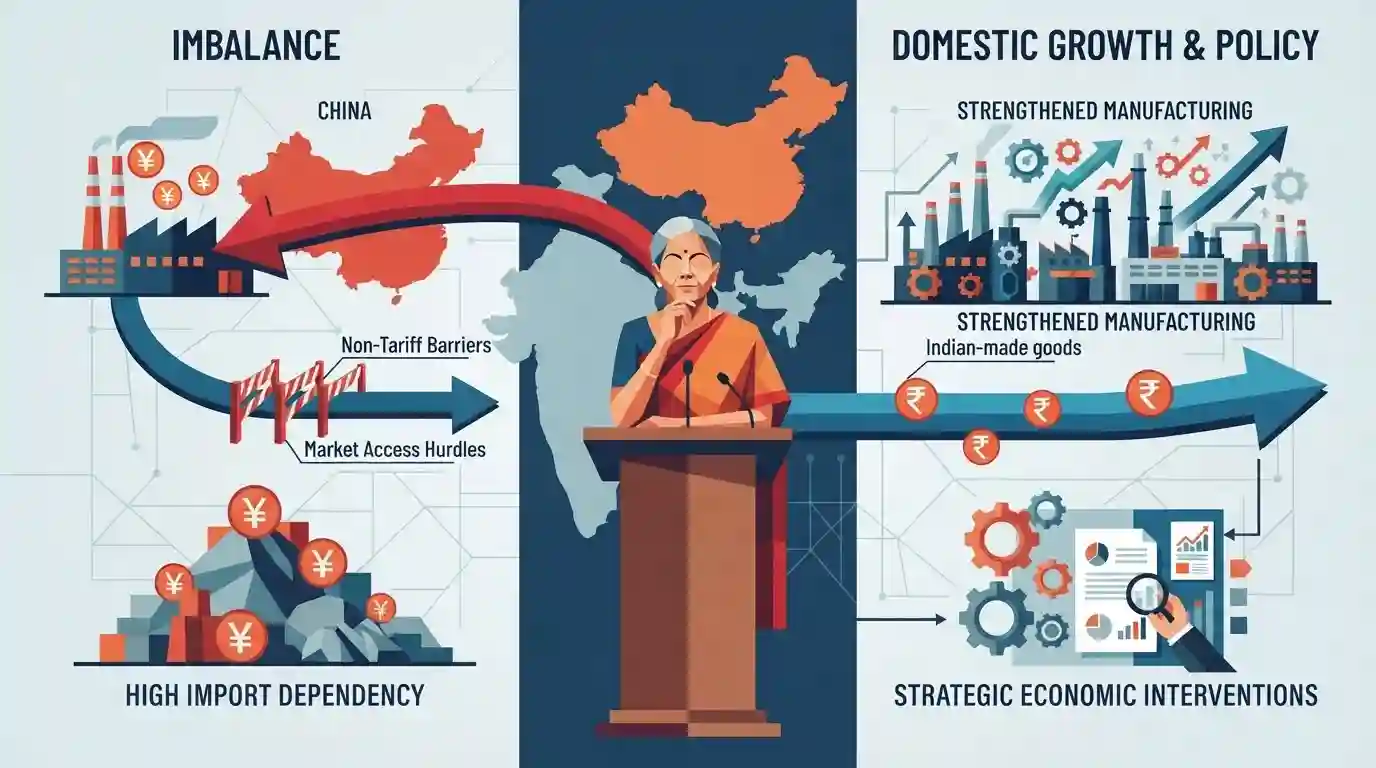
Union Finance Minister Nirmala Sitharaman addressed the persistent trade imbalance between India and China, pointing out that non-tariff barriers and lack of market access create hurdles for Indian exports. The discussions emphasize the need for strengthening domestic manufacturing ecosystems, reducing import dependencies on raw materials and intermediate goods, and strategic economic policy interventions to achieve balanced international trade.
Key Points
- India-China trade imbalance remains a major structural challenge due to heavy reliance on imported components, intermediates, and raw materials.
- Union Finance Minister Nirmala Sitharaman highlighted that non-tariff barriers and market access restrictions imposed by trading partners hinder balanced bilateral trade.
- Addressing trade deficits requires boosting domestic manufacturing capabilities, supply chain resilience, and reducing import dependencies in critical sectors.
Important Terms
Non-Tariff Barriers

Trade restrictions other than traditional customs duties, such as strict technical standards, quotas, sanitary measures, and bureaucratic licensing, used by nations to restrict imports.
UPSC context
UPSC Mains GS Paper III: Important international trade issues, bilateral relations, and protectionist trade practices affecting Indian exports.
Trade Imbalance
An economic condition where a country's total value of imports exceeds its total value of exports, creating a trade deficit.
UPSC context
UPSC Mains GS Paper III: Growth, development, and external sector dynamics of the Indian economy.
World Trade Organization
The global international organization dealing with the rules of trade between nations, providing a framework for negotiating agreements and resolving trade disputes.
UPSC context
UPSC Mains GS Paper II & III: International institutions, multilateral trade agreements, and global economic governance.
Prelims Trap
India's trade deficit with China is primarily caused by a lack of competitiveness in final consumer goods.
Aspirants often assume India has completely banned or placed heavy tariffs on all Chinese goods; however, the persistent deficit is structural, driven by vital intermediate inputs and raw materials rather than final consumer goods alone.
Static Concepts Connected
What are Non-Tariff Barriers (NTBs) and how do they differ from Tariffs under international trade?
- Tariffs Definition: Tariffs are direct taxes or duties imposed on imported goods at the border, raising their relative price.
- NTB Scope: NTBs are trade restrictions other than traditional tariffs, such as quotas, import licensing, cumbersome customs procedures, and stringent technical regulations.
- WTO Context: Sanitary and Phytosanitary (SPS) measures and Technical Barriers to Trade (TBT) are legitimate WTO-sanctioned NTBs, but often misused for protectionism.
Cross-Topic Patterns
Trade Deficit vs. Domestic Manufacturing Security
India's heavy import reliance on Chinese APIs and electronics intermediates connects trade deficits directly to domestic pharmaceutical security and national high-tech manufacturing policies.
WTO SPS Measures and Bilateral Trade Hurdles
Chinese sanitary and phytosanitary (SPS) barriers faced by Indian agro-exports highlight the operational scope and limitations of WTO dispute mechanisms.

Expect UPSC to test WTO-compliant non-tariff barriers (NTBs) versus tariff barriers in the context of bilateral trade deficit structures.
Linked PYQs · 2
Linked PYQs · 2
- 2025MainsGS3
What are the challenges before the Indian economy when the world is moving away from free trade and multilateralism to protectionism and bilateralism? How can these challenges be met?
- 2020PrelimsGS1
With reference to the international trade of India at present, which of the following statements is/are correct? 1. India's merchandise exports are less than its merchandise imports. 2. India's imports of iron and steel, chemicals, fertilisers and machinery have decreased in recent years. 3. India's exports of services are more than its imports of services. 4. India suffers from an overall trade/current account deficit. Select the correct answer using the code given below:
