VBSA Bill Proposes Overhaul of Higher Education Rankings
Source:The Hindu ↗
Why It Matters
Quality assurance, accreditation, and rankings in higher education are critical components of the GS-2 syllabus (Issues relating to Education). The structural overhaul of bodies like NIRF and NAAC under new legislative frameworks (like the VBSA Bill) and NEP 2020 directly impacts India's human capital development and institutional global standing.
Summary
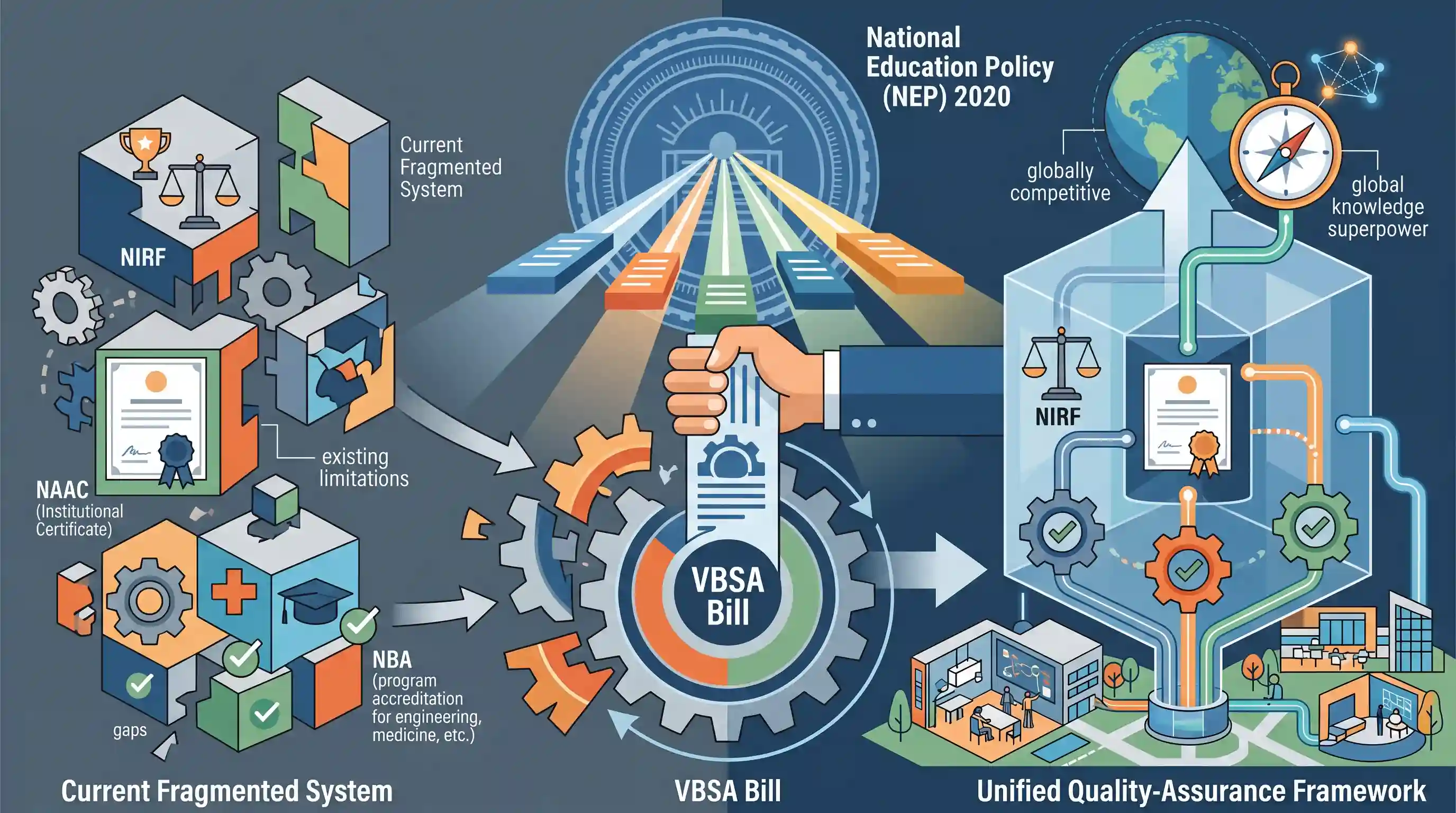
The article examines the prospective overhaul of India's higher education ranking and accreditation ecosystem, currently centered around the National Institutional Ranking Framework (NIRF). It highlights how the upcoming VBSA Bill could redefine the metrics and methodologies used to evaluate universities, addressing existing limitations such as fragmented accreditation bodies (NAAC, NBA). These legislative and structural changes are geared toward realizing the National Education Policy (NEP) 2020's vision for a unified, transparent, and globally competitive quality-assurance framework for higher education institutions.
Key Points
- India's higher education ranking and accreditation system, currently led by frameworks like NIRF, is undergoing a critical transition to improve global competitiveness.
- The proposed VBSA Bill represents a legislative effort to redefine and overhaul institutional rankings and accreditation standards, likely aimed at unifying fragmented processes.
- The reforms align with the broader mandate of the National Education Policy (NEP) 2020, which recommends a single meta-accrediting body to enforce quality standards and reduce institutional compliance burdens.
- A revamped framework is expected to impact university autonomy, funding allocations, and the objective assessment of academic quality and research output in India.
Important Terms
VBSA Bill, 2025

A 2025 legislative proposal to unify higher education regulation by replacing UGC, AICTE, and NCTE with a single umbrella commission, separating grant-disbursal from academic regulation.
UPSC context
GS Paper II: Government policies and interventions; tests understanding of regulatory overhauls and legislative reforms in the education sector.
National Institutional Ranking Framework (NIRF)
An annual methodology adopted by the Ministry of Education since 2015 to rank Indian higher education institutions based on teaching, research, graduation outcomes, inclusivity, and stakeholder perception.
UPSC context
GS Paper II: Issues relating to development and management of Social Sector/Services relating to Education; tests awareness of quality-assurance benchmarks.
National Education Policy (NEP) 2020
The comprehensive 2020 framework aiming to transform India's education system through "light but tight" regulation, multidisciplinary learning, and the integration of professional and general higher education.
UPSC context
GS Paper II: Policy implementation and social sector reforms; core topic for education-related questions in Prelims and Mains.
Higher Education Commission of India (HECI)
The proposed overarching regulatory body envisioned by NEP 2020 to replace existing regulators; the VBSA Bill serves as the legislative instrument to establish its architecture.
UPSC context
GS Paper II: Statutory/regulatory bodies; tests knowledge of the structural transition from fragmented to unified governance in education.
National Assessment and Accreditation Council (NAAC)
An autonomous body established by the UGC to assess and accredit higher education institutions; currently undergoing reforms to move toward an outcome-based, unified accreditation model.
UPSC context
GS Paper II: Educational standards and quality; relevant for questions on institutional accountability and quality assurance frameworks.
Ministry of Education (MoE)
The Ministry responsible for formulating education policy and managing the NIRF; under the VBSA Bill, it will directly handle the disbursement of grants to institutions.
UPSC context
GS Paper II: Structure and functioning of the Executive; tests knowledge of the evolving role of ministries in financial and academic governance.
Prelims Trap
The VBSA Bill regulates all higher education and retains the UGC's power to disburse financial grants.
Medical and legal education are strictly excluded. Crucially, VBSA strips the regulator of grant-disbursing powers, transferring direct financial control to the Union Education Ministry.
Static Concepts Connected
How is legislative power over higher education distributed in the Constitution?
- Concurrent List: Entry 25 covers general education, including technical and medical education, allowing both the Centre and States to legislate (moved by the 42nd Amendment).
- Union List: Entry 66 grants the Centre exclusive power over the "coordination and determination of standards" in institutions for higher education or research.
What are the primary evaluation parameters of the NIRF?
- Teaching & Research: Evaluates student strength, faculty-student ratios, financial resources, publications, citations, and patents.
- Outcomes & Inclusivity: Assesses graduation placement rates, regional and gender diversity, and overall peer perception among academics and employers.
Cross-Topic Patterns
Shift to Binary Accreditation
Transitioning from a graded NAAC system to binary "Accredited/Not Accredited" aligns with global norms, reducing compliance burdens while bridging the gap with QS World University Rankings.
Education federalism and Entry 66
Shifting university funding controls directly to the Union Ministry under the VBSA framework will likely spark Centre-State federalism debates over the financial and administrative autonomy of State-run universities.

Expect a multi-statement Prelims question testing the specific constitutional entries (Union 66 vs Concurrent 25) alongside VBSA's purview.
Linked PYQs · 3
Linked PYQs · 3
- 2020MainsGS2
National Education Policy 2020 is in conformity with the Sustainable Development Goal-4 (2030). It intends to restructure and reorient education system in India. Critically examine the statement.
- 2015MainsGS2
The quality of higher education in India requires major improvements to make it internationally competitive. Do you think that the entry of foreign educational institutions would help improve the quality of higher and technical education in the country? Discuss.
- 2014MainsGS2
Should the premier institutes like IITs/IIMs. be allowed to retain premier status, allowed more academic independence in designing courses and also decide mode/criteria of selection of students. Discuss in light of the growing challenges.
