NIRF 2025 Architecture and Planning Rankings Analysis
Source:Indian Express ↗
Why It Matters
NIRF rankings serve as a vital parameter for institutional quality and human capital development (GS2). The focus on 'Architecture and Planning' highlights the educational infrastructure needed to support sustainable urbanization and smart city development (GS1).
Summary
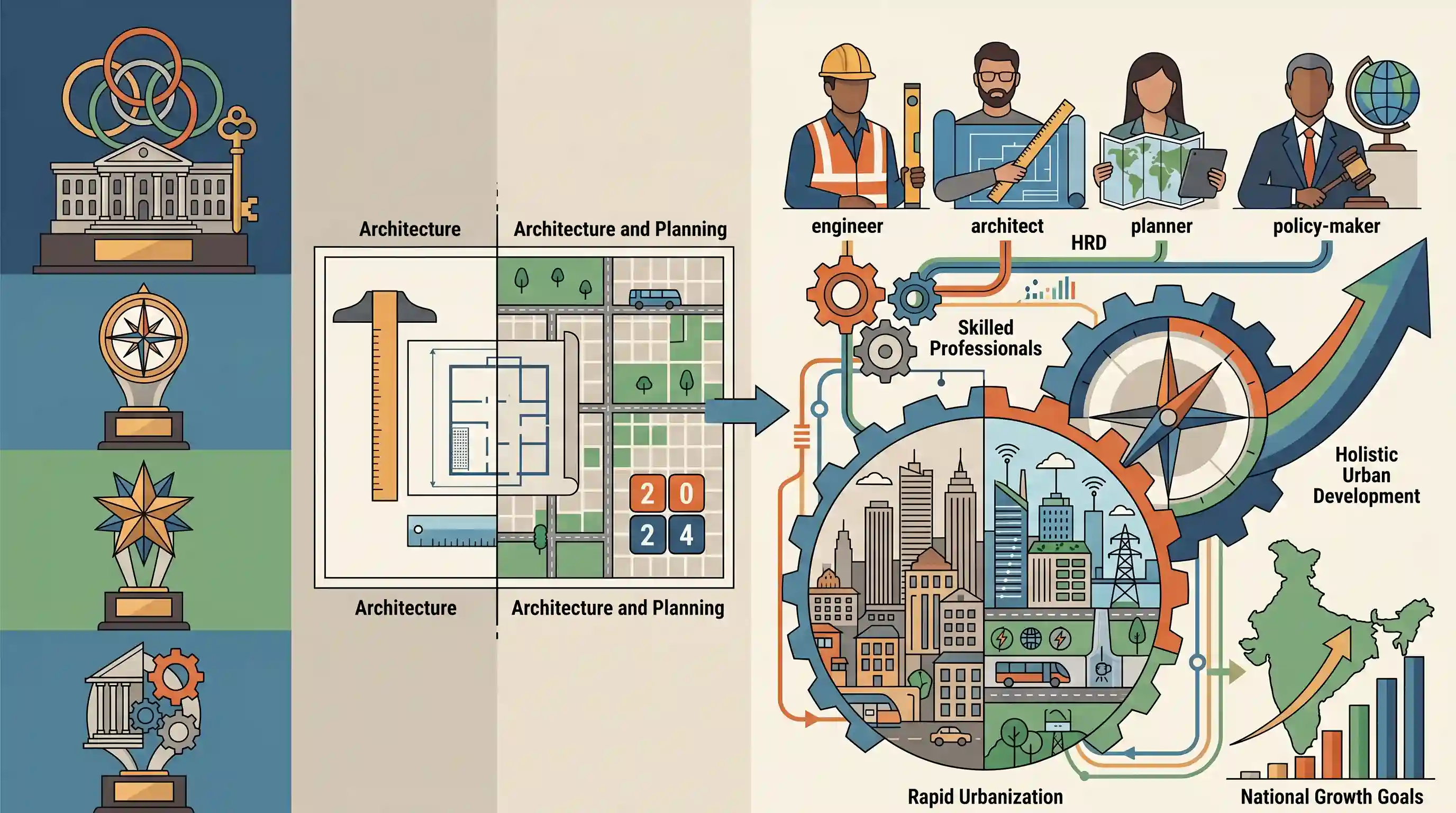
The NIRF 2025 rankings saw IIT Roorkee retain its top position in the 'Architecture and Planning' category for the fifth consecutive year. NIT Calicut, IIT Kharagpur, and IIEST Shibpur occupied the subsequent top spots, highlighting the dominance of premier technical institutes (IITs and NITs) in specialized education. The expansion of this category in 2024 to explicitly include 'Planning' underscores a strategic shift toward holistic urban development. This evolution reflects the growing demand for skilled professionals to address India's rapid urbanization, infrastructure expansion, and Smart City projects, directly linking human resource development to national growth goals.
Key Points
- IIT Roorkee secured the top position in the NIRF 2025 Architecture and Planning rankings for the fifth consecutive year.
- NIT Calicut ranked second, followed by IIT Kharagpur and IIEST Shibpur, illustrating the continued dominance of IITs and NITs in the field.
- The category was expanded in 2024 from 'Architecture' to 'Architecture and Planning,' indicating a strategic focus on comprehensive spatial and urban design.
- This growing emphasis on planning education aligns with India's infrastructural needs, rapid urbanization, and smart city initiatives.
Important Terms
National Institutional Ranking Framework (NIRF)

A Ministry of Education initiative launched in 2015 to rank Indian higher education institutions using five parameters: Teaching, Research, Graduation Outcomes, Outreach, and Perception.
UPSC context
GS Paper-II: Governance and Education. Tests understanding of quality benchmarks and institutional accountability in India's higher education sector.
Institutes of National Importance (INI)
A status conferred by the Parliament of India upon premier public higher education institutions (like IITs, NITs, and IIEST) to provide specialized training and research.
UPSC context
GS Paper-II: Education and Human Resources. Relevant for understanding the legislative framework supporting India's premier technical and research institutions.
IIT Roorkee
India’s oldest engineering institution (est. 1847) that has consistently topped the NIRF Architecture rankings, reflecting long-standing excellence in technical and design education.
UPSC context
GS Paper-II: Education. Serves as a benchmark for institutional excellence and heritage in India's technical education landscape.
IIEST Shibpur
India's first Indian Institute of Engineering Science and Technology, converted from BESU in 2014; it remains a top-ranked institution for architecture and planning.
UPSC context
GS Paper-II: Education. Represents the evolution of state colleges into central institutes of national significance for specialized research.
Architecture and Planning Category
A specialized NIRF category expanded in 2024 to emphasize the role of planning and urban design in addressing India’s rapid urbanization and infrastructure needs.
UPSC context
GS Paper-I: Urbanization and GS Paper-III: Infrastructure. Tests awareness of human resource development geared toward sustainable urban growth.
Prelims Trap
"Participation in the National Institutional Ranking Framework (NIRF) is strictly voluntary for all higher educational institutions in India."
While initially voluntary upon its 2015 launch, participation in NIRF was made mandatory for all government-funded higher educational institutions starting in 2018.
Static Concepts Connected
What are the five core evaluation parameters of the National Institutional Ranking Framework (NIRF)?
- Teaching & Learning: Assesses core resources including student strength, faculty-student ratio, and financial resource utilization.
- Research Practice: Evaluates research output via high-quality publications, citation metrics, and the number of patents granted.
- Outcomes & Perception: Covers graduation placements, regional/gender inclusivity, representation of economically backward students, and academic/employer peer perception.
How does the Constitution mandate urban planning frameworks at the local level?
- 74th Amendment Act: Added the 12th Schedule, explicitly listing "Urban planning including town planning" as a core functional item for municipalities.
- District Planning Committees: Article 243ZD mandates DPCs to consolidate spatial and infrastructure plans prepared by local Panchayats and Municipalities.
- Metropolitan Planning: Article 243ZE requires Metropolitan Planning Committees (MPCs) to draft comprehensive development plans for large urban agglomerations.
Cross-Topic Patterns
Town Planning deficit & Smart Cities
NITI Aayog has repeatedly flagged a severe shortage of qualified urban planners in India, making this academic shift crucial for implementing AMRUT and Smart City projects.
IoE scheme & institutional autonomy
The dominance of IITs and NITs reinforces the need for schemes like the Institutes of Eminence (IoE), granting greater autonomy to premier institutes to boost global competitiveness.

Expect a multi-statement prelims question testing NIRF's five core parameters alongside its mandatory status for government institutions.
Linked PYQs · 5
Linked PYQs · 5
- 2015MainsGS2
The quality of higher education in India requires major improvements to make it internationally competitive. Do you think that the entry of foreign educational institutions would help improve the quality of higher and technical education in the country? Discuss.
- 2014MainsGS2
Should the premier institutes like IITs/IIMs. be allowed to retain premier status, allowed more academic independence in designing courses and also decide mode/criteria of selection of students. Discuss in light of the growing challenges.
- 2023MainsGS2
The crucial aspect of development process has been the inadequate attention paid to Human Resource Development in India. Suggest measures that can address this inadequacy.
- 2016MainsGS1
With a brief background of quality of urban life in India, introduce the objectives and strategy of the 'Smart City Programme'.
- 2025MainsGS1
How does smart city in India, address the issues of urban poverty and distributive justice?
