Nirav Modi Deportation Status After Legal Proceedings
Source:Indian Express ↗
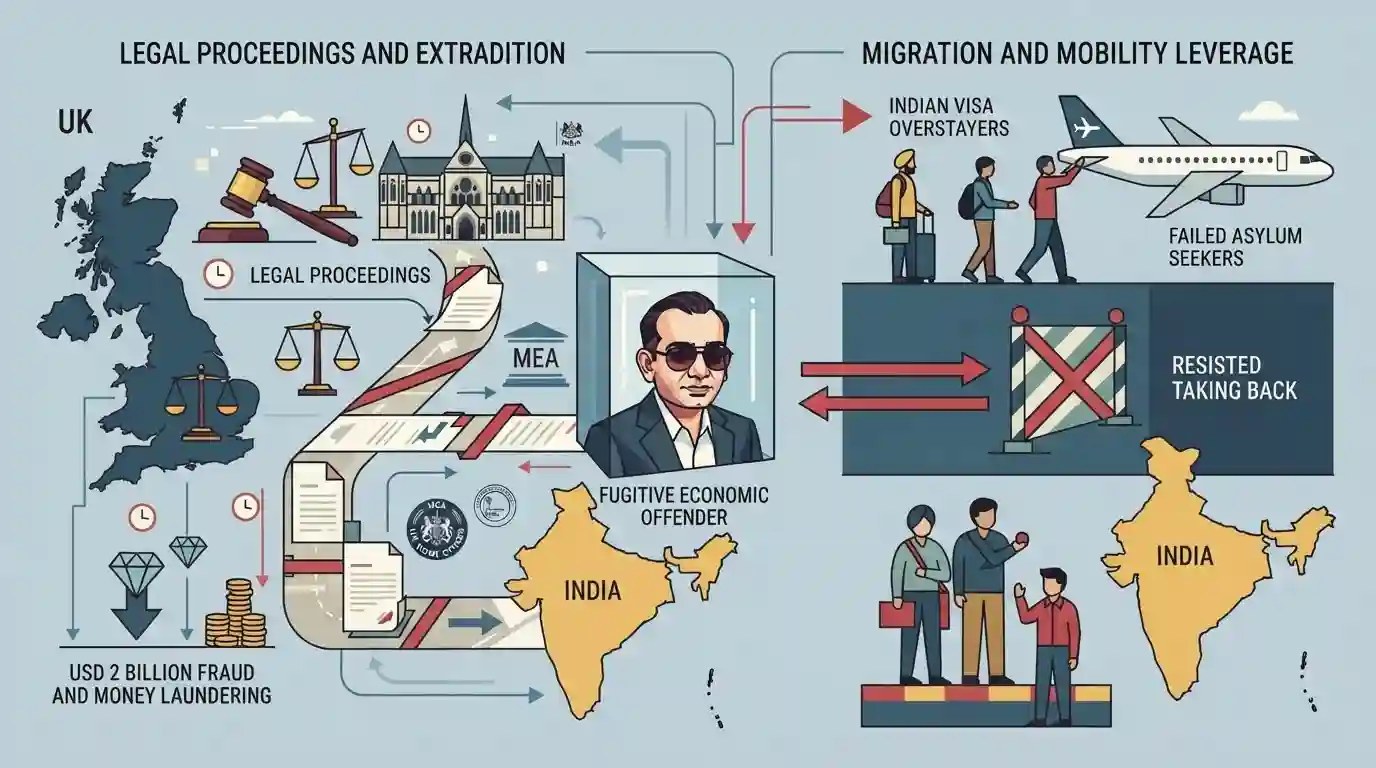
Why It Matters
The case showcases the complex intersection of international law, bilateral diplomacy, migration negotiations, and judicial systems. It illustrates how the extradition of fugitive economic offenders can become diplomatic leverage points in bilateral ties, highlighting the institutional challenges India faces in repatriating offenders under foreign legal frameworks.
Summary
The Ministry of External Affairs (MEA) announced that fugitive diamond merchant Nirav Modi, wanted in India for a USD 2 billion fraud and money laundering case involving Punjab National Bank (PNB), will be deported as soon as UK legal proceedings wrap up. This comes after former UK Home Secretary Priti Patel claimed that New Delhi had resisted taking back Indian visa overstayers and failed asylum seekers from the UK to apply leverage over the slow extradition of high-profile fugitives like Nirav Modi.
Key Points
- The Ministry of External Affairs (MEA) confirmed that fugitive economic offender Nirav Modi will be deported to India once legal proceedings in the United Kingdom are concluded.
- Nirav Modi is wanted in India to face legal trials on charges of fraud and money laundering related to a USD 2 billion Punjab National Bank (PNB) loan scam.
- Former British Home Secretary Priti Patel stated she signed Nirav Modi's extradition order in 2021, but legal hurdles in the UK have delayed the final deportation.
- Patel asserted that India utilized the delay in extraditing high-profile fugitives like Nirav Modi as leverage, resisting agreements to accept visa overstayers and failed Indian asylum seekers from the UK until progress was demonstrated.
- The issue highlights the geopolitical friction and linkage between migration agreements, judicial sovereignty, and extradition treaties in bilateral relations.
Important Terms
Fugitive Economic Offenders Act, 2018

An Indian legislation empowering the government to confiscate properties of economic offenders who have fled the country with a scheduled offence value of ₹100 crore or more to evade criminal prosecution.
UPSC context
GS Paper III (Economy & Internal Security); tests mechanisms combating financial fraud, asset recovery, and regulatory frameworks for economic fugitives.
Prevention of Money Laundering Act (PMLA), 2002
A comprehensive Indian statute enacted to prevent money laundering, provide for the confiscation of property derived from or involved in money laundering, and establish special courts for trial.
UPSC context
GS Paper III (Internal Security & Economy); crucial for understanding anti-money laundering frameworks, financial integrity, and investigative powers of federal agencies.
India-UK Extradition Treaty (1992)
A bilateral treaty signed in 1992 that obligates both countries to extradite individuals wanted for prosecution or punishment for offences carrying at least one year of imprisonment.
UPSC context
GS Paper II (Bilateral Relations/International Law); tests legal processes, cross-border justice, and challenges in extraditing financial fugitives.
Directorate of Enforcement (ED)
A premier multi-disciplinary law enforcement and economic intelligence agency under India's Ministry of Finance, responsible for enforcing the PMLA, FEMA, and Fugitive Economic Offenders Act.
UPSC context
GS Paper II (Statutory Bodies) and GS Paper III (Internal Security); tests understanding of economic regulatory authorities and anti-corruption machinery.
Ministry of External Affairs (MEA)
The government ministry responsible for conducting India's relations with foreign nations, administering the country's foreign policy, and coordinating diplomatic and international legal procedures like extradition.
UPSC context
GS Paper II (Bilateral Relations & Indian Diaspora); tests executive governance, diplomatic machinery, and the implementation of international treaties.
Prelims Trap
Under the Fugitive Economic Offenders Act, 2018, confiscation of properties can only occur after the judicial conviction of the offender in India.
The FEOA specifically allows the attachment and confiscation of an accused's domestic and international properties even before conviction to compel their return to India.
Static Concepts Connected
What is the Principle of Dual Criminality in extradition?
- Core definition: Requires the conduct to be recognized as a criminal offence with comparable gravity under the national laws of both the requesting and requested nations.
- India-UK threshold: Under the 1992 bilateral treaty, the offence must carry a minimum punishment of one year imprisonment in both India and the UK.
What key tools does the Fugitive Economic Offenders Act (FEOA), 2018 provide?
- Monetary limit: The Act only applies to scheduled economic offences where the total value involved is ₹100 crore or more.
- Asset confiscation: Empowers the state to confiscate properties of the accused, including those overseas and those not directly linked to the proceeds of crime.
- Judicial bar: Allows courts to disentitle the declared fugitive offender from defending any civil claim in Indian courts.
Cross-Topic Patterns
Migration diplomacy and extraditions
India linking mobility pacts to extradition progress demonstrates a strategic shift where legal migration quotas are leveraged to overcome judicial hurdles in foreign sovereign courts.
Human rights vs. state sovereignty
UK domestic litigation invoking human rights (like prison conditions under ECHR Article 3) acts as a systemic barrier to extraditing economic offenders, testing bilateral strategic trust.

Mains 2026 may analyze how 'migration diplomacy' and judicial sovereignty under ECHR complicate extradition of financial fugitives.
Linked PYQs · 3
Linked PYQs · 3
- 2025PrelimsGS1
With reference to the Government of India, consider the following information: Organization Some of its functions It works under I. Directorate of Enforcement Enforcement of the Fugitive Economic Offenders Act, 2018 Internal Security Division-I, Ministry of Home Affairs II. Directorate of Revenue Intelligence Enforces the Provisions of the Customs Act, 1962 Department of Revenue, Ministry of Finance III. Directorate General of Systems and Data Management Carrying out big data analytics to assist tax officers for better policy and nabbing tax evaders Department of Revenue, Ministry of Finance In how many of the above rows is the information correctly matched?
- 2021MainsGS3
Discuss how emerging technologies and globalisation contribute to money laundering. Elaborate measures to tackle the problem of money laundering both at national and international levels.
- 2020MainsGS2
The judicial systems in India and UK seem to be converging as well as diverging in recent times. Highlight the key points of convergence and divergence between the two nations in terms of their judicial practices.
